
SALON des Refusés 2021
25 Sep

Every August, Salon Art Projects presents the Salon des Refusés, an exhibition of works submitted but not accepted into NATSIAA (National Aboriginal and Torres Strait Islander Art Awards).
Its quality demonstrates the superb standard of art being created by Aboriginal and Torres Strait Islander artists, nationwide and it also provides valuable insight into where the movement has come from, and where it is heading.
This year, as COVID uncertainties continue, the 2021 Salon des Refusés is partnering with the Darwin Aboriginal Art Fair and going online only.
ABOVE: Lennard Walker, Tali (detail), 2020, acrylic on linen, 290 x 200 cm (courtesy Spinifex Arts Project)
Paintings
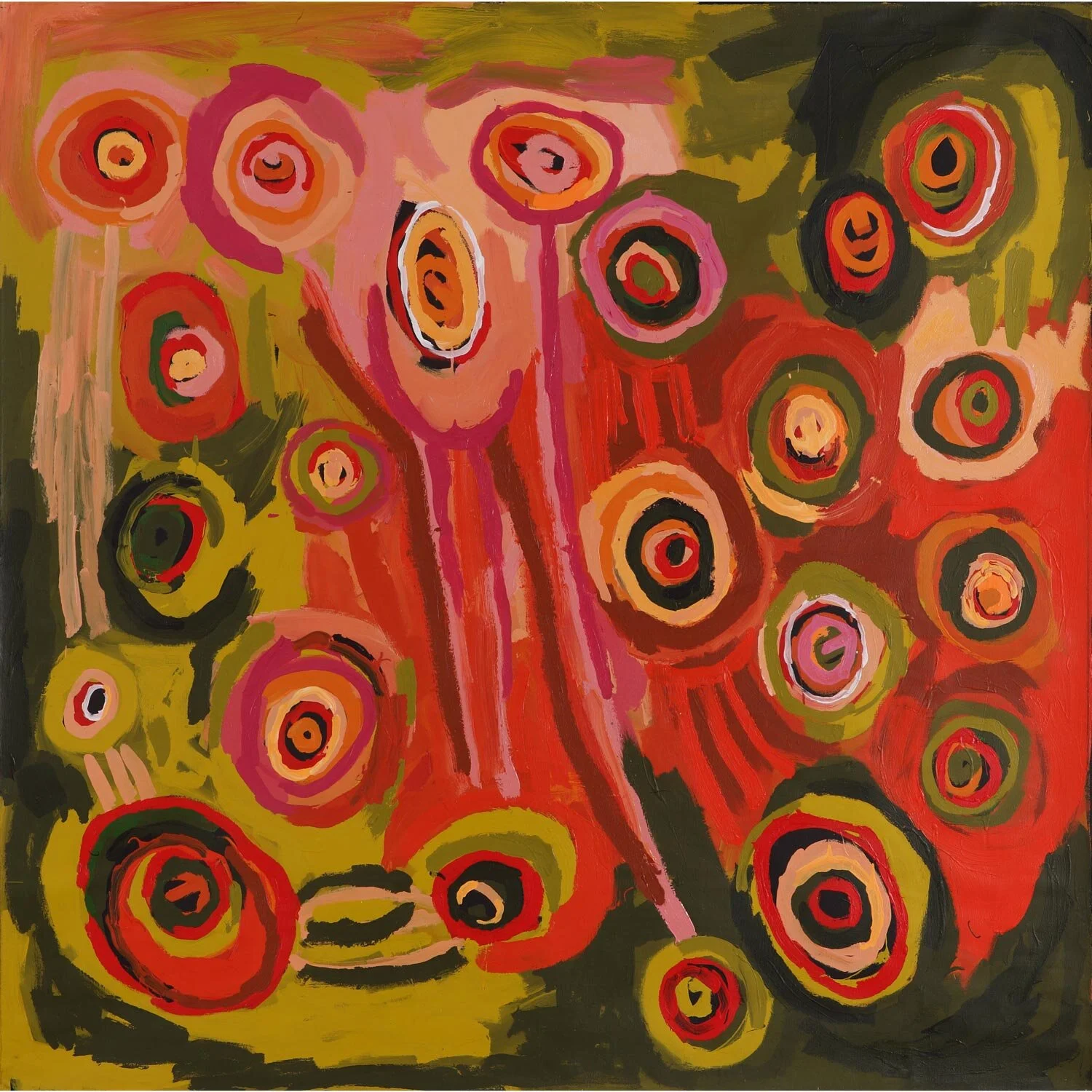
Barbara Moore
2021, Acrylic on linen
200 x 200 cm
29-2
PHOTOGRAPHY BY FIONA MORRISON
In this painting, Barbara has depicted her country near Ti Tree in the Northern Territory. The different colours and shapes represent variations in the landscape. Some of the landmarks are the rockholes that lie in and around her country. Connected by travel lines, these sites hold important Tjukurrpa (Dreaming). Through her painting, Barbara stays connected to her own country in the Northern Territory.
Barbara Moore, Tjala Arts, APY Lands

Bingarli Annette Lormada
2021, Acrylic on canvas
180 x 60 cm
25/21
PHOTOGRAPHY BY FIONA MORRISON
“Piyalpiyal is sawfish, that we eat, that lives along the Fitzroy River. We catch them by fishing lines and net. Some people cheat by fishing them by nets. They are not supposed to do that in this river.”
Bingarli Annette Lormada, Mangkaja Arts, Kimberley

Bob Gibson
2020, Acrylic on cavnas
121 x 147 cm
20-967KA
PHOTOGRAPHY BY FIONA MORRISON
Patjantja is the story of two snakes and two men who travelled north to Karrkurinkitja, deep in the Western Desert, near Bob's mother's country, Kulkurta. As they travelled, some strangers came up behind them and the snakes fled. The boss of the Tingari men, Kurningka, went looking after them. The snakes were travelling fast but clouds were gathering around them. As water started to rise the female snake went into an ant's hole, leaving the other snake outside. Kurningka was saying, ‘water is coming closer’ but the other snake was too big for the hole. The Kurningka cut the snake and a lot of fat came out.
Bob Gibson, Tjarlirli Art, Western Desert

Candy Nelson
2021, Synthetic polymer paint on linen
152 x 274 cm
54-21
PHOTOGRAPHY BY FIONA MORRISON
This painting depicts Candy’s Water Dreaming site at Kalipinypa, North-east of Kintore.
It tells the story of rain and hail making ceremony for Kalipinypa. Ancestral forces bring on a powerful storm with lightning, thunderclouds and rain, filling the rock holes, clay pans and creeks and creating new life. Today, the Nakamarra, Tjakamarra, Napurrula and Tjupurrula men and women are the custodians of this important Water Dreaming site and celebrate its stories in the ceremonies.
Candy has represented the tali (sandhills) and running water in her background and uses dotting to represent hailstorm and rain. Candy draws various shapes and motifs to represent the waterholes, running water, bush tucker, water birds and flowers present after a big storm. These also represent the wanampi (water snake) which lives under the waterhole and is responsible for making water bubble up. She says that her canvases "look as if they are breathing, with the drawing elements popping out of the canvas."
Candy Nelson, Papunya Tjupi Arts, Central Desert

Carbiene McDonald
2021, Sythetic polymer on linen
274 x 152 cm
74-21
PHOTOGRAPHY BY FIONA MORRISON
In this work, Carbiene depicts four dreaming stories which he inherited from his father. These Tjukurrpa are associated with a series of waterholes running between Docker River and Kata Tjuta. Specifically, it includes four important sites: Petermann Ranges, Docker River, Kalaya Murrpu (Blood's Range) and Mulyayti near Kata Tjuta. As a young man, Carbiene returned to these places and retraced the footsteps of his father. These memories stay with him vividly today.
Carbiene McDonald, Papunya Tjupi Arts, Central Desert

Geraldine Bedford
2021, earth pigment, acrylic and synethetic fixative on canvas
120 x 180 cm
WAC 053/21
IMAGE COURTESY OF WARMUN ART
Geraldine's Aunty Lena Nyadbi told her this story and now Geraldine is the custodian.
Women travelled up river placing a spinifex net across the water to catch Dayiwul (Barramundi). Halfway to Gawinji, the women stopped and left the net. It turned to stone. This place was destroyed when the Argyle Diamond Mine was first cut. There was a soak where Gija people used to dig down into the ground for water when other waterholes dried up. The diamonds mined today are the scales of the barramundi who jumped through the range to escape capture. She saw the net they had placed in the river and jumped over it. These sites have been destroyed by the pit of the mine. Bedford has made this work to remember the country before the mine and to pass these stories and history on to her children and grandchildren.
Geraldine Bedford, Warmun Art, Kimberley

Eva Nargoodah
2021, Acrylic on canvas
155 x 155 cm
28/21
PHOTOGRAPHY BY FIONA MORRISON
“When I was a young girl, I was walking with my jaja (grandmother) and japi (grandfather). I said to them ‘Look there is water there, I am thirsty.’ My grandfather said ‘No, that is not water. That is yirrirriny (heat haze). Yirrirriny is a heat wave. Don't look at it. It will blind your eyes.’ That's what my japi used to tell me. The heatwave is shiny and dancing."
Eva Nargoodah, Mangkaja Arts, Kimberley
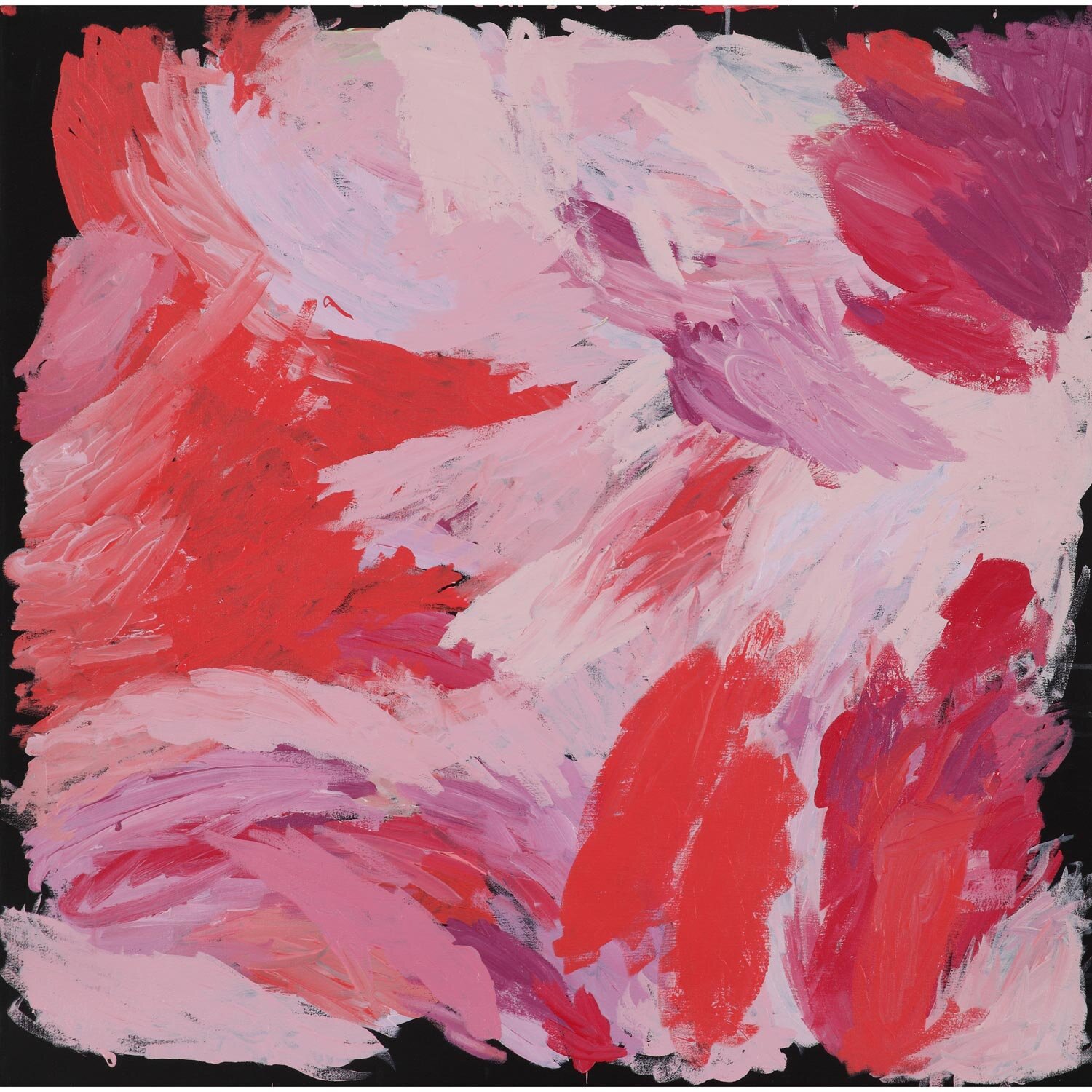
Gloria
2021, Acrylic on canvas
91 x 91 cm
21-82
PHOTOGRAPHY BY FIONA MORRISON
Born in the Pilbara in 1975, Gloria is a Martu woman working within a powerful matriarchal tradition that emerged from Australia’s Western Desert in the early 2000s. Her paintings are known for their bold use of colour, loose brushstrokes and energetic mark making and have attracted critical attention for their highly affecting presence.
Gloria, Spinifex Hill Studio, Pilbara
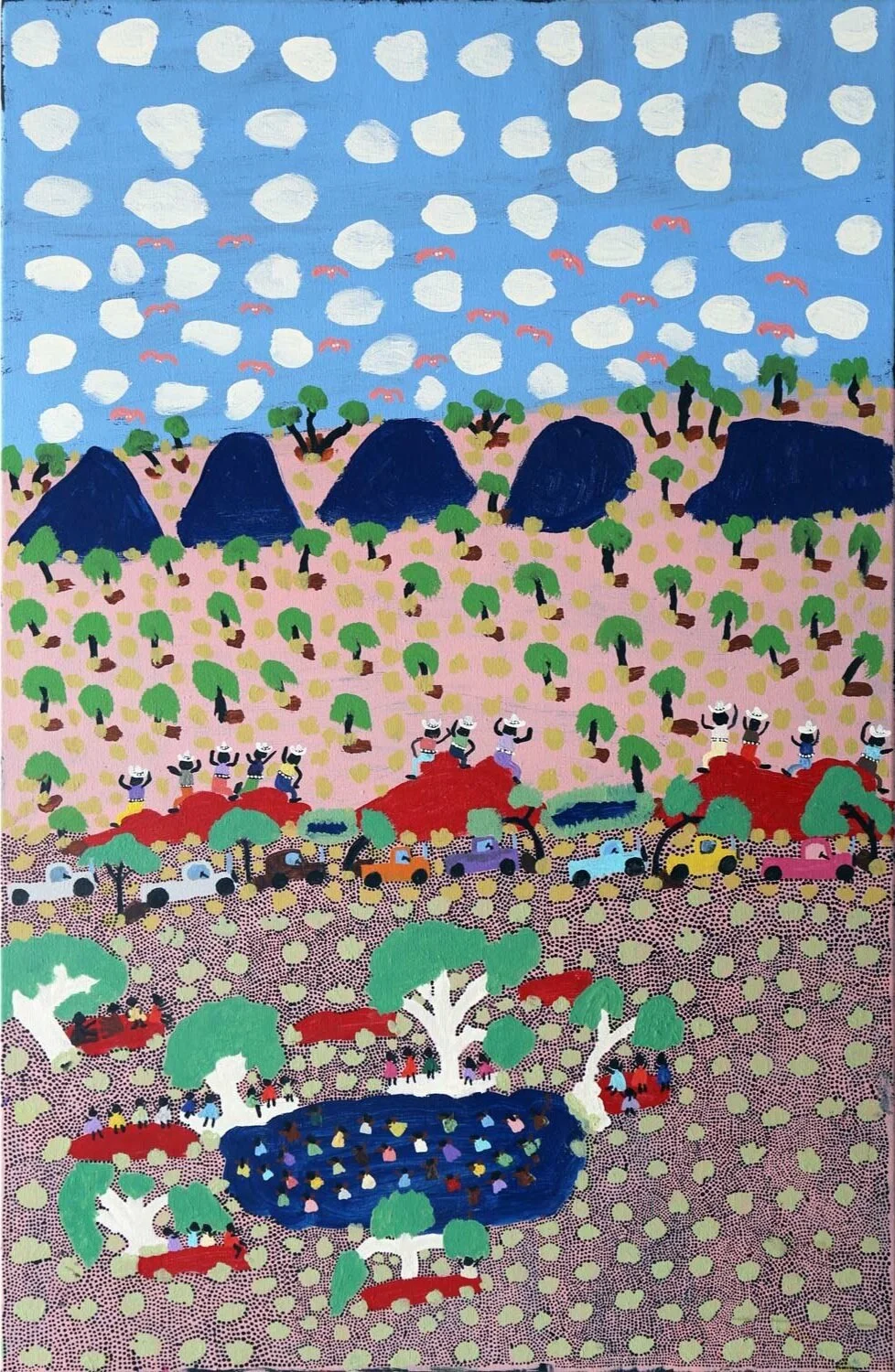
Grace Robinya
2021, Acrylic on Linen
91 x 59.5 cm
11257-21
IMAGE COURTESY OF TANGENTYERE ARTISTS
“Kids swimming, little bit rockhole. Lot of birds coming down for drinking that water. Kids frighten all them birds. Men are all up in the hills looking, singing out ‘All the birds coming!’ Mothers sitting in shade, watching. Kids might be teasing each other. Tracks everywhere in the sand from kids, animals. This was when I was young one.”
Grace Robinya, like many Tangentyere Artists has had to move into town for health reasons but would rather be out bush. Whenever she can, she paints, telling stories and memories of her earlier life. Since 2015, Robinya’s practice has focussed on figurative paintings detailing important locations and events in her life: her childhood at Hermannsburg Mission; visits to her beloved Irremangkere; details of station life at Ntaria, Wallace Rockhole, Mt Allan, Coniston, Karrinyarra, Mt Wedge, and Napperby Stations, where she and her husband worked as a domestic, and ringer respectively, while raising their growing family.
Grace Robinya, Tangentyere Artists, Central Desert
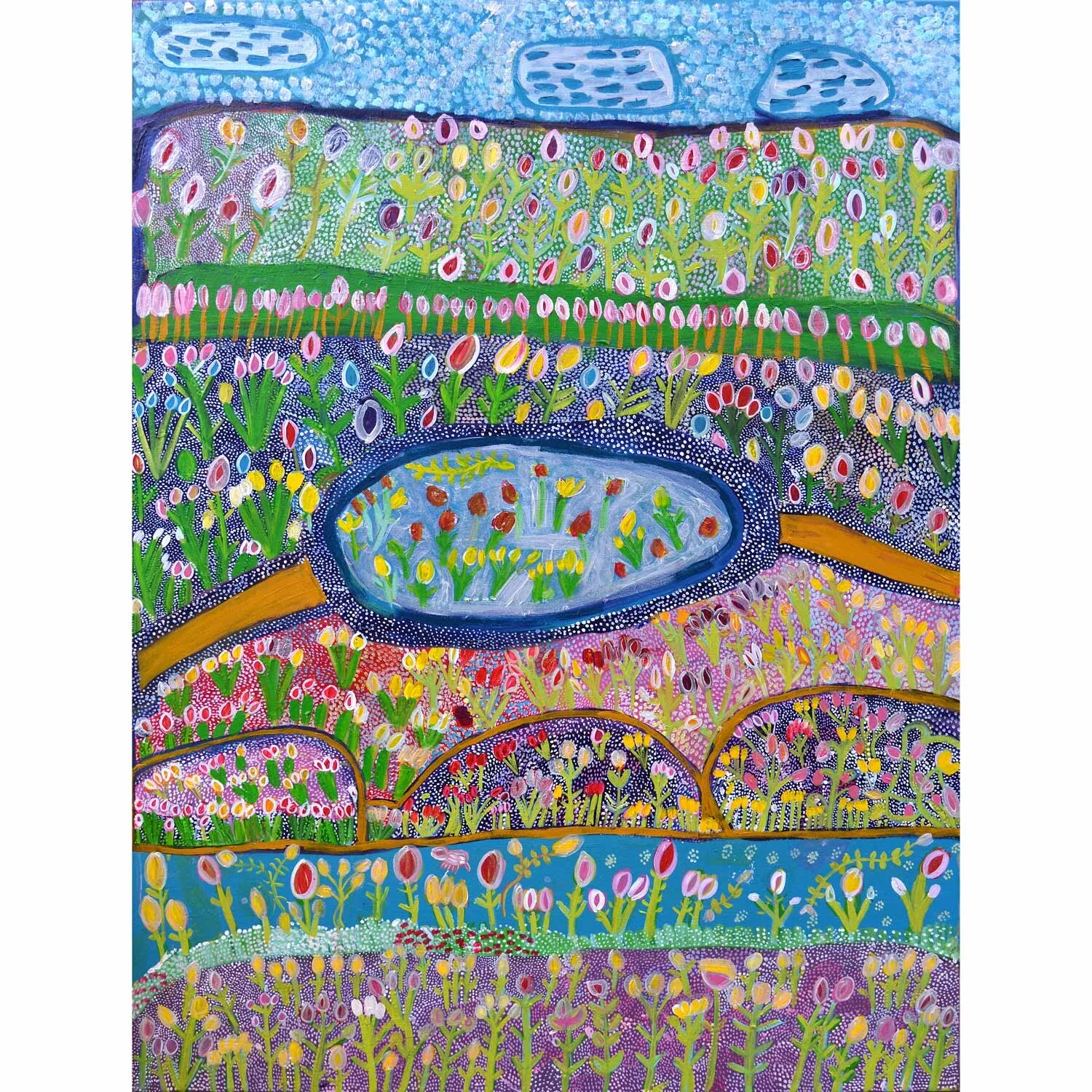
Gwenneth Blitner
2021, Acrylic on canvas
120 x 90 cm
25-21
IMAGE COURTESY OF NGUKURR ARTS
“This painting is of Walmaja Billabong and Hill. We used to go there for school picnics. I liked that country a lot so I kept it in my head. I’ve painted Walmaja in the Wet Season when all the flowers come out. There’s jawjaw (lilies) there. They are good tucker. There are too many crocodiles now for us to collect jawjaw. We just look at that tucker now.".
Gwenneth Blitner, Ngukurr Arts, Arnhem Land
Kieren Karritpul
2021, Acrylic on cavnas
155 x 200 cm
SDR-01
PHOTOGRAPHY BY FIONA MORRISON
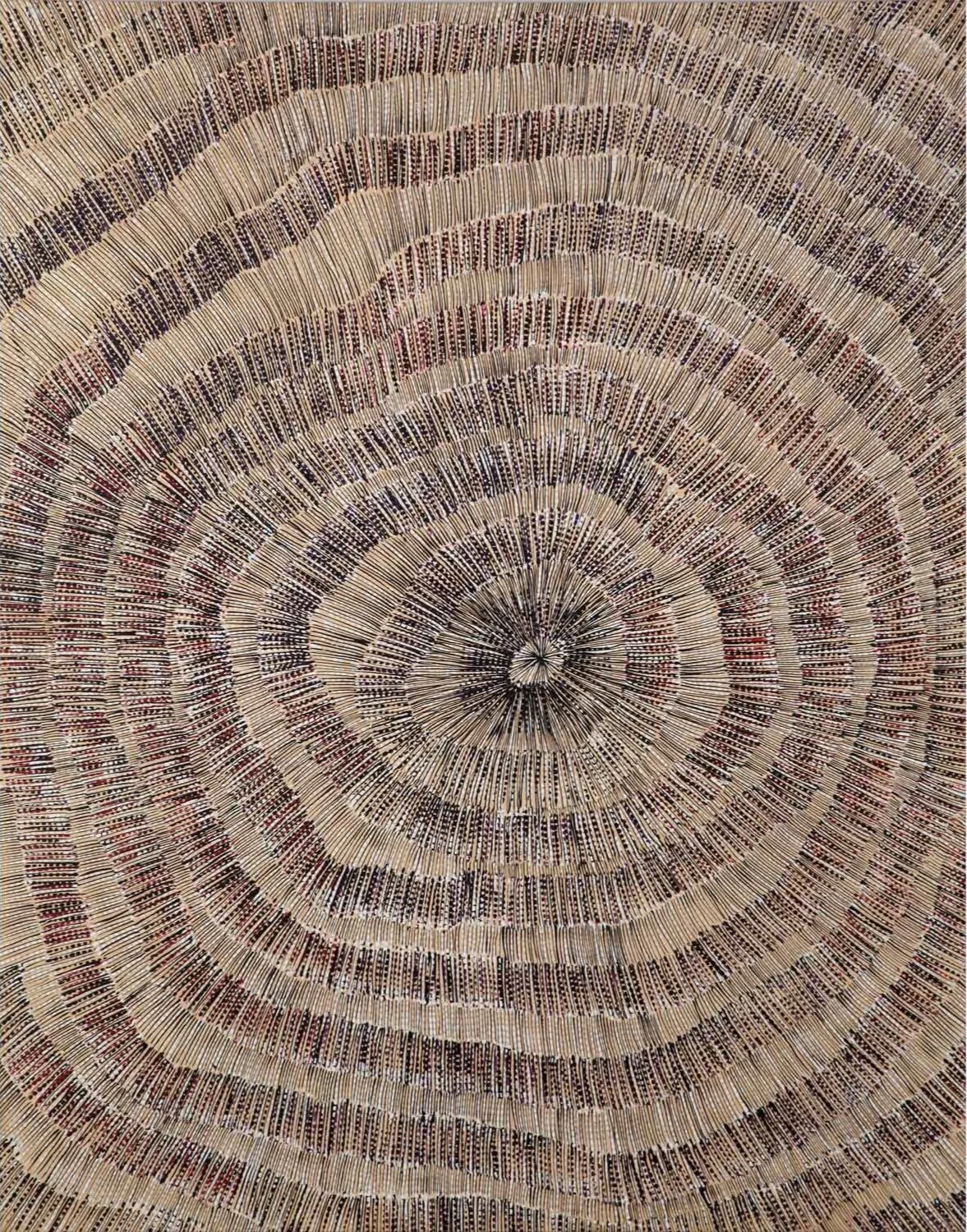
“ As a child I loved hearing my grandmother’s stories. She would bring the past to life through her stories and simultaneously teach me our culture. One story she repeated was about living in a simple hut made from paperbark. Inside the hut, paperbark was used as a swag to sleep on, as a blanket to sleep under, for cooking, rafts and to make light in the dark. Paperbark was also used to carry water, bush tucker and even babies, and as a shroud for dead bodies.
Sometimes, I use paperbark to carry things and for a ground oven. I also use it to make a small temporary shelter when I am out fishing and hunting. I use it to remember my culture and to recall my grandmother’s wonderful stories. I have painted the paperbark as a magnified view. The lines and movement in the painting reflect the growth of the paperbark trees and all trees as living things important to all people. This painting honours my grandmother who taught me through her stories who I am; my culture, my history and also the importance of looking after our land and vegetation for future generations.”
Kieren Karritpul, Merrepen Arts, Top End

Ian Rictor
2020, Acrylic on linen
290 x 300 cm
20-228
PHOTOGRAPHY BY FIONA MORRISON
Ian has depicted two significant sites. Kamanti, which has two rockholes, situated in the heart of traditional Spinifex Lands and forms part of the Wati Kutjara Tjukurrpa (Two Men Creation Line). This is a powerful epic that follows a father and son as they traverse Spinifex Country on cultural business. These two men take the form of Wanampi (Magical Water Serpents), shaping the landscape as they move through it, and leaving behind physical and spiritual reminders of their journey. The two rockholes are where the two men made camp. The other site is Tuwan, a special men’s site where the Tjilpu Tjuta Tjukurrpa (Many Birds Creation Line) begins. This story follows a group of Zebra Finch Men as they move south to the coast to stop the rising sea waters. Kapi Mankurpa translates as three rockholes.
Ian Rictor, Spinifex Arts Project, Western Desert

Jill Daniels
2021, Acrylic on linen
120 x 80 cm
31-21
PHOTOGRAPHY BY FIONA MORRISON
“This cattle station has a fence all around and gates too. One paddock has horses and one has cattle. They eat grass and some walk around under the shady trees. The station has a cattle truck and some cars so they can go to town. My dad worked on cattle stations when I was young. I remember the smell of cattle and the sound of horses from that time.”
Jill Daniels, Ngukurr Arts, Arnhem Land
Johnathon World Peace Bush
2020, Locally sourced natural earth pigments on canvas
150 x 260 cm
234/497-20
IMAGE COURTESY OF JILAMARA ARTS
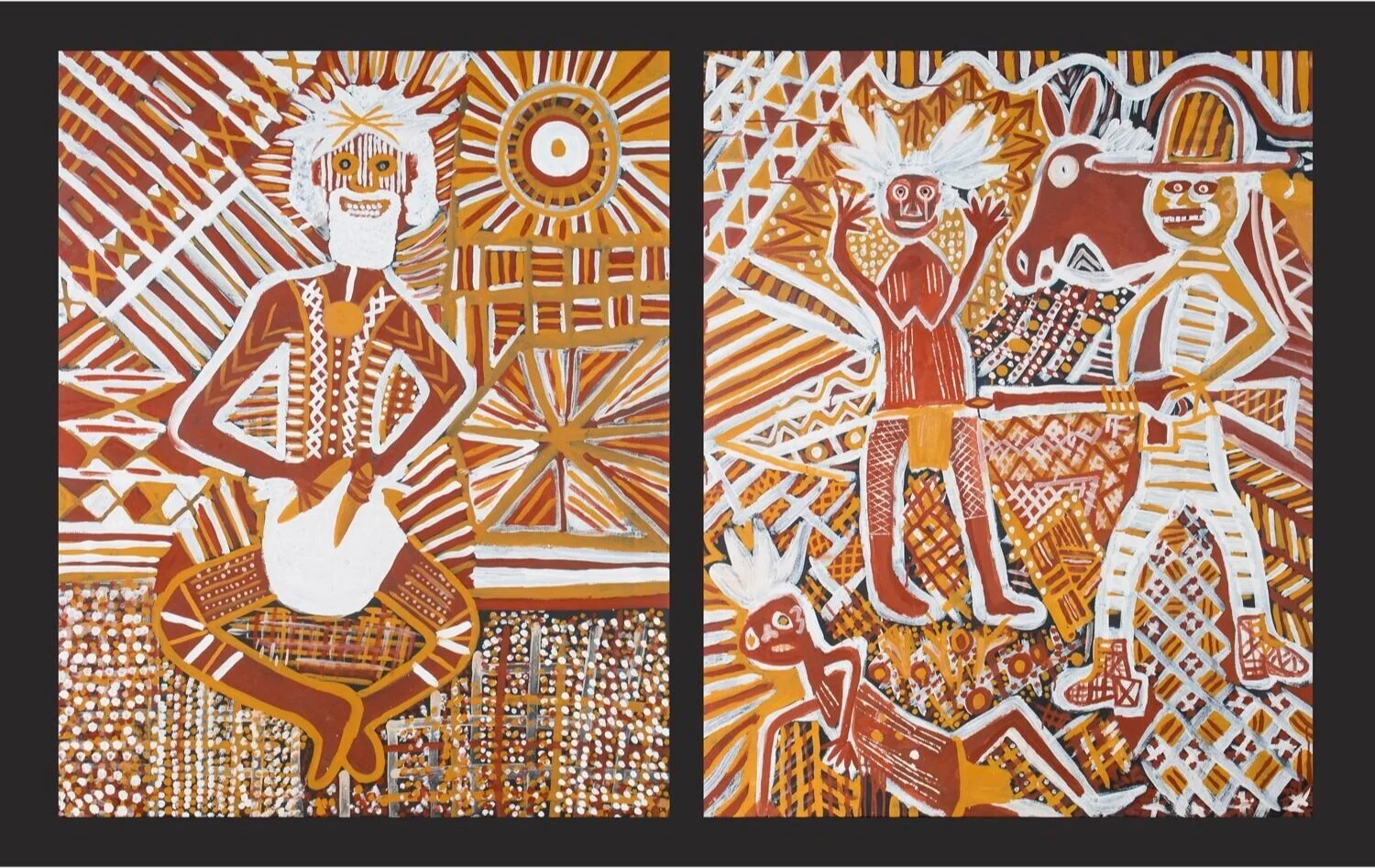
“This is my painting of my people fighting against the foreign power. My people had spears. They had rifles. Using powerful things to try to overpower my people in my native land… It is important to link the past to the present for healthy future regeneration. Like a chain reaction. To fix up a family tree you have to go down to the roots and into the past.”
Johnathon World Peace Bush, Jilamara Arts, Tiwi Islands

Joey Nganjmirra
2020, Acrylic on canvas
180 x 84 cm
381-20
IMAGE COURTESY OF INJALAK ARTS
Joey is sharing an important part of Australian history in this painting. For him, there are three key stages. The Nayuhyungki (first people) at the top, Captain Cook's arrival in the middle, as well as explorers from other countries, and the two totems of the Australian crest, Emu and Kangaroo, with the balanda (white people) and bininj (Aboriginal people) at the bottom, working together and making a new family tree.
Joey Nganjmirra, Injalak Arts, Arnhem Land
Lennard Walker
2020, Acrylic on linen
290 x 300 cm
20-222
PHOTOGRAPHY BY FIONA MORRISON
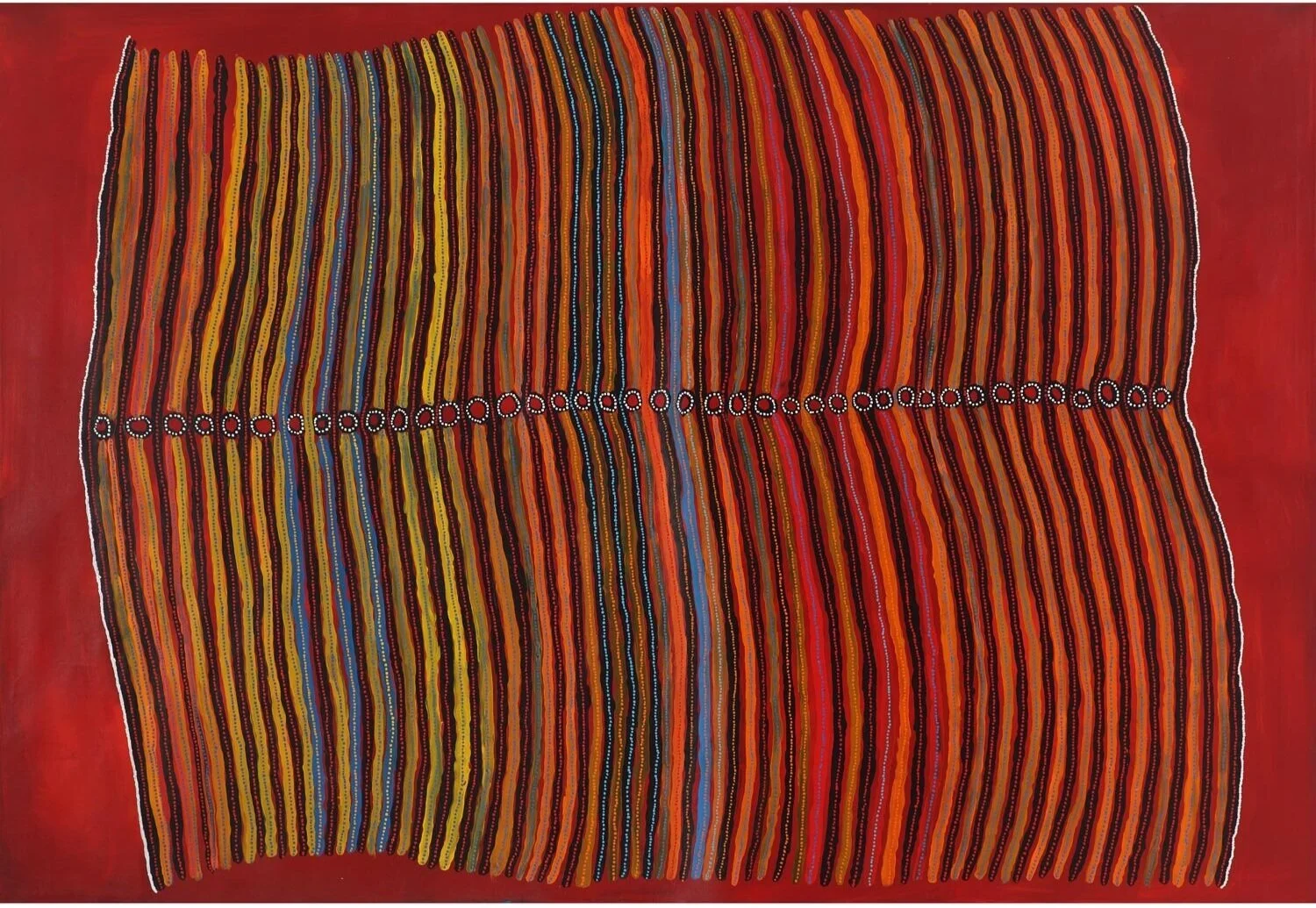
“This is the country north from Tali tjuta (many sand dunes) all along here. As you travel north past Ilkurlka, you reach the country I am responsible for around Kuru Ala (located in the Great Victoria Desert of WA). There are small rockholes along the way, which provided much needed water as people walked this country on foot.
Lennard is the senior custodian for Kuru Ala, an immensely important site in the region. It is a Women’s Site, holding the Kungkarangkalpa Tjukurrpa — Seven Sisters story. As a man, there are places he cannot go but he still holds authority and cultural responsibilities for Kuru Ala. Before reaching Kuru Ala there are many sand dunes to pass over. Lennard has great knowledge for this country and lists the following rockholes; Purpurnya, Kapi Wiyatjara, Nyuman, Kamanti, Tuwan and Wayatji.
Lennard Walker, Spinifex Arts Project, Western Desert

Lynley Nargoodah
2021, Acrylic on polycarbonate
triptych 3 x 184 x 61 cm
53/21
PHOTOGRAPHY BY FIONA MORRISON
This painting shows the different stages of the seven seasons cycle. The blue yitlal (rain) brings forth life, the country comes alive and then becomes green. After yitlal is makurra (cold weather), the time when all the trees and bush flowers bloom. This is also a good time to burn as the plants are still green and it won’t damage the country. Then comes parranka (hot and dry) when the gum seeds have fallen off the Bloodwood and are ready for picking. I collect the seeds with my children, we paint them and make jewellery. It’s also a time of wild bushfires. They destroy everything in their path, killing the plants and animals. When the fires have finished they leave wuntra (burnt ground). Rebirth green shoots are coming up, waiting patiently for the rains to come. Then the cycle starts again.
Lynley Nargoodah, Mangkaja Arts, Kimberley

Maggie Green
2021, Acrylic on canvas
122 x 122 cm
21-109
PHOTOGRAPHY BY FIONA MORRISON
“This one's Myroodah Station, Kunmunya. We was working for station manager, Mick Lannigan. That's where we were born there, me and my mum, and my grandmothers too. We start doing painting on Myroodah Station. My mum and my grandmother teaching us, doing painting for us. That’s how we were learning dot paint.”
Maggie Green, Spinifex Hill Studio, Pilbara

Margaret Renee Kerinauia
2021, Acrylic primer & natural ochre mixed with pva binder on canvas
200 x 160 cm
161-21
IMAGE COURTESY OF TIWI DESIGN
“There is an old Tiwi creation story about that man Yirrikapayi. He used to carve spears near Cape Fourcroy on Bathurst Island.
One day he was attacked by another mob who were jealous of his ceremonial spears. He made Arawinkiri with long barbs down both edges of the spearhead. They chased him off the edge of the cliff and threw his spears at him. That man became Yirrikapayi the saltwater crocodile and his spear became his tail. Yirrikapayi Turwara, crocodile tail. That’s my painting. Yirrikapayi Turwara."
Margaret Renee Kerinauia, Tiwi Design, Tiwi Islands
Marita Sambono
2021, Acrylic paint and canvas
177 x 213 cm
SDR-02
PHOTOGRAPHY BY FIONA MORRISON
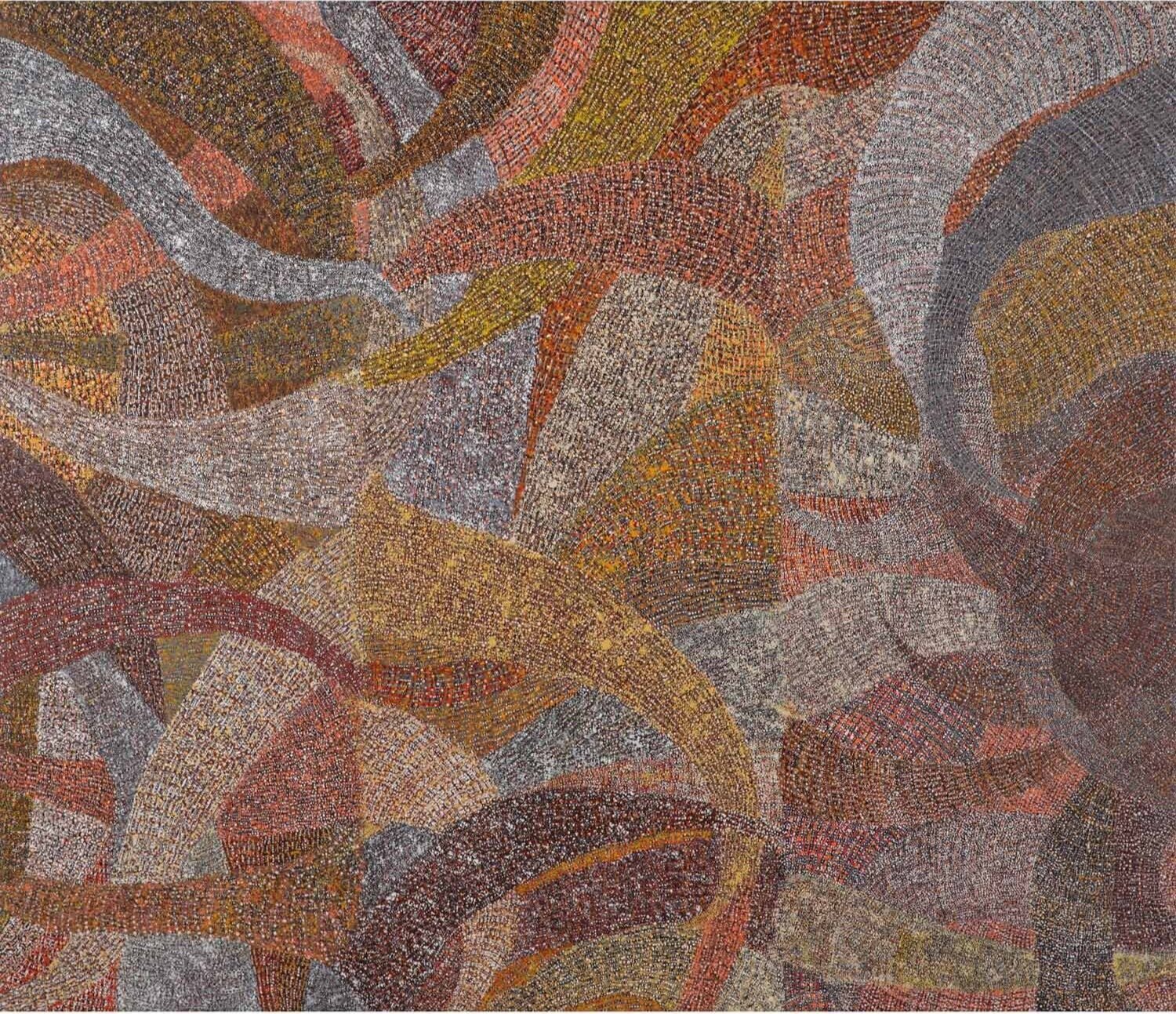
This painting uses the sweeping movements made when using the traditional bush broom, as a metaphor for the seasonal changes in the Daly River landscape. The changing colours and growth in the seasons are depicted in the sweeping actions of the broom. Nauiyu has very distinct seasons when the colours of the landscape change in response to the weather and consequently, the plants and animals in the landscape change. Different bush tucker foods are available seasonally in the water and on land. Each season means we collect and hunt for different foods in different ways. This painting depicts the colours, textures and vibrancy of this seasonal change in landscape and activities.
Marita Sambono, Merrepen Arts, Top End
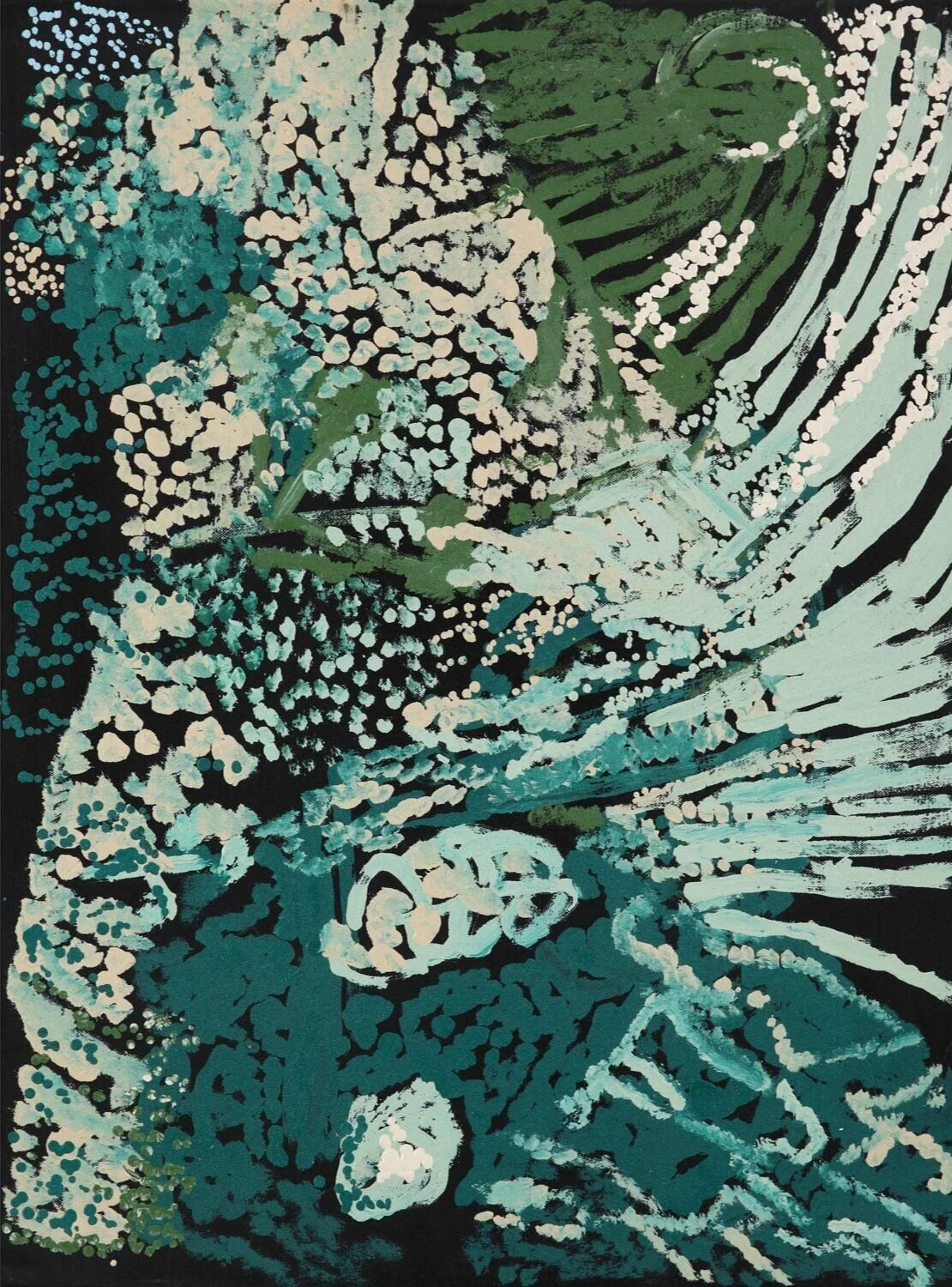
Martha McDonald
2021, Synthetic polymer on linen
61 x 46 cm
2-21
PHOTOGRAPHY BY FIONA MORRISON
Martha depicts Walukuritji in her works. It is one of a series of claypans to the south of Lake MacDonald that were significant for her father, Shorty Lungkata Tjungurrayi. The surrounding dot matrix depicts the tapestry of different types of vegetation across the landscape.
“These are ngati (holes) and a little bit of kapi (water) in the waterholes, still ngati. And watiya (trees). Watiya, one, two, three, four. Watiya."
Martha has been painting for a long time. She witnessed the beginnings of the Papunya Art Movement in the early 1970s, when her father created authoritative works that would go on to be internationally celebrated. While Martha paints his country, she does so in her own way, and only in relation to the stories that she knows about it.
"This place is my father’s country, Warlukuritji, other side of Kintore. I don’t know where, South of Kintore, I am watching my father paint, his way, in the old way. They are doing painting before, outside, otherside of the church. We used to see them. You listen — this is father’s country, Daddy. But I paint differently to my father.”
Martha McDonald, Papunya Tjupi Arts, Central Desert
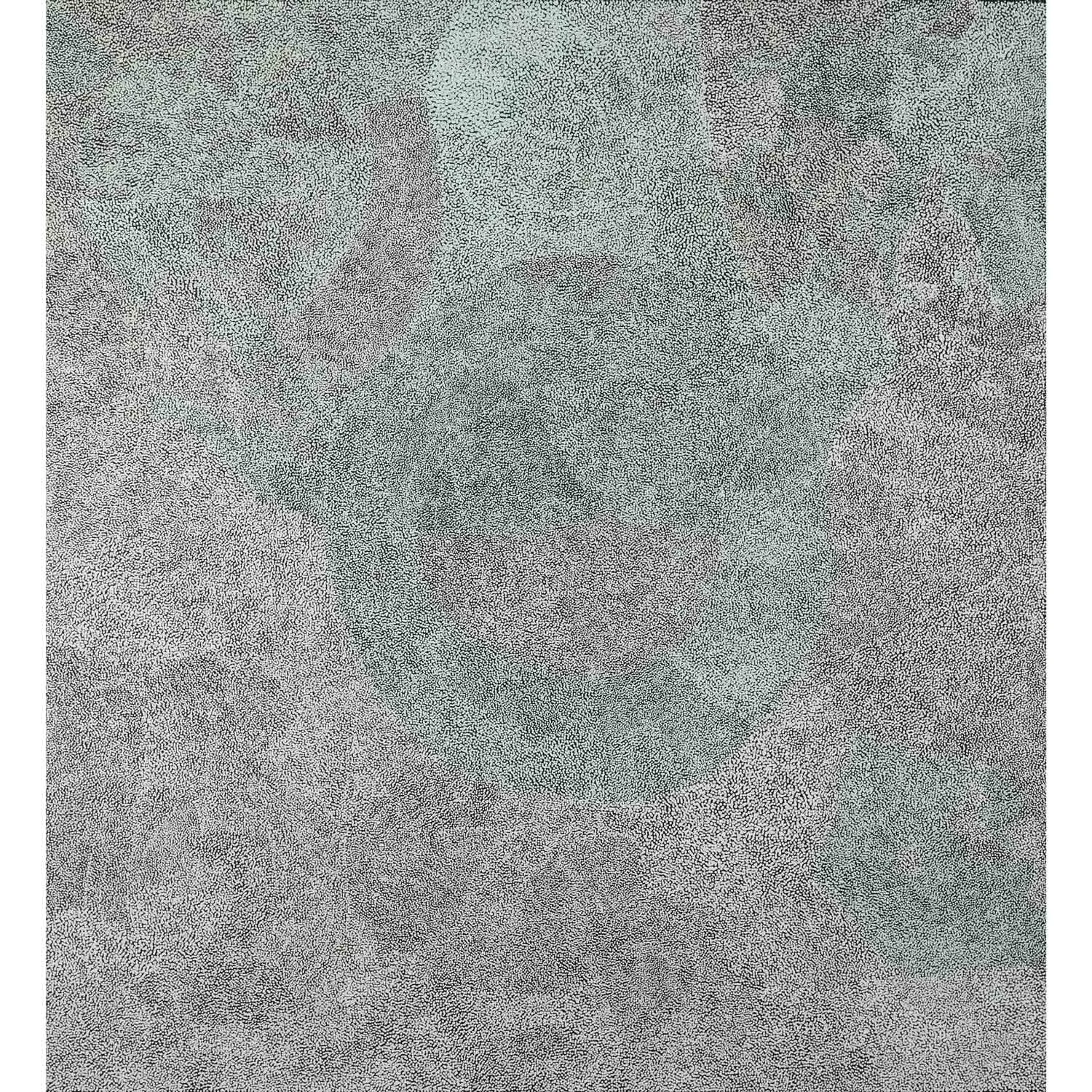
Matjangka (Nyukana) Norris
2021, Acrylic on Belgian linen
200 x 183 cm
23-21
PHOTOGRAPHY BY FIONA MORRISON
Matjangka has depicted the infinite and breathtakingly beautiful night sky that is omnipresent above the country of the APY lands. Detailed dotting creates an expansive field of stars. This is the Milky Way where the Kungkarangkalpa Tjukurrpa depicts the Seven Sisters when they have flown up into the Milky Way. The story involves seven sisters who traveled from place to place to escape the man called Nyirru. He constantly changed his shape so they had to keep running away. He wanted to marry the youngest sister but the other sisters did not like the idea of the sister marrying the man because he is ugly and has six toes. Eventually the sisters fly up into the Milky Way and can be seen as the star cluster known as the Pleiades (Seven Sisters).
Matjangka (Nyukana) Norris, Kaltijiti Arts, APY Lands

Paulina Puruntatameri
2021, Natural ochres on canvas
180 x 120 cm
21-25
PHOTOGRAPHY BY FIONA MORRISON
When [the] tide goes out it leaves markings and designs on the sand of different sizes, small and big.
Paulina Puruntatameri, Munupi Arts, Tiwi Islands
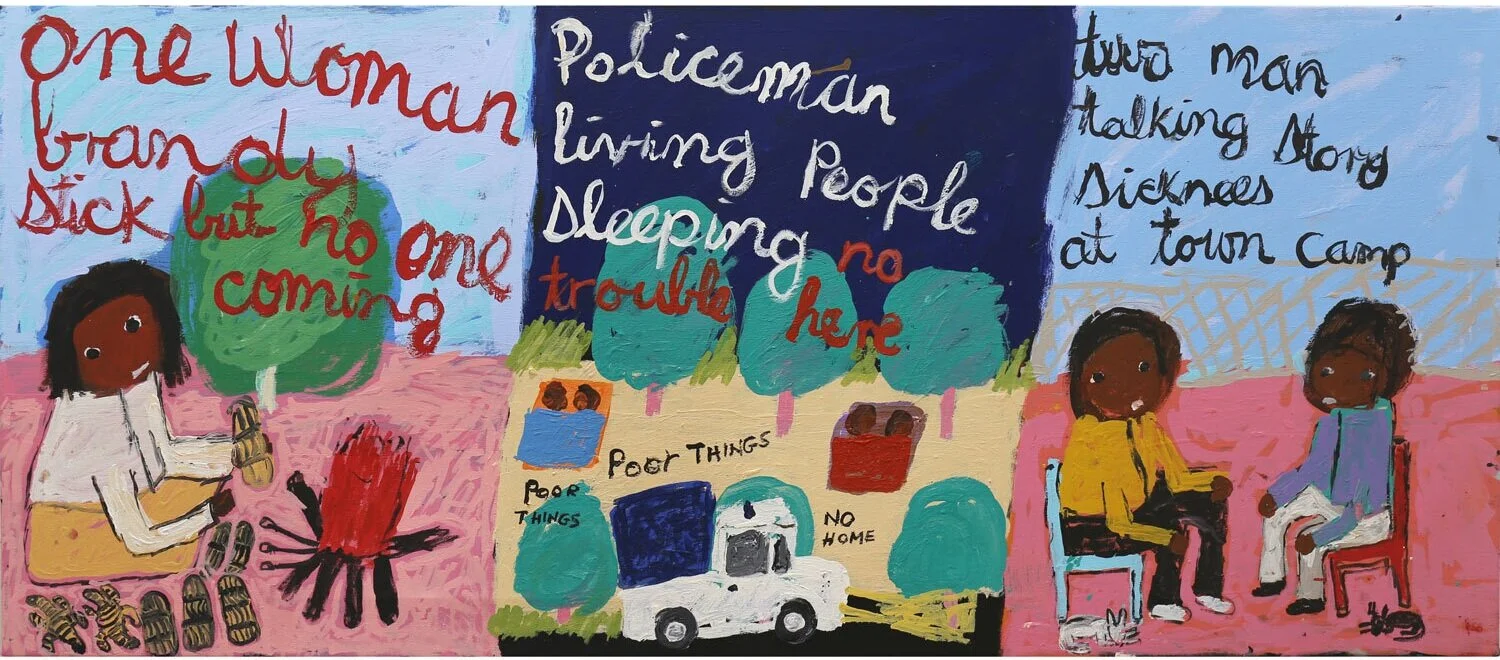
Sally M Mulda
2020, Acrylic on linen
153 x 66 cm
11022-20
IMAGE COURTESY OF TANGENTYERE ARTISTS
Sally Mulda's painting documents Covid-19 anxieties felt by Town Camp residents and visitors during 2020. Women, who normally earn from selling bean tree punu, hotwired mulga clap sticks, or seed jewellery, have no visiting tourist customers. Due to sudden community closures, many people are accidentally bound to Alice Springs, unable to return home to family and community. Homeless, they sleep in other people's yards, and in the bush, too often with only a single blanket. Rangers and police move them on and confiscate their blankets because it is illegal. Men and women endlessly discuss what they have heard about Covid-19. The impact of this sickness is felt by everyone across Central Australia and causes great consternation and worry.
Sally M Mulda, Tangentyere Artists, Central Desert

Sandra Teece
2021, Acrylic on linen
122 x 152 cm
7-21
IMAGE COURTESY OF AMPILATWATJA ARTISTS
“My father, Murphy Teece, is a painter. He taught me about bush medicine and how to make it. I paint the plants and flowers that I know and how to make the medicine. This is medicine for the skin, to drink when sick. We always use traditional medicine.
This painting is after fire, the rain starts and the seeds grow, bringing new plants.
Sandra Teece, Ampilatwatja Artists, Central Desert
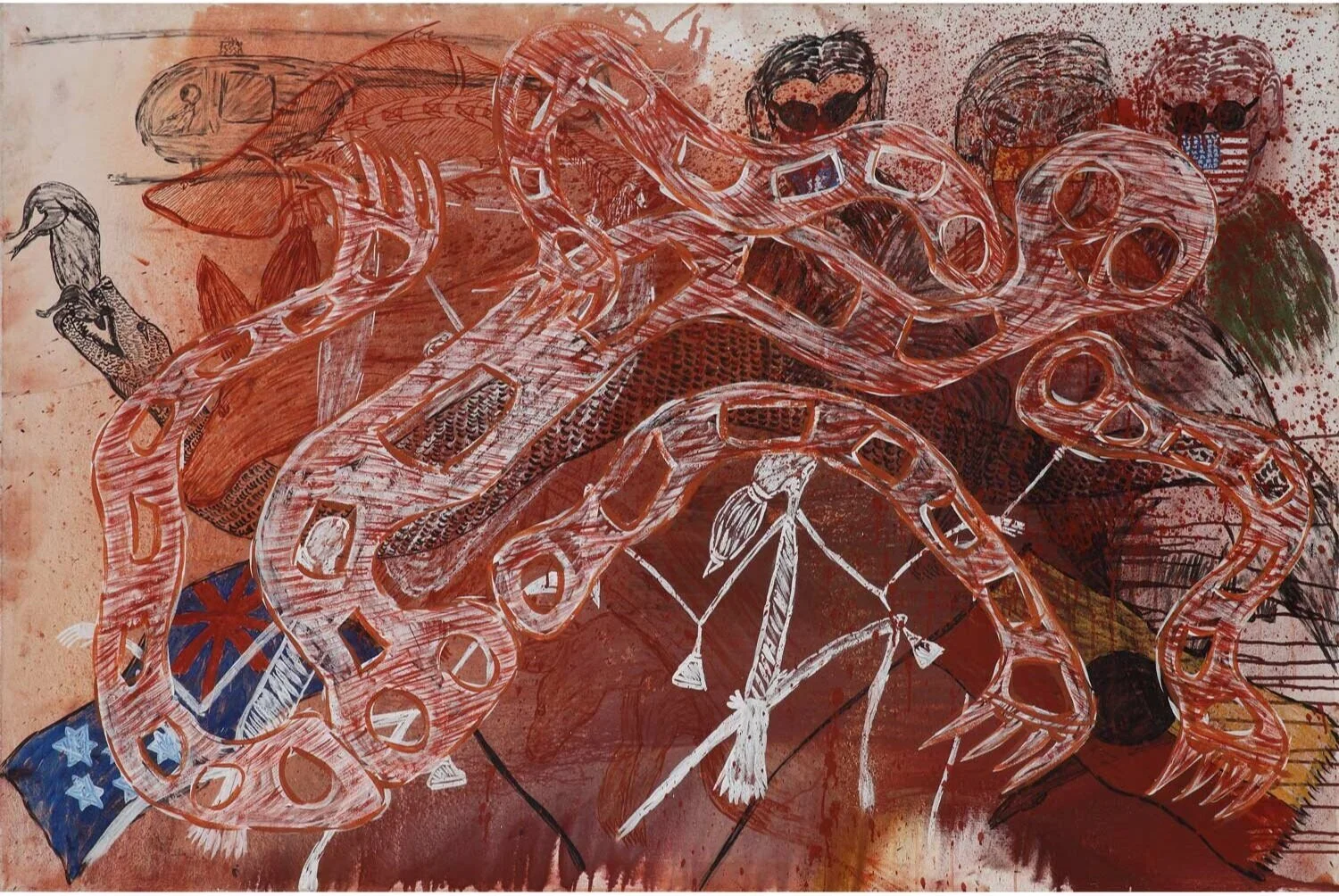
Shaun Namarnyilk
2021, Acrylic and ochre on canvas
122 x 183 cm
4-21
PHOTOGRAPHY BY FIONA MORRISON
Shaun's art practice is inspired by his memories. He feels a duty to share the stories he learns from rock art through the canvas. In doing so, he releases his many thoughts into a visual language that other people can interpret and appreciate. He does not only want to share his ancestors’ legacy, but to incorporate elements of his everyday life and his deepest opinions about the present.
Shaun Namarnyilk, Injalak Arts, Arnhem Land

Taylor Wanyima Cooper & Witjiti George
2021, Acrylic on Belgian linen
183 x 200 cm
69a-21
PHOTOGRAPHY BY FIONA MORRISON
Taylor Cooper is an important senior artist and a recognised custodian of traditional law and culture. He was born at Malara, a waterhole near Pipalyatjara. His father was from Pipalyatjara and his mother from Iltur (Coffin Hill), a site associated with traditional men's ceremony. Malara is the place of the Wanampi Tjukurpa (Water Serpent Dreaming) in the far west of the APY Lands, which is often featured in Taylor's works. Taylor is also an expert craftsman.
Witjiti George holds extensive cultural knowledge and is a senior artist and Elder. He was born at Lambina/Granite Downs, a cattle station in the far north of South Australia. His father was from Iltur and his mother's country is Piltati in the Mann Ranges. Due to an extended drought, his family were forced to travel east to the Central Australia Railway. He attended primary school at Oodnadatta before moving to Pukatja/Ernabella and finally to Kaltjiti/Fregon to work in the cattle industry. With his wife Tjangili, Witjiti established the small community of Mulga Bore east of Kaltjiti.
Together, these men paint most days, side by side, quietly discussing their Tjukurrpa, whether they are working on a painting on their own, or on a collaboration, they work as a close-knit team and have huge admiration and respect for each other.
Taylor Wanyima Cooper & Witjiti George, Kaltijiti Arts, APY Lands

Tjawina Porter
2020, Acrylic on cavnas
56 x 91 cm
20-1012
PHOTOGRAPHY BY FIONA MORRISON
This is Marlu Kumpungka, a long sliver of water which snakes through Warlurtu, or Lake Hopkin, the salt lakes to the north of Tjukurla. The water was laid down by the kangaroo, and always runs, even in very dry times.
But kapi kumpuwalyku tjikiltja wiya!
That water is too salty, you cannot drink it!
Tjawina Porter, Tjarlirli Art, Western Desert

Wokka Taylor & Muuki Taylor
2020, Acrylic on canvas
122 x 152 cm
LEFT: 20-726 (Wokka Taylor)
RIGHT: 20-736 (Muuki Taylor)
IMAGE COURTESY OF MARTUMILI ARTISTS
This painting depicts Kulyakartu, Muuki’s and Wokka’s ngurra (home Country, camp). Kulyakartu is located far north of the Martu Homelands, near the Percival Lakes region of Western Australia's Great Sandy Desert. Both brothers have extensive knowledge of the Country in this region, where they grew up living traditionally during the pujiman (traditional, desert dwelling) days with their family.
Wokka says, “My Country, Kulyakartu. I grew up there, from little boy to big boy, grew up there.”
Wokka Taylor & Muuki Taylor, Martumili Artists, Pilbara
3D Works

Barayuwa Munuŋgurr
2021, Etched aluminium sign and automotive enamel spray
180 x 120 cm
1-21
PHOTOGRAPHY BY FIONA MORRISON
Hidden bones of a slaughtered whale create a reef known as Garapana, surrounded by the white foam of Manbuyŋa. Ŋarrpiya (the Octopus) is a guardian of this dangerous and sacred place. This artwork is a repurposed architectural aluminium panel. Yolŋu have repurposed found metal since first contact with Makassans and Balanda first knew them as the Murrŋiny, a name given by neighbouring groups, which references their steel spearheads.Wokka Taylor & Muuki Taylor, Martumili Artists, Pilbara
Barayuwa Munuŋgurr, Buku-Larrŋgay Mulka Centre, Arnhem Land
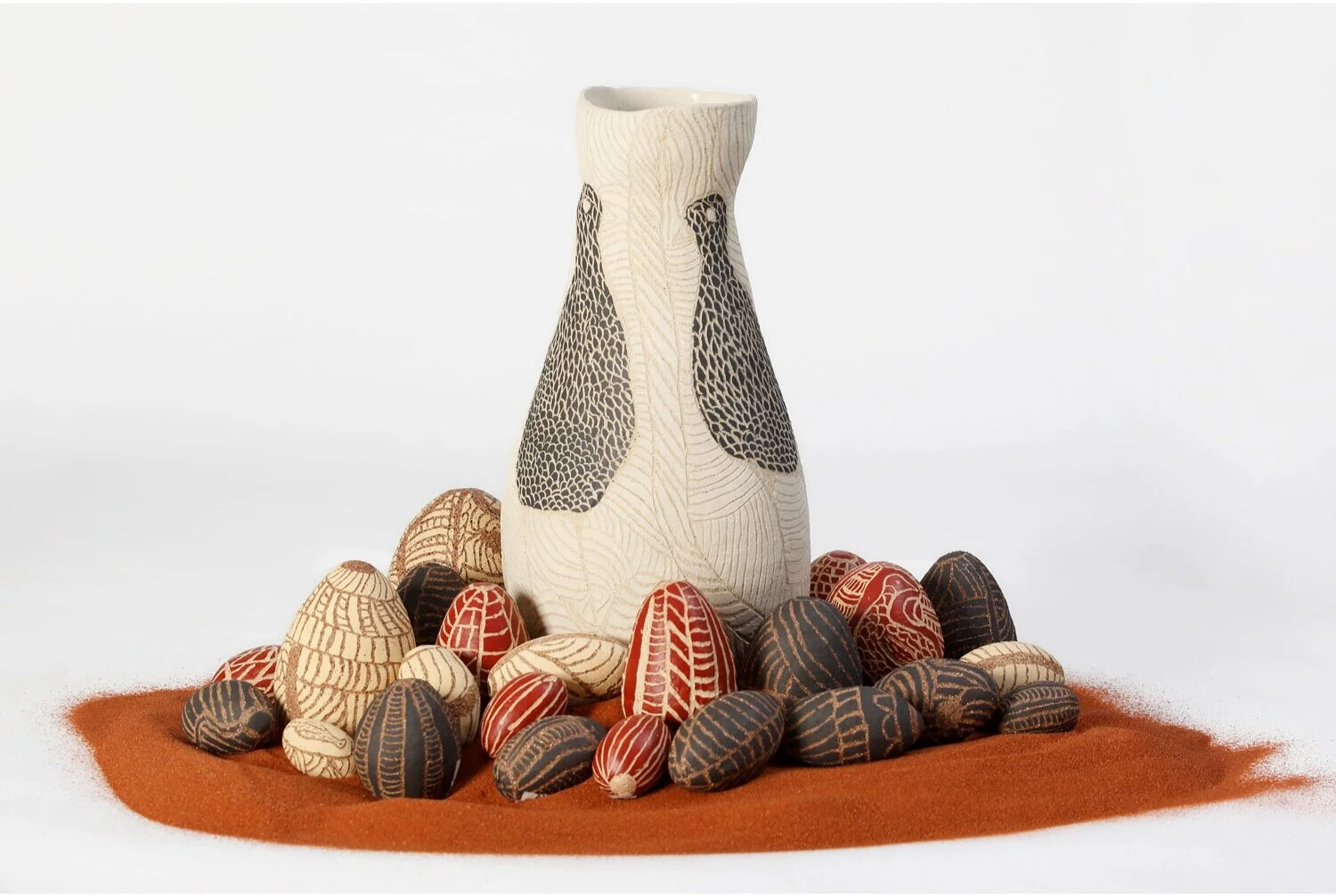
Carlene Thompson
2021, Stoneware and sand
43 x 62 x 55 cm
95c-21
PHOTOGRAPHY BY FIONA MORRISON
Carlene is a senior artist in the Ernabella community. Carlene had six children — five girls and a boy. She started working in the art centre in 2007 and started concentrating on ceramics in 2009. Her works are about tjulpu tjuta (birds). People call her Tjulpu Thompson, and she says, “Like I did with my children, I now raise chicks every day on canvas and in clay in my work.” Carlene marks in clay her family’s land near Kanypi in the Western APY Lands. It is the kalaya (emu) that formed that country. He travelled from Kanpi to Watarru. This artwork tells the story of kalaya (emu) and kalaya ngampu (emu egg). It shows how Carlene is ensuring that knowledge is being passed down by having many children, as it is typical for the kalaya to have many children as well. The eggs represent new life.
Carlene Thompson, Ernabella Arts, APY Lands
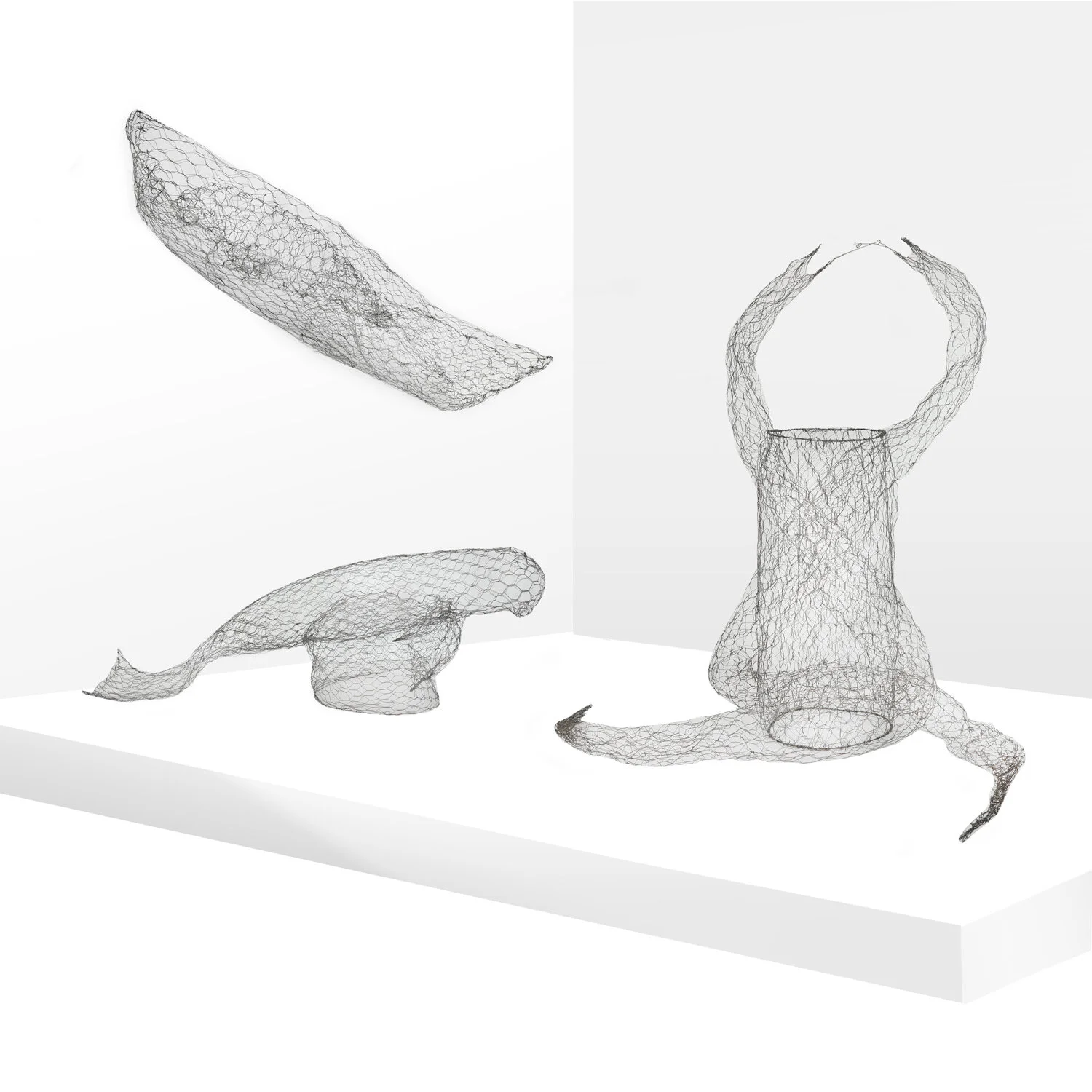
Gunybi Ganambarr
2021, Galvanised steel wire
300 x 300 x 300 cm
1524-19
Dugong in boat 64 x 173 x 35 cm
Burrut’tji (water pythons) 157 x 155 x 80 cm
Dugong (large) 63 x 191 x 43 cm
IMAGE COURTESY OF BUKU-LARRŊGAY MULKA CENTRE
This is the landscape at Yathikpa, a stretch of sea in Northern Blue Mud Bay where dugong hunters drowned in their canoe and the lightning snake towers in the Wet.
Gunybi Ganambarr, Buku-Larrŋgay Mulka Centre, Arnhem Land
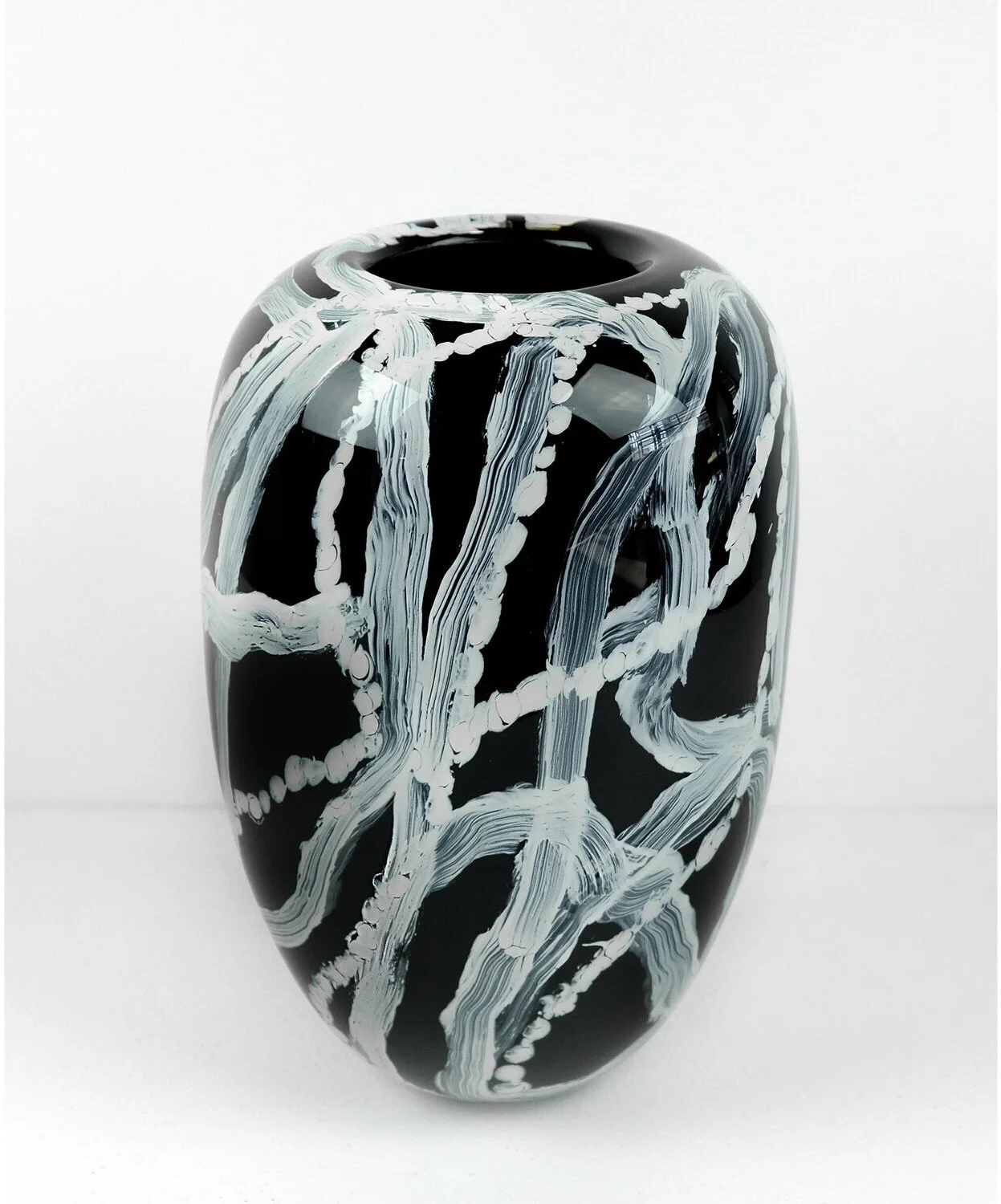
Jimmy Donegan
2021, Blown glass and enamel
35 x 50 x 25 cm
21-39 and 21-46
IMAGES COURTESY OF NINUKU ARTS
Jimmy Yanyatjari Donegan was born at Yanpan, a rockhole near Ngatuntjarra Bore circa 1940. He grew up in the country surrounding Papulankutja in Western Australia. A highly skilled wood craftsman, hunter, and important elder, Mr. Donegan is well known for his electric depictions of Tjukurrpa stories associated with Pukara, a sacred men's site south of Irrunytju community. Jimmy began recreating these works in glass as part of Ninuku Art's Walka Waru Kalawtjanga Project in 2018.
Jimmy Donegan, Ninuku Arts, APY Lands
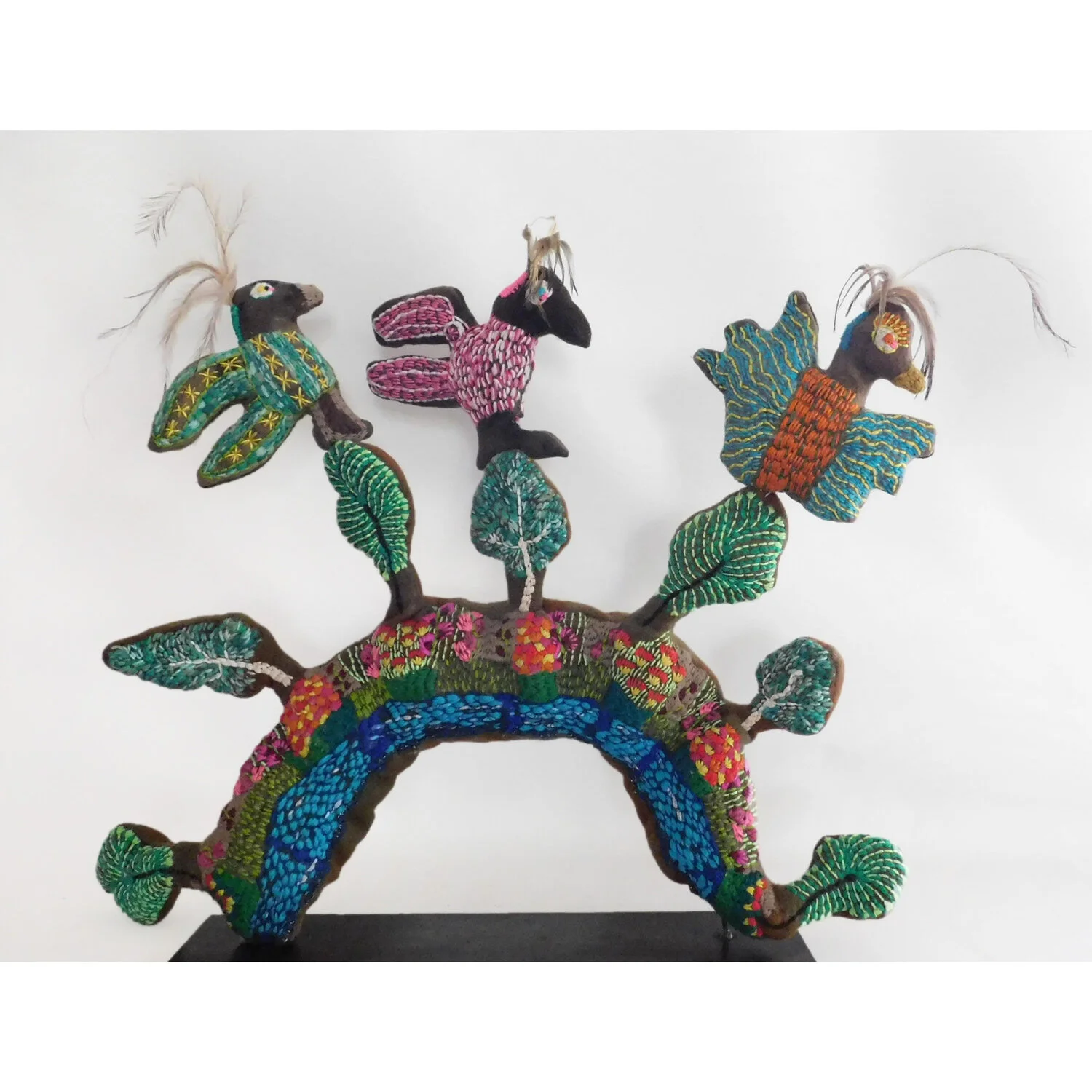
Louise Robertson
2021, Natural dyed recycled woollen blankets embellished with wool and cotton thread
103 x 65 x 17 cm
93-21
IMAGE COURTESY OF YARRENYTY-ARLTERE ARTISTS
“After the rain I feel alive and happy. We go swimming and pick bush plants. The kids like to swim too. They play in the clay. They rub it on their faces and hair and we all really laugh.
We love sitting near the water under the trees watching the birds and the kids all playing. We get beautiful shade from the tree and we eat good food like kangaroo tail and damper. We drink tea. The rain makes everything fresh, just like when you hose your back and front yard. I made this sewing scene to get that feeling about when the rain comes, when the birds are singing and the trees are all green and make shade for us, and when the bush flowers are everywhere and the river is full. Then we all feel really happy.”
Louise Robertson. Yarrenty Arltere Artists, Central Desert
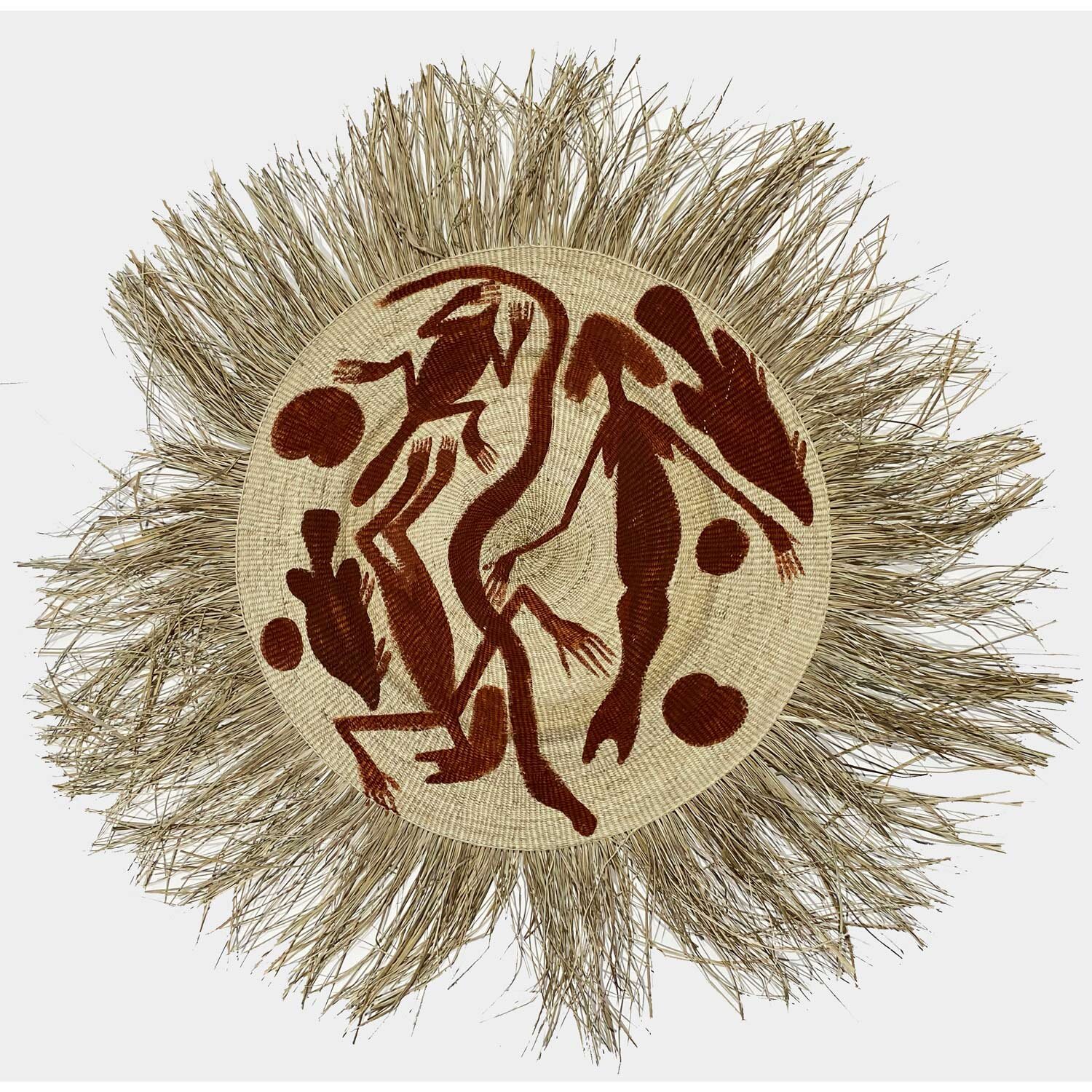
Robyn Nabegeyo
2020, Ochre on pandanus weaving
130 x 130 cm
1004-20
IMAGE COURTESY OF MARRAWUDDI ARTS AND CULTURE
“I was born in Darwin. When I was little, I stayed with my mum and dad in Madginbardi. Then, when I was 16/17, I came to Gunbalanya and got married. I've been here ever since.
I have been weaving for 22 years. I learned from my great grandmother, my mum’s grandmother. She used to make marebu (mat), big one. I started practising when I was young and tried on marebu, dilly bags and baskets. I wasn't very good but when I was 20, I started getting better, doing my baskets and dillybags, string bags and floor mats. Old people, long time ago, were painting like this, mimih, djenj (fish), kinga (crocodile) — we call that bim (rock art). I picked up the idea of painting on the dilly bag from the old people. I get the ochre from outstation, Mandedjkadjang, my homeland.”
Robyn Nabegeyo, Marrawuddi Arts and Culture, Arnhem Land
Bark painting

Dhuwarrwarr Marika
2020, Earth pigments on stringybark
190 x 72 cm
1522-20
IMAGE COURTESY OF BUKU-LARRŊGAY MULKA CENTRE
The songs which found this work’s meaning start as the Djaŋ’kawu Sisters’ journey by canoe from their mythical Atlantis-like island Burralku. They finally arrive in North-East Arnhem Land at sunrise. One of the most sacred places in Australia is this landing place at Yalaŋbara. Humanity begins. The sand slips leave this pattern as they mount the dunes to the birthing place.
Dhuwarrwarr Marika, Buku-Larrŋgay Mulka Centre, Arnhem Land
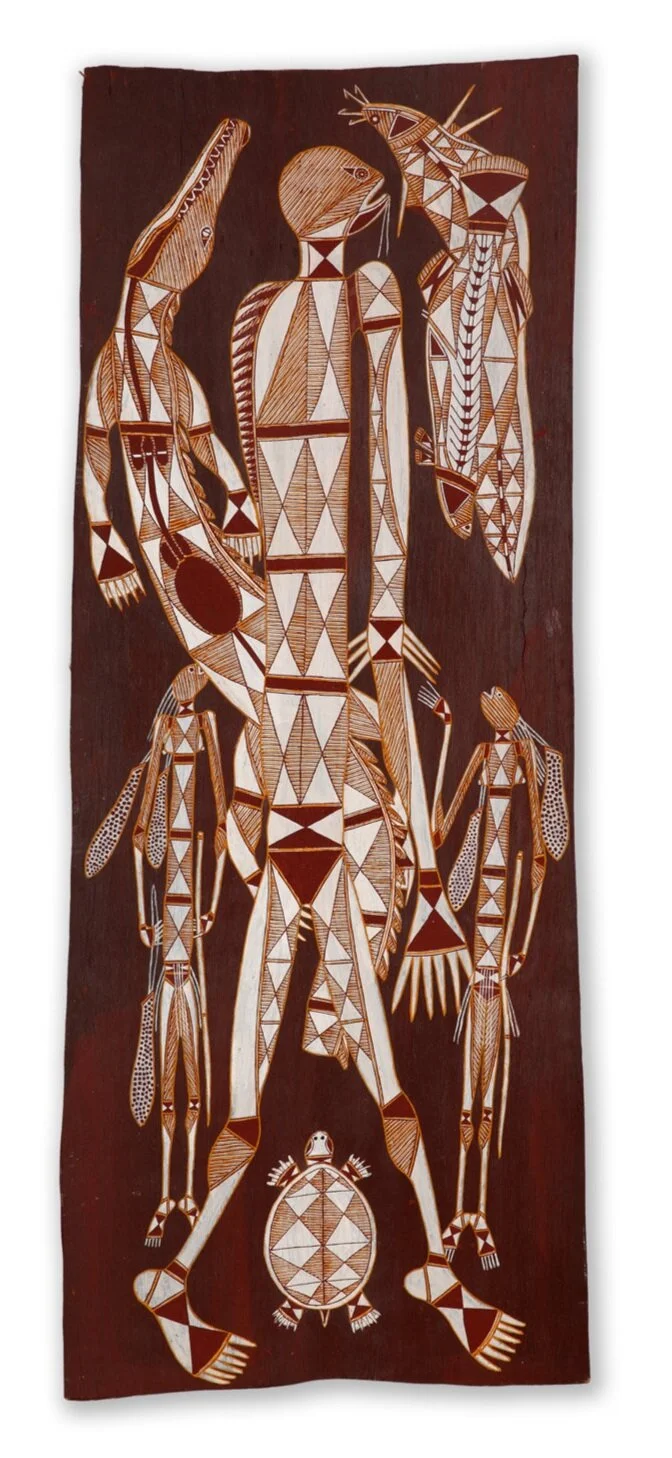
Graham Badari
2020, Ochre on Bark
117 x 45 cm
339-20
PHOTOGRAPHY BY FIONA MORRISON
Graham has painted Nawuroh, an ancestral spirit of significance to the country of the Kudjekbinj, located between Marlwon and Gumaderr. Nawuroh was a Dreamtime spirit or mimih with six fingers and toes. He had two wives who were sisters. Nawuroh is still believed to wander, sometimes in the shape of a man or in the shape of Ngalyod (the Rainbow Serpent). Nawuroh came from the sandstone country and taught Aboriginal men how to make hunting weapons such as spears, spear throwers, stone axes and fish traps. Graham has painted him alongside mimih and animals from the freshwater billabong, including Kinga (crocodile), a highly respected and feared animal associated with many significant sites in West Arnhem Land.
Graham Badari's country is Maburrinj, in the rocky escarpment country about 120 kilometres east of Gunbalanya. He draws artistic inspiration from this environment and also paints the Dreamings of his Mother Country, Djurlka.
Graham Badari, Injalak Arts, Arnhem Land
works on paper
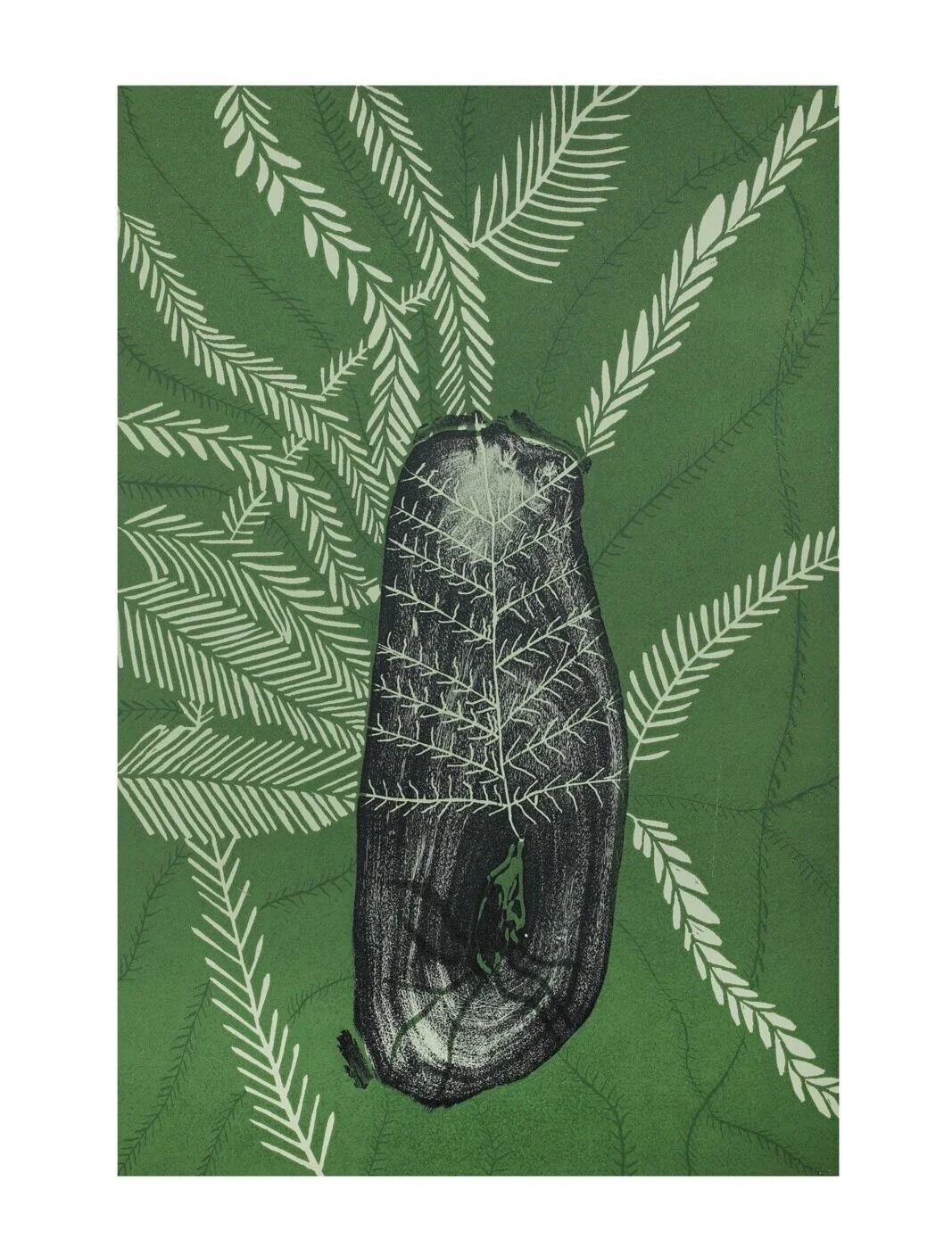
Dhalmula Burarrwaŋa
2020, Woodblock and lino print on paper
59 X 40 cm
3433-20-1/AP
IMAGE COURTESY OF BUKU-LARRŊGAY MULKA CENTRE
In 2020, Buku-Larrŋgay hosted a workshop with the students of Yirrkala Community Education Centre.
Carly Farugia, the art teacher and her ranger partner Liam, assisted in sourcing local trees to create woodblocks, like Gadayka (Stringybark), Lanapu (Cypress Pine), Djomula (Casuarina) and Ganiri (Beauty Leaf). Instead of using woodblocks industrially prepared in pre-cut rectangles, the idea was to allow the shape of the local trees to reflect in the composition. This workshop was facilitated by master printmaker Sean Smith. As a long-term printmaker facilitating the workshop, Dhalmula tried her hand with this piece of Casuarina, also known as Whistling Trees or She-Oak in English, and Djomula, Mawurraki, Gaywangi or Warrapangi in Yolŋu matha. She spoke of the calming effect of the whistling sound which comes from the Yirritja songs. Casuarina are the most typical shade for Yolŋu to sit under at the beach. The tree therefore equates, in lived experience, with family afternoons eating shellfish and stingray or turtle as the tides come and go.
Dhalmula Burarrwaŋa, Buku-Larrŋgay Mulka Centre, Arnhem Land
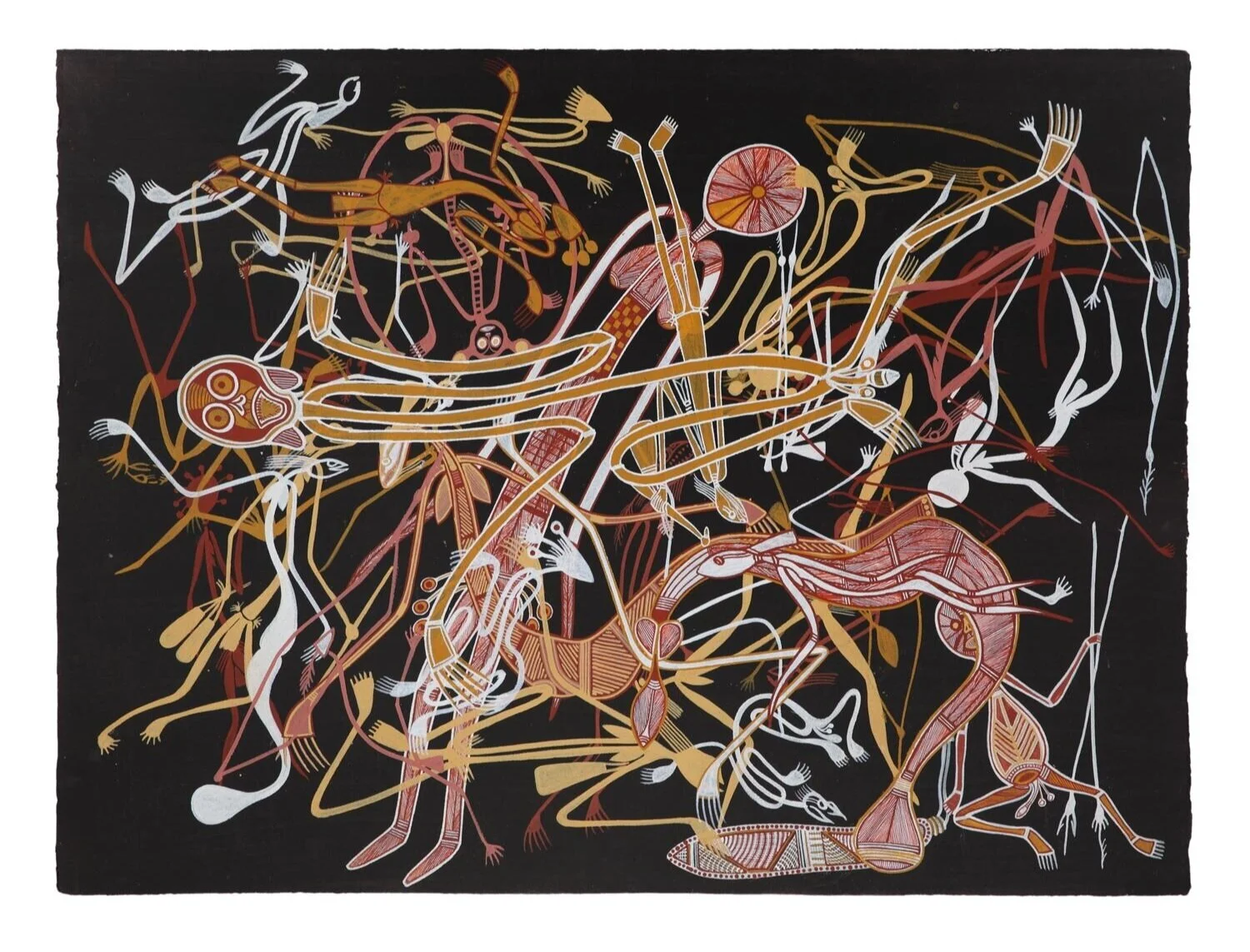
Gabriel Maralngurra
2020, Acrylic on Arches paper
76 x 102 cm
569-20
PHOTOGRAPHY BY FIONA MORRISON
Gabriel has painted Nayuhyungki, the 'first people' of creation time. They were the ancestors of the present day bininj (Aboriginal people) and are often depicted carrying hunting spears, spear throwers and woven dilly bags. These people were taught everything they needed to know by mimihs, the original spirit beings of the region. Gabriel's artistic practice is reflected in the breadth and depth of the subjects he paints, his fluent linework and highly original compositions. His works show the constant layering of different stories, the influence of figurative painting from the region and graphic depictions of the various ancestral beings.
Gabriel Maralngurra, Injalak Arts, Arnhem Land

Leemyn Corby
2021, SolarFast on Arches Watercolour paper
30 x 21 cm
75-21
PHOTOGRAPHY BY FIONA MORRISON
“Tiima ngayukuya, tiima ngyuku, papunya tiima ngayuku yuwa. Tjana ankula tawunu pliitipayi, every weekend and ngururrpa ngarripayi ankula yuwa.
They’re my team, yeah Pupanya’s my team. They always go to town to play football, every weekend, in between, they camp.
Three young men dressed in their football uniforms, playing for the Papunya Eagles. The wording Tjupi (honey ant) derives its meaning from significant Tjukurrpa (Dreaming) at Papunya. Leemyn is experimenting with a new medium for the first time, as well as new subject matter, inspired by books and images collected at the Papunya school archive.
Leemyn Corby, Papunya Tjupi Arts, Central Desert

Maureen Poulson
2020, Ink on paper
120 x 80 cm
134-20
PHOTOGRAPHY BY FIONA MORRISON
The painting depicts designs associated with Kapi Tjukurrpa (Water Dreaming) at Kalipinypa, a site northwest of Kintore. The Tjukurrpa tells of an important rain making ceremony to invoke the elements. It is a powerful storm bringing on the lightning, thunderclouds and rain sending its deluge to rejuvenate the earth, filling rock holes, clay pans and creeks. It has the power to create new life and growth upon the land.
Maureen Poulson, Papunya Tjupi Arts, Central Desert
Theo Gulamuwu Manmurulu
2021, Acrylic on Arches paper
57 x 76 cm
170-21
PHOTOGRAPHY BY FIONA MORRISON
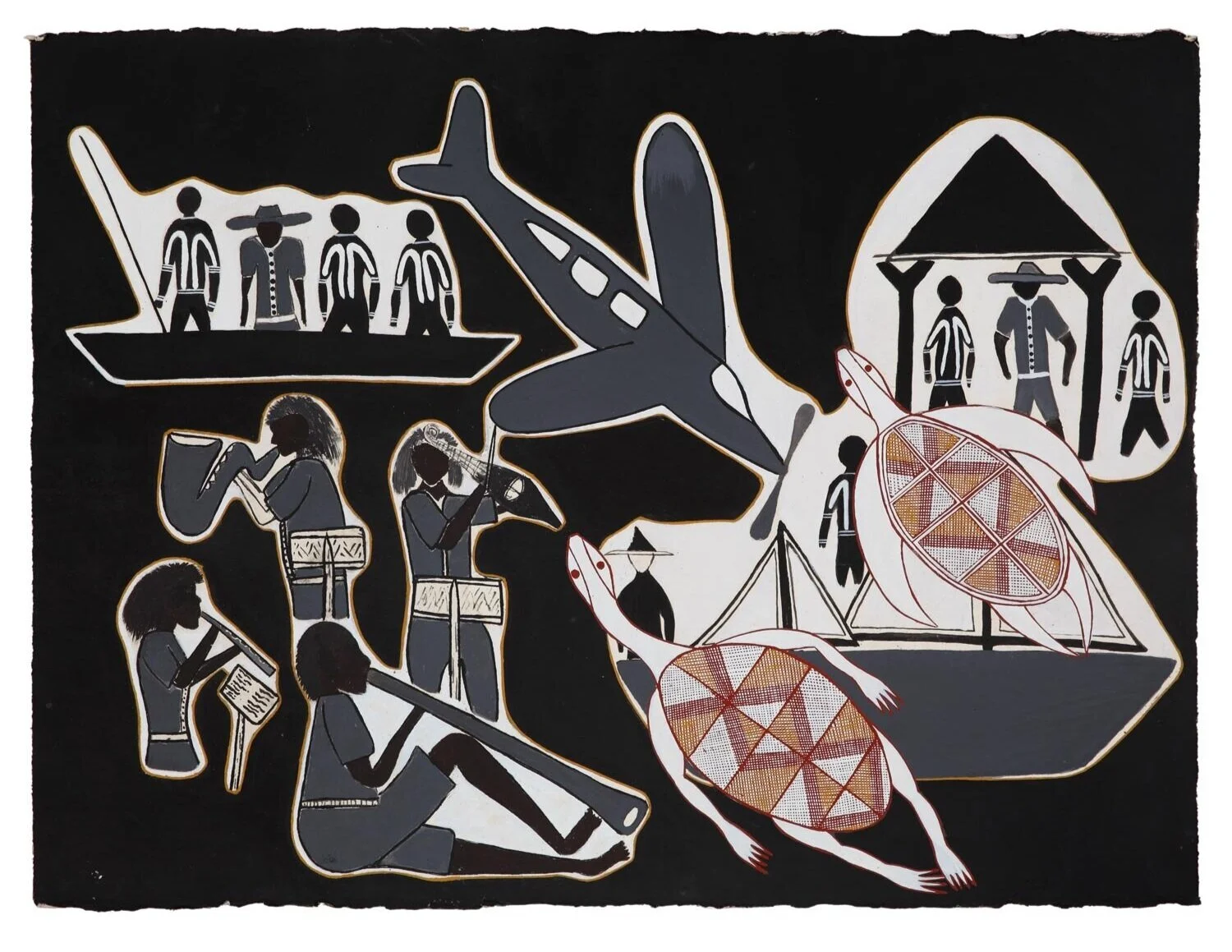
Theo is an amazing storyteller. He fondly remembers his grandfather, George Winunguj, and memories about his life have inspired this artwork. He draws together multiple stories, from the past to the present, all correlated with his grandfather’s life. Stories about encounters between Maccassan and Bininj, missionary days and his most special memory — his grandfather playing the didgeridoo with David Cubbin, Jiri Tancibudek, Thomas Wightman, Patrick Brislan, Gabor Reeves and the Adelaide Wind Quintet.
Theo Gulamuwu Manmurulu, Injalak Arts, Arnhem Land

Trudy Inkamala
2021, Pigmented ink on archers paper
130 x 90 cm
73-21
PHOTOGRAPHY BY FIONA MORRISON
“This beautiful old kurrkurrka (owl) is still here, like me! Every day coming to do my art, on the bus, from my outstation, Kwale Kwale. We are still here.
During COVID times, I started making owls on paper, and Old Laddie, my grandmother. My fingers got sore from sewing. My eyes got sore too but I still do little bit of sewing because I really love my sewing. You can't stop me! I come everyday on the school bus. It picks up all the kids that go to Yipirinya school. My family and some other strong families started that school for all the kids to have a place to learn safely. My sister Dulcie and other strong families started this art room to have a safe place to learn and help each other. It’s good this place is here. We like working and we like seeing family. This art room is now full up with my owls. They all watch us all day, the owls and soft sculptures. I feel really happy when I come here. And this kurrkurrka is really happy that I made it. I love being in the art room with everybody, I can' t sit at home and do nothing, too boring!”
Trudy Inkamala, Yarrenyty Arltere Artists, Central Desert
Multimedia
Timothy Nabegeyo
2021, Stone, stringybark, earth pigments, feathers, digital video & audio
90 x 280 x 4 cm
647-20
PHOTOGRAPHY BY FIONA MORRISON
It is our responsibility to take care of our traditional homelands and the rock art that our ancestors painted there. Our ancestors had feelings when they made the rock art. They painted each one to tell us something.
This is a film of me and my family restoring a rock art site on my traditional homeland, Mandilbareng. We went there for two days and restored the rock art. When I came back here, I had a dream that the ancestors said to me ‘It is good that you came back here and remember us.’
Timothy Nabegeyo, Injalak Arts, Arnhem Land
Andre Tipungwuti
2021, Natural ochres on canvas
120 x 182 cm
21-110
Salon des Refusés 2021
» ENQUIRE
PHOTOGRAPHY BY FIONA MORRISON
The Kulama design depicts this important ceremony of the Tiwi people; the dancers and singers create a circle and prepare the poisonous yam for eating, as indicated by the circles in the painting. The Kulama ceremony was given to the Tiwi people by the Nyingawi, who are little spirit people (as depicted in Tiwi mythology). It is a celebration of life and food, occurring at the end of the Wet Season. The Tiwi know to perform Kulama when the last full moon of the Wet Season has a yellow halo surrounding it, which tells them that Japarra (the moon man) is ready for it to begin.
Andre Tipungwuti, Munupi Arts, Tiwi Islands