
Punu – Living Wood
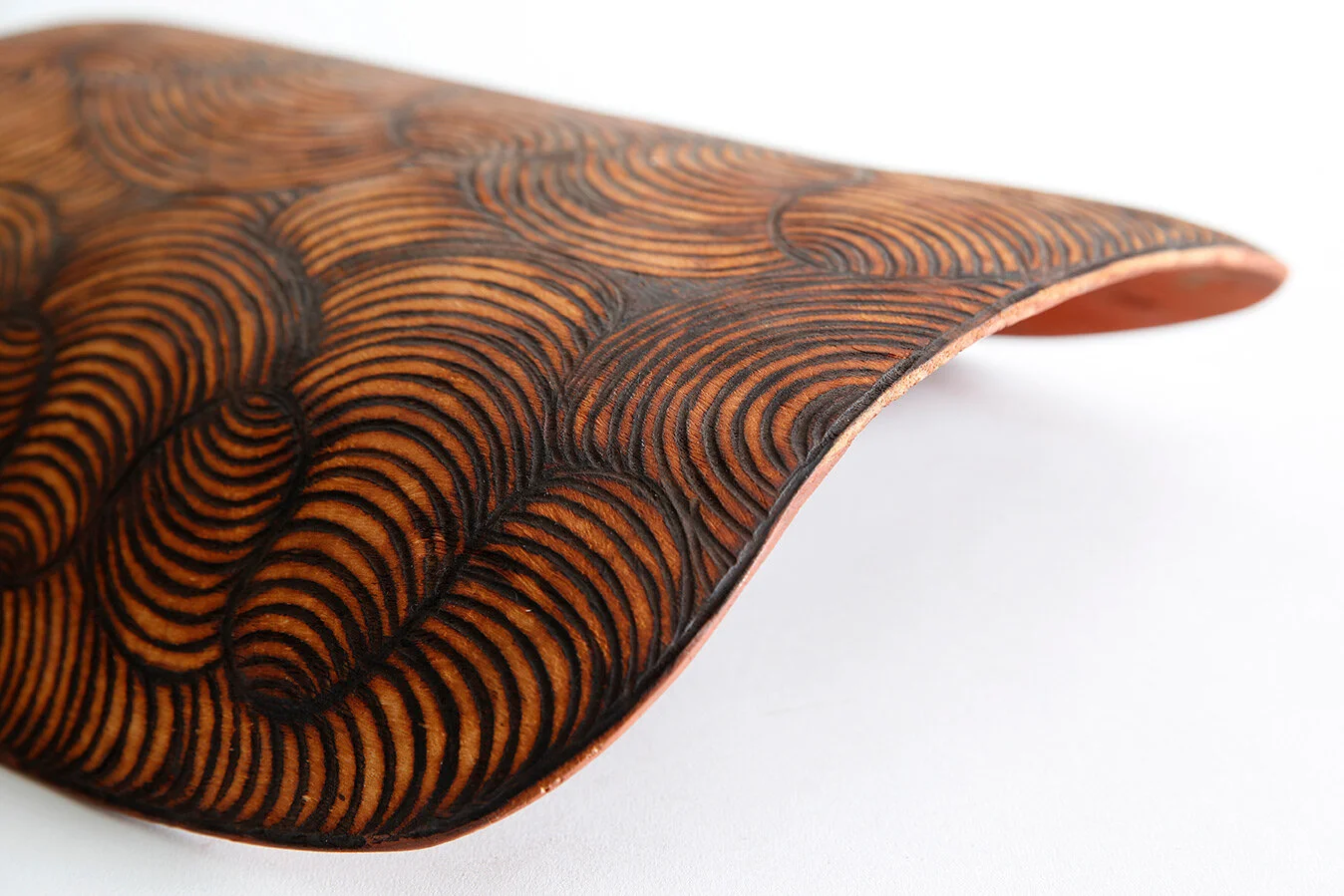
SALON Art Projects and Maruku Arts present Punu - Living Wood, an exhibition of carved wooden objects by multidisciplinary artists from remote communities spanning the Western and Central Desert regions.
The exhibition includes hand carved kali (boomerangs), wana (digging sticks), piti (collection bowls) and a range of walka boards, designs that are burnt/painted and etched onto plywood.
Punu is the Pitjantjatjara word for ‘living wood’. The carvings on show present both traditional and contemporary elements. The piti, wiras and mimpus – all sorts of bowls traditionally produced over generations for daily use, are engraved or left natural to form impressive contemporary sculptures. The walka board (walka meaning design or pattern) is a relatively new medium that enables artists to express their wood carving skills in contemporary ways. Artists engrave their stories and designs, just like painting a canvas. Some use fencing wires heated in the fire, other use a pyrography-pen.
Niningka Lewis is an established artist whose colourful boards illustrate the arrival of the first camels and white people in the desert, they tell the story of the Maralinga Atomic-bomb tests in the desert, and about life in the missions.
Younger artists have learned the burning skills from their parents and grandparents but have taken the designs further. Dallas Smythe and Cynthia Burke are two young artists from Warakurna who have developed their own way of expressing themselves on walka boards and sculptures.
Punu – Living Wood fuses together youth, wisdom, tradition and present-day, culminating in a beautiful exhibition of three-dimensional work,
IMAGE: Billy Cooley, Piti Walkatjara - Collecting Bowl with Design, 2019, photograph by Fiona Morrison
Katie Brown
Sandy Dodd
Ned Grant
Lydon Stevens
Robert Woods
Lalla West
Fred Ward
Noli Rictor
Stanley Presley Patju
Lulu Cooley
Billy Cooley
Ernest Bennett
Cynthia Burke
Dallas Smythe
Reggie Uluru
Kathryn Queama
Niningka Lewis
Maruku – carvings

1st row:
Sandy Dodd
2018, wooden carving
67 x 24 x 2 cm
Cat No C044H4-18
2nd row:
Lydon Stevens
2018, wooden carving
53 x 20 x 1 cm
Cat No C045D4-18
Punu – Living Wood
Maruku Arts
The Central and Western Desert kali or boomerang is a non-returning one and usually crafted from wanari, mulga wood. It is used for hunting and fighting but most commonly in pairs as a percussive instrument for inma or ceremony. Size and shape differ according to the individual craftsman.
“Watingku pungkula tjilpirpungkula kutjarara irira, ayi - mira mira wirura mulapa.” – Anangu wati tjilpi
‘A man strikes and splits the wood in two, trims it back - exclaiming with pride - paying close attention to his expert crafting.’ – Senior Aboriginal man
– MARUKU ARTS

1st row:
Stanley Presley Patju
2019, wooden carving
74 x 5 x 2 cm
Cat No C046D15-19
2nd row:
Ned Grant
2018, wooden carving
70 x 6 x 2 cm
960d1-18
3rd row:
Ned Grant
2019, wooden carving
63 x 5 x 2 cm
Cat No C045R1-19
4th row:
Fred Grant
2018, wooden carving
61 x 10 x 2 cm
Cat No C046H1-19
Punu – Living Wood
Maruku Arts
The Central and Western Desert kali or boomerang is a non-returning one and usually crafted from wanari, mulga wood. It is used for hunting and fighting but most commonly in pairs as a percussive instrument for inma or ceremony. Size and shape differ according to the individual craftsman.
“Watingku pungkula tjilpirpungkula kutjarara irira, ayi - mira mira wirura mulapa.” – Anangu wati tjilpi
‘A man strikes and splits the wood in two, trims it back - exclaiming with pride - paying close attention to his expert crafting.’ – Senior Aboriginal man
– MARUKU ARTS


Noli Rictor
2018, wooden carving
83 x 5 cm
Cat No C046C-19
Punu – Living Wood
Maruku Arts
Known collectively as punu, the carvings of Anangu (Central and Western Desert Aboriginal people) have their beginnings in the Tjukurpa when the Creation Ancestors fashioned the first weapons and tools, setting down the laws and conventions of their design. Highly experienced craftsmen having grown up making traditional tools and weapons under the instruction of their fathers and grandfathers. The knowledge involved in this ‘men’s business’ is inherited and passed on through the Tjukurpa or traditional Law.
– MARUKU ARTS

Robert Woods
2018, wooden carving
70 x 10 x 3 cm
Cat No C032B4-18
Punu – Living Wood
Maruku Arts
Known collectively as punu, the carvings of Anangu (Central and Western Desert Aboriginal people) have their beginnings in the Tjukurpa when the Creation Ancestors fashioned the first weapons and tools, setting down the laws and conventions of their design. Highly experienced craftsmen having grown up making traditional tools and weapons under the instruction of their fathers and grandfathers. The knowledge involved in this ‘men’s business’ is inherited and passed on through the Tjukurpa or traditional Law.
– MARUKU ARTS

Stanley Presley Patju
2018, wooden carving
65 x 8 x 4 cm
Cat No C046D13-19
Punu – Living Wood
Maruku Arts
Known collectively as punu, the carvings of Anangu (Central and Western Desert Aboriginal people) have their beginnings in the Tjukurpa when the Creation Ancestors fashioned the first weapons and tools, setting down the laws and conventions of their design. Highly experienced craftsmen having grown up making traditional tools and weapons under the instruction of their fathers and grandfathers. The knowledge involved in this ‘men’s business’ is inherited and passed on through the Tjukurpa or traditional Law.
– MARUKU ARTS

Ernest Bennett
2019, wooden carving
72 x 12 x 6 cm
Cat No 929P-19
Punu – Living Wood
Maruku Arts
Known collectively as punu, the carvings of Anangu (Central and Western Desert Aboriginal people) have their beginnings in the Tjukurpa when the Creation Ancestors fashioned the first weapons and tools, setting down the laws and conventions of their design. Highly experienced craftsmen having grown up making traditional tools and weapons under the instruction of their fathers and grandfathers. The knowledge involved in this ‘men’s business’ is inherited and passed on through the Tjukurpa or traditional Law.
– MARUKU ARTS

Katie Brown
Left:
2019, wooden carving
38 x 11 x 5 cm
Cat No C046B2-19
Right:
2019, wooden carving
28 x 8 x 4 cm
Cat No C046B3-19
Punu – Living Wood
Maruku Arts
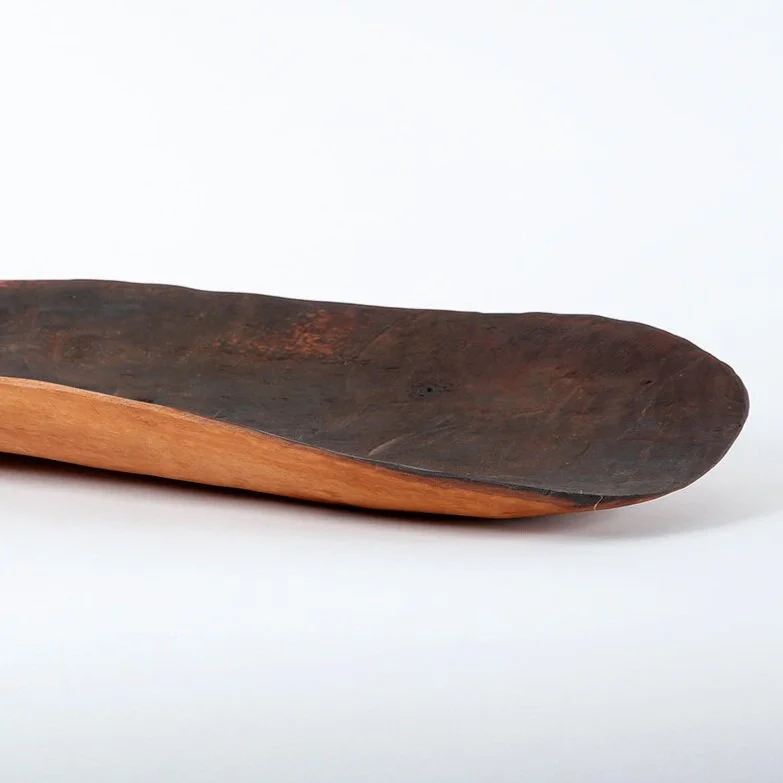

Narelle Holland
2018, wooden carving
62 x 16 x 12 cm
Cat No C027M2-18
Punu – Living Wood
Maruku Arts

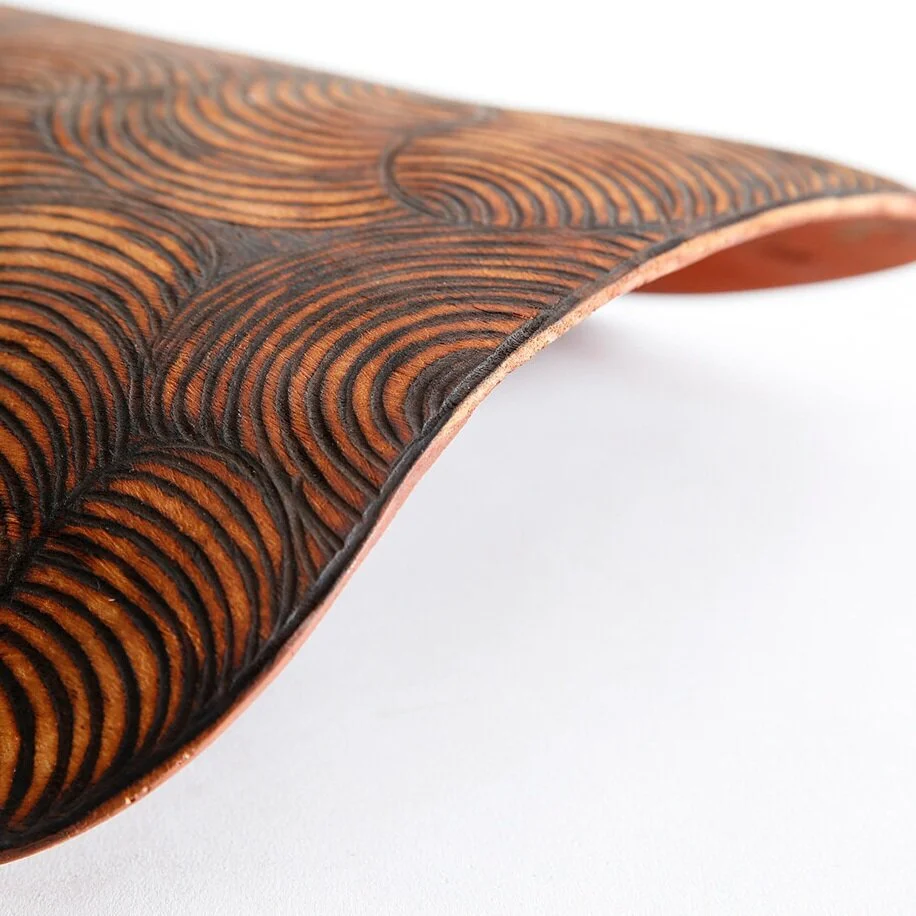
Billy Cooley
2019, wooden carving
39 x 32 x 10 cm
Cat No L575D-19
Punu – Living Wood
Maruku Arts
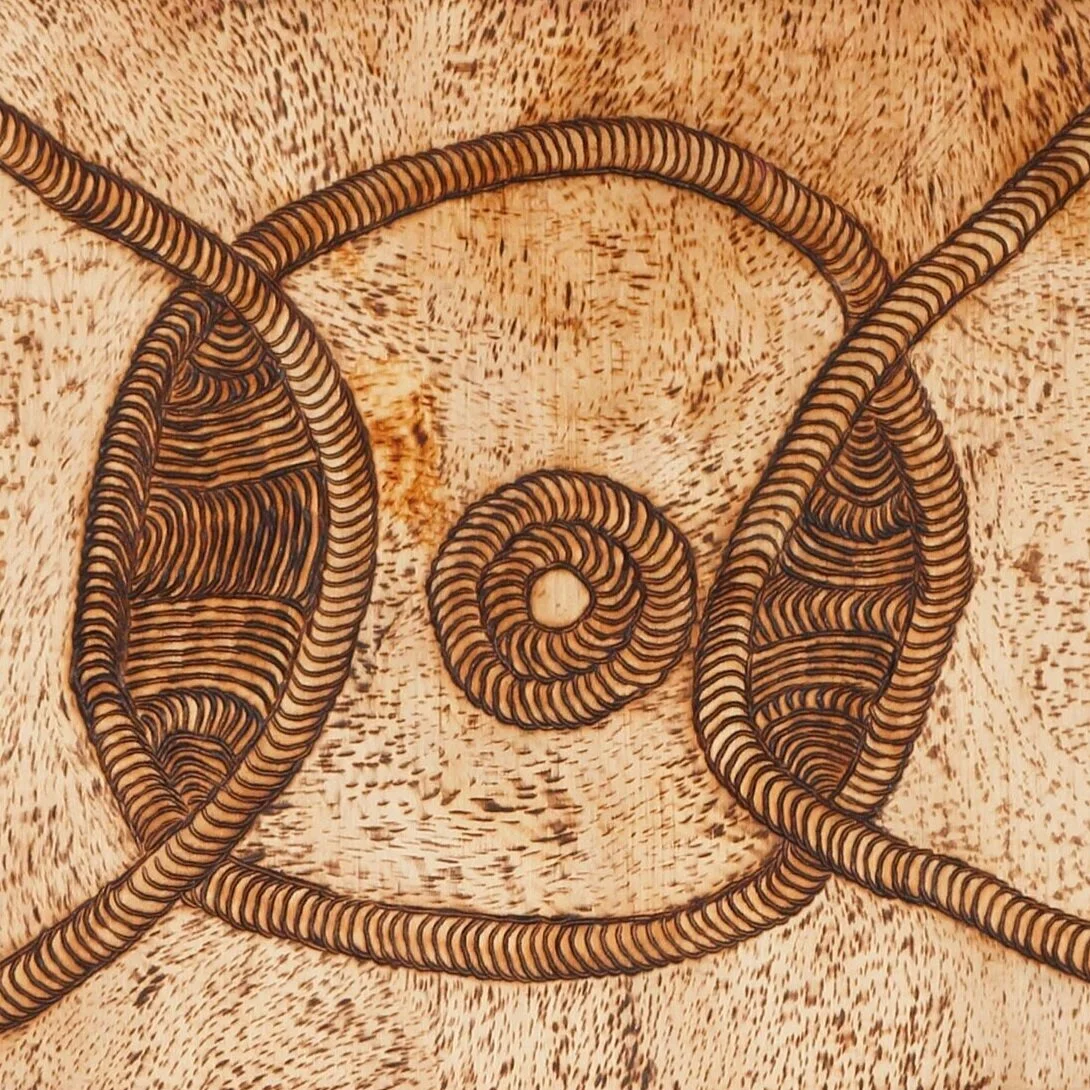
Cynthia Burke
2018, burnt etching on plywood
30 x 40 cm
Cat No WB652-18
Punu – Living Wood
Maruku Arts
Cynthia Burke was born in Alice Springs and grew up in the central desert of Western Australia. She has been a youth and media worker for many years and hosts a weekly radio programme for Radio NGm. Cynthia is an internationally exhibited painter with Warakurna Artists and also works with Tjanpi Desert Weavers. She is one of Maruku’s foremost up and coming wood carvers, and its youngest directors. She carries on the traditions of the Tjukurpa, the Law and way of life governing her country.
Walka is Desert design and inextricably linked with Tjukurpa: the Law and way of life of Anangu (Central and Western Desert Aboriginal people). The symbols were traditionally used in cave, ground and body paintings, in story telling, teaching and signalling inheritance.
Cynthia has created a kapi tjukurla or water hole design. By their very nature, waterholes also mark sites related to the Creation Ancestors’ journeys across the country; the ‘dreaming tracks’ followed by countless generations of Anangu since. They created landforms and customs to be passed on and maintained over subsequent generations. The sites are linked through inma or ceremony - the singing, dancing and body painting which reveals the laws of nature and provides a blue print for life and a guiding map of country.
– MARUKU ARTS

Cynthia Burke
2019, burnt etching on plywood
60 x 60 cm
Cat No 793-19
Punu – Living Wood
Maruku Arts
Cynthia Burke was born in Alice Springs and grew up in the central desert of Western Australia. She has been a youth and media worker for many years and hosts a weekly radio programme for Radio NGm. Cynthia is an internationally exhibited painter with Warakurna Artists and also works with Tjanpi Desert Weavers. She is one of Maruku’s foremost up and coming wood carvers, and its youngest directors. She carries on the traditions of the Tjukurpa, the Law and way of life governing her country.
Walka is Desert design and inextricably linked with Tjukurpa: the Law and way of life of Anangu (Central and Western Desert Aboriginal people). The symbols were traditionally used in cave, ground and body paintings, in story telling, teaching and signalling inheritance.
Cynthia has created a ngura or landscape of tali, puli munu pantu: sand dunes, rocky outcrops and a salt lake. By their very nature landforms also mark sites related to the Creation Ancestors’ journeys across the country; the ‘dreaming tracks’ followed by countless generations of Anangu since. They created landforms and customs to be passed on and maintained over subsequent generations. The sites are linked through inma or ceremony – the singing, dancing and body painting which reveals the laws of nature and provides a blue print for life and a guiding map of country.
– MARUKU ARTS

Cynthia Burke
2020, burnt etching on plywood
40 x 40 cm
Cat No WB872-20
Punu – Living Wood
Maruku Arts
Cynthia Burke was born in Alice Springs and grew up in the central desert of Western Australia. She has been a youth and media worker for many years and hosts a weekly radio programme for Radio NGm. Cynthia is an internationally exhibited painter with Warakurna Artists and also works with Tjanpi Desert Weavers. She is one of Maruku’s foremost up and coming wood carvers, and its youngest directors. She carries on the traditions of the Tjukurpa, the Law and way of life governing her country.
Walka is Desert design and inextricably linked with Tjukurpa: the Law and way of life of Anangu (Central and Western Desert Aboriginal people). The symbols were traditionally used in cave, ground and body paintings, in story telling, teaching and signalling inheritance.
– MARUKU ARTS

Cynthia Burke
2020, burnt etching on plywood
60 x 60 cm
Cat No WB870-20
Punu – Living Wood
Maruku Arts
Cynthia Burke was born in Alice Springs and grew up in the central desert of Western Australia. She has been a youth and media worker for many years and hosts a weekly radio programme for Radio NGm. Cynthia is an internationally exhibited painter with Warakurna Artists and also works with Tjanpi Desert Weavers. She is one of Maruku’s foremost up and coming wood carvers, and its youngest directors. She carries on the traditions of the Tjukurpa, the Law and way of life governing her country.
Walka is Desert design and inextricably linked with Tjukurpa: the Law and way of life of Anangu (Central and Western Desert Aboriginal people). The symbols were traditionally used in cave, ground and body paintings, in story telling, teaching and signalling inheritance.
– MARUKU ARTS

Dallas Smythe
2018, burnt etching on plywood
20 x 40 cm
Cat No WB657-18
Punu – Living Wood
Maruku Arts
Dallas Smythe is minyma Yarnangu, an Aboriginal woman from the Western Desert area of Australia. Born at Wiluna, she grew up in Warburton and now lives in Warakurna, all communities in the central desert region of Western Australia. Dallas is also an emerging artist with Tjanpi Desert Weavers. Her skills have been passed on through the Tjukurpa, the Law and way of life governing her country. She started working with walka boards a few years ago.
Walka is Desert design and inextricably linked with Tjukurpa: the Law and way of life of Anangu (Central and Western Desert Aboriginal people). The symbols were traditionally used in cave, ground and body paintings, in story telling, teaching and signalling inheritance.
– MARUKU ARTS

Dallas Smythe
2019, burnt etching on plywood
40 x 40 cm
Cat No WB727-19
Punu – Living Wood
Maruku Arts
Dallas Smythe is minyma Yarnangu, an Aboriginal woman from the Western Desert area of Australia. Born at Wiluna, she grew up in Warburton and now lives in Warakurna, all communities in the central desert region of Western Australia. Dallas is also an emerging artist with Tjanpi Desert Weavers. Her skills have been passed on through the Tjukurpa, the Law and way of life governing her country. She started working with walka boards a few years ago.
Walka is Desert design and inextricably linked with Tjukurpa: the Law and way of life of Anangu (Central and Western Desert Aboriginal people). The symbols were traditionally used in cave, ground and body paintings, in story telling, teaching and signalling inheritance.
This is ngura talitja or sand dune country. Series of curving lines are wind rippled sand dunes, sometimes intercut by the tracks of a Tjukuritja; the burrowings of animals; or the dry bed of a desert creek. By their very nature landforms mark sites related to the Creation Ancestors’ journeys across the country; the ‘dreaming tracks’ followed by countless generations of Anangu since. They created landforms and customs to be passed on and maintained over subsequent generations. The sites are linked through inma or ceremony - the singing, dancing and body painting which reveals the laws of nature and provides a blue print for life and a guiding map of country.
– MARUKU ARTS

maruku – paintings

Reggie Uluru
2020, acrylic on canvas
60 x 90 cm
Cat No X2100-20
Punu – Living Wood
Maruku Arts
Reggie Uluru is tjilpi Yankuntjatjara, a Yankuntjatjara speaking senior Aboriginal man from the Central Desert of Australia.
The Ngintaka or Perentie lizard (Varanus giganteus) is the largest lizard of Central Australia and a highly prized and important food. It is powerful Tjukurpa, celebrated in inma (ceremony, song, and dance), story telling and art work. Wati Ngintaka (Perentie Man) Tjukurpa stretches from one side of South Australia to the other, many sacred sites marking his passage from the first greedy sighting of a prized grindstone, to his death in punishment for its theft.
Coded in this Law story is intricate information about the country and its food and water sources as well as instructions for maintaining the balance and harmony of society. Paintings such as this are a contemporary way of continuing to celebrate and teach through the Tjukurpa.
– MARUKU ARTS
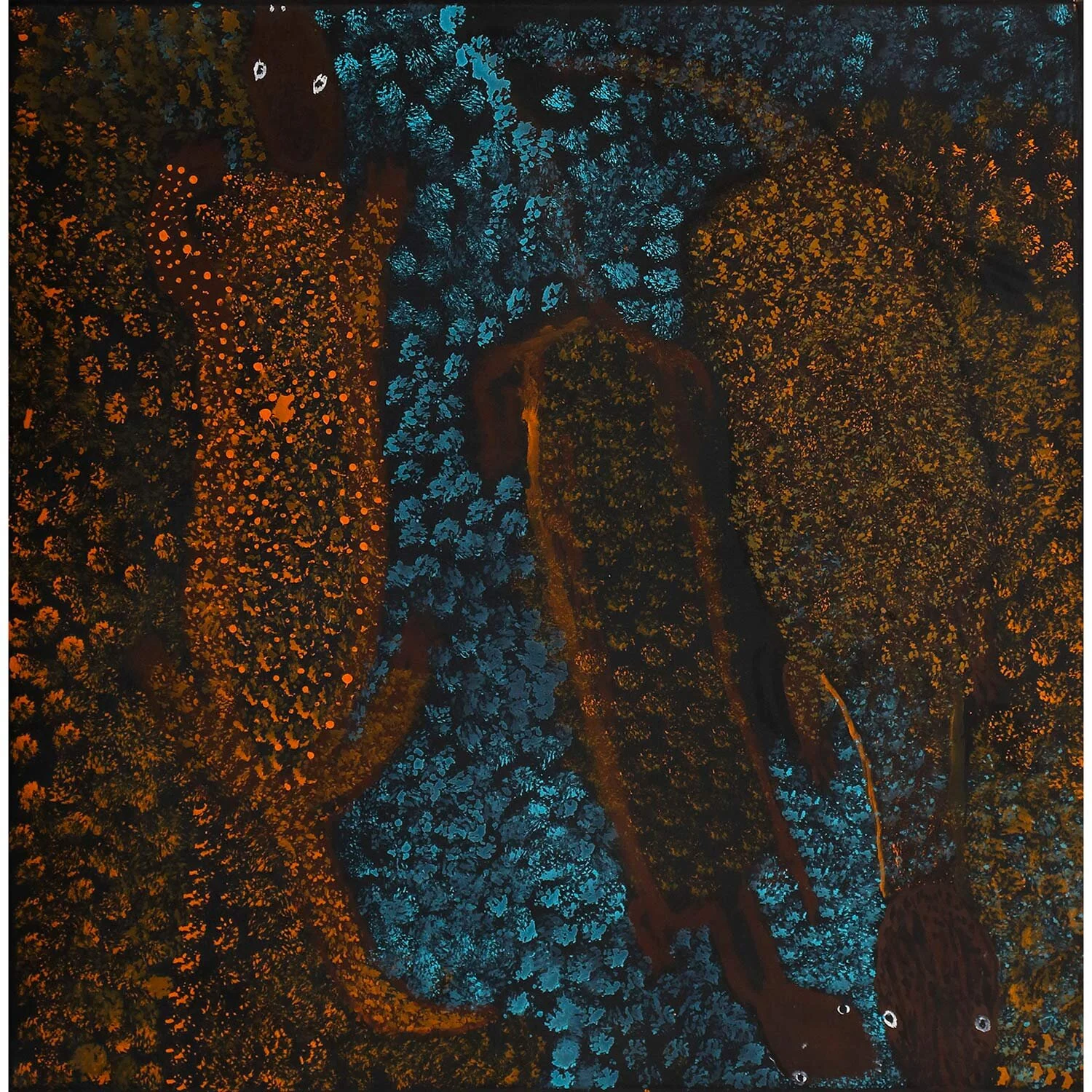
Reggie Uluru
2020, acrylic on canvas
91 x 91 cm
Cat No X2103-20
Punu – Living Wood
Maruku Arts
Reggie Uluru is tjilpi Yankuntjatjara, a Yankuntjatjara speaking senior Aboriginal man from the Central Desert of Australia.
The Ngintaka or Perentie lizard (Varanus giganteus) is the largest lizard of Central Australia and a highly prized and important food. It is powerful Tjukurpa, celebrated in inma (ceremony, song, and dance), story telling and art work. Wati Ngintaka (Perentie Man) Tjukurpa stretches from one side of South Australia to the other, many sacred sites marking his passage from the first greedy sighting of a prized grindstone, to his death in punishment for its theft.
Coded in this Law story is intricate information about the country and its food and water sources as well as instructions for maintaining the balance and harmony of society. Paintings such as this are a contemporary way of continuing to celebrate and teach through the Tjukurpa.
– MARUKU ARTS

Reggie Uluru
2020, acrylic on canvas
60 x 92 cm
Cat No X2138-20
Punu – Living Wood
Maruku Arts
Reggie Uluru is tjilpi Yankuntjatjara, a Yankuntjatjara speaking senior Aboriginal man from the Central Desert of Australia.
The Ngintaka or Perentie lizard (Varanus giganteus) is the largest lizard of Central Australia and a highly prized and important food. It is powerful Tjukurpa, celebrated in inma (ceremony, song, and dance), story telling and art work. Wati Ngintaka (Perentie Man) Tjukurpa stretches from one side of South Australia to the other, many sacred sites marking his passage from the first greedy sighting of a prized grindstone, to his death in punishment for its theft.
Coded in this Law story is intricate information about the country and its food and water sources as well as instructions for maintaining the balance and harmony of society. Paintings such as this are a contemporary way of continuing to celebrate and teach through the Tjukurpa.
– MARUKU ARTS

Kathryn Queama
2019, acrylic on linen
90 x 90 cm
Cat No X1879-19
Punu – Living Wood
Maruku Arts
Kathryn Queama is minyma Anangu, a Pitjantjatjara woman from the Central Desert area of Australia. As well as working in the Docker River Store and for regional organisation, Nyangatjatjara Aboriginal Corporation, she has been learning carving from her u Kulitja. Her traditional skills have been passed on through the Tjukurpa, the Law and way of life governing their country.
Kungkarangkalpa is the Tjukurpa of the Seven Sisters, concerning a group of women being pursued by a cunning man called Nyiru who attempts to lure them into marriage with him. He disguises himself in countless ways to trick the sisters, and is sometimes also invisible in paintings. In their escape the sisters travelled through a vast amount of Australia. They stopped to camp, build shelters and hunt for food, thus forming many features of the landscape and embedding the knowledge of survival in it. Eventually they fled into the sky where they became the constellation known as the Pleiades or Seven Sisters. Nyiru still follows them ceaselessly across the night sky as one of the bright stars in the constellation of Orion.
– MARUKU ARTS

Kathryn Queama
2019, acrylic on linen
91 x 121 cm
Cat No X1879A-18
Punu – Living Wood
Maruku Arts
Kathryn Queama is minyma Anangu, a Pitjantjatjara woman from the Central Desert area of Australia. As well as working in the Docker River Store and for regional organisation, Nyangatjatjara Aboriginal Corporation, she has been learning carving from her u Kulitja. Her traditional skills have been passed on through the Tjukurpa, the Law and way of life governing their country.
Kungkarangkalpa is the Tjukurpa of the Seven Sisters, concerning a group of women being pursued by a cunning man called Nyiru who attempts to lure them into marriage with him. He disguises himself in countless ways to trick the sisters, and is sometimes also invisible in paintings. In their escape the sisters travelled through a vast amount of Australia. They stopped to camp, build shelters and hunt for food, thus forming many features of the landscape and embedding the knowledge of survival in it. Eventually they fled into the sky where they became the constellation known as the Pleiades or Seven Sisters. Nyiru still follows them ceaselessly across the night sky as one of the bright stars in the constellation of Orion.
– MARUKU ARTS

Niningka Lewis
2017, acrylic and burnt etching on plywood
40 x 60 cm (diptych)
Cat No WBS468-17
Punu – Living Wood
Maruku Arts
Niningka Lewis is an artist whose creative innovation is loved by many. Born between the mission settlement of Areyonga and Tempe Downs cattle station in the Northern Territory, she grew up in the Ernabella area, making regular trips throughout her traditional lands. After living and working in Kalka and Ernabella for many years where she was a painter and ceramic artist. Niningka now resides at Mutitjulu in the Uluru-Kata Tjuta National Park and is a leading wood etcher and carver with Maruku Arts. She also works with Tjanpi Desert Weavers, sculpting and weaving native grass artefacts.
Niningka has shown a mission truck on its way to Warburton Mission on Ngaanyatjarra country. It distributes supplies to Anangu living traditionally on the land.
– MARUKU ARTS

Niningka Lewis
2017, acrylic and burnt etching on plywood
22 x 40 cm
Cat No WB491-17
Punu – Living Wood
Maruku Arts
Niningka Lewis is an artist whose creative innovation is loved by many. Born between the mission settlement of Areyonga and Tempe Downs cattle station in the Northern Territory, she grew up in the Ernabella area, making regular trips throughout her traditional lands. After living and working in Kalka and Ernabella for many years where she was a painter and ceramic artist. Niningka now resides at Mutitjulu in the Uluru-Kata Tjuta National Park and is a leading wood etcher and carver with Maruku Arts. She also works with Tjanpi Desert Weavers, sculpting and weaving native grass artefacts.
In this walka board Niningka is reminiscing about irititja or these early days. Her parents were part of the first generation of people at Ernabella and much of her childhood was spent there during her people’s first contact with non-indigenous Australians. People still travelled widely though, helped now by the availability of camels and reliable water supplies.
– MARUKU ARTS

Niningka Lewis
2019, acrylic and burnt etching on plywood
20 x 50 cm
Cat No WB770-19
Punu – Living Wood
Maruku Arts
Niningka Lewis is an artist whose creative innovation is loved by many. Niningka resides at Mutitjulu in the Uluru-Kata Tjuta National Park and is a leading wood etcher and carver with Maruku Arts. She also works with Tjanpi Desert Weavers, sculpting and weaving native grass artefacts.
This is Niningka’s outstation on her grandfathers country at Malara near the WA, SA and NT borders. Lying on the road from Amata to Pipalyatjara, a new homestead was built there to allow Niningka and her families to spend more time on their ancestral country.
It is a place of significant Wanampi Tjukurpa. Wanampi are powerful water serpents which inhabit and protect water holes. They are evidenced at Malara by the rock formation to the north of the homestead. In the Creation Time, a group of Wati Liru or poisonous snake men marched in battle across the lands as far afield as Uluru and Kata Tjuta. They arrived back in Malara in human form and rested for a while by the fire before taking becoming Wanampi and disappearing into the ground.
– MARUKU ARTS

Niningka Lewis
2019, acrylic and burnt etching on plywood
30 x 30 cm
Cat No WB771-19
Punu – Living Wood
Maruku Arts
Niningka Lewis is an artist whose creative innovation is loved by many. Niningka resides at Mutitjulu in the Uluru-Kata Tjuta National Park and is a leading wood etcher and carver with Maruku Arts. She also works with Tjanpi Desert Weavers, sculpting and weaving native grass artefacts.
This is Niningka’s outstation on her grandfathers country at Malara near the WA, SA and NT borders. Lying on the road from Amata to Pipalyatjara, a new homestead was built there to allow Niningka and her families to spend more time on their ancestral country.
It is a place of significant Wanampi Tjukurpa. Wanampi are powerful water serpents which inhabit and protect water holes. They are evidenced at Malara by the rock formation to the north of the homestead. In the Creation Time, a group of Wati Liru or poisonous snake men marched in battle across the lands as far afield as Uluru and Kata Tjuta. They arrived back in Malara in human form and rested for a while by the fire before taking becoming Wanampi and disappearing into the ground.
– MARUKU ARTS

Niningka Lewis
2019, acrylic and burnt etching on plywood
30 x 60 cm (diptych)
Cat No WBS758-19
Punu – Living Wood
Maruku Arts
Niningka Lewis is an artist whose creative innovation is loved by many. Born between the mission settlement of Areyonga and Tempe Downs cattle station in the Northern Territory, she grew up in the Ernabella area, making regular trips throughout her traditional lands. After living and working in Kalka and Ernabella for many years where she was a painter and ceramic artist. Niningka now resides at Mutitjulu in the Uluru-Kata Tjuta National Park and is a leading wood etcher and carver with Maruku Arts. She also works with Tjanpi Desert Weavers, sculpting and weaving native grass artefacts.
The Piltati Tjukurpa belongs to the ranges in far northern South Australia. It tells of two women, seen here with their piti munu wana (collecting bowls and digging sticks), who set out hunting and gradually draw further and further away from home. They dig burrow after burrow hoping to find small game. Their husbands follow them and transform into Wanampi, water snakes, to lie in wait for their wives in the water hole known as Piltati. When the woman approach they are startled by the Snake Men who leap up and swallow them whole. The four then become Wanampi together at Piltati.
– MARUKU ARTS
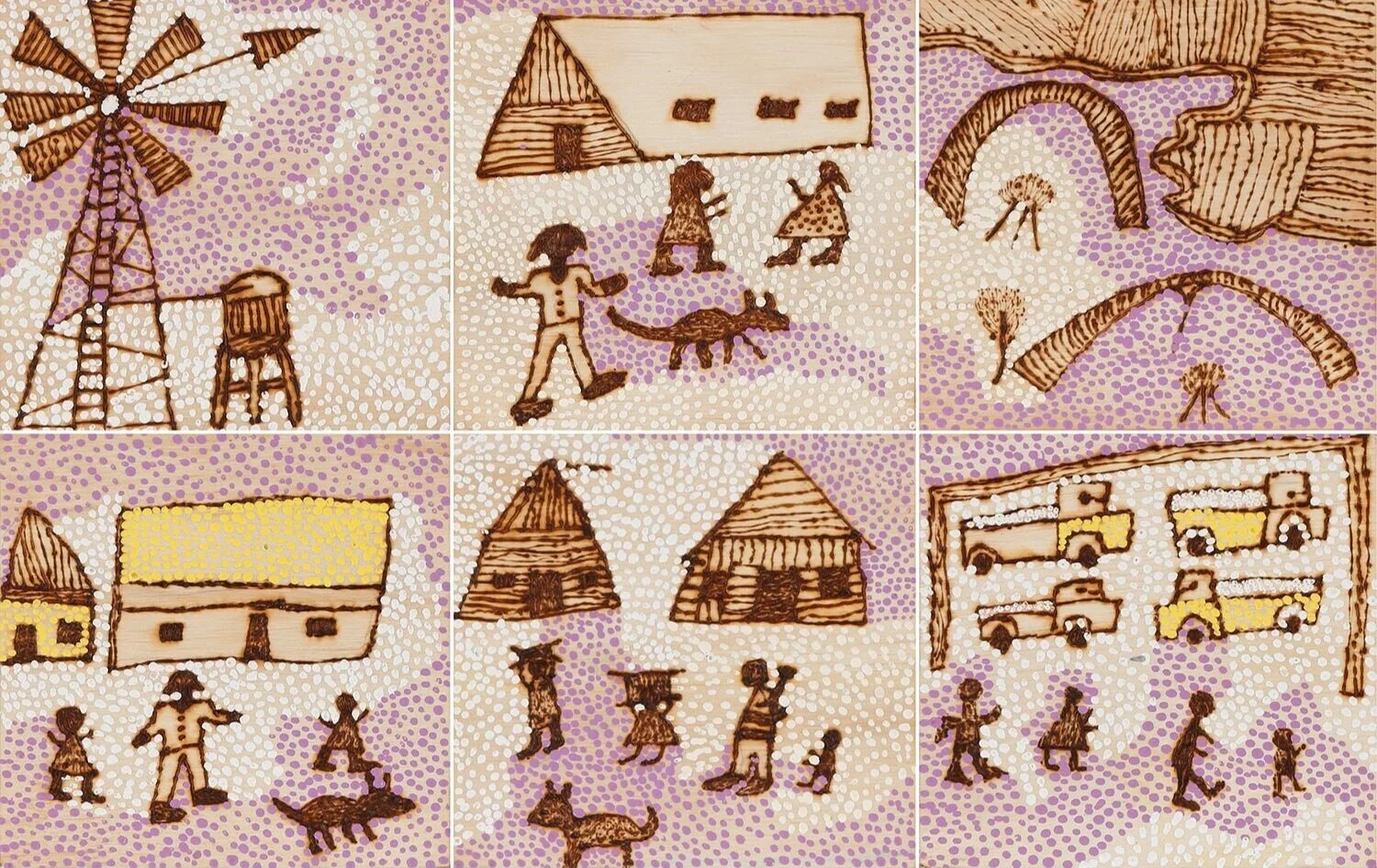
Niningka Lewis
2018, acrylic and burnt etching on plywood
15 x 15 x 6 (hexaptych)
Cat No WBS608-18
Punu – Living Wood
Maruku Arts
Niningka Lewis is an artist whose creative innovation is loved by many. Niningka resides at Mutitjulu in the Uluru-Kata Tjuta National Park and is a leading wood etcher and carver with Maruku Arts. She also works with Tjanpi Desert Weavers, sculpting and weaving native grass artefacts.
Niningka vividly remembers the initial contact of the Pitjantjatjara of this area with white Presbyterian ministers. The first community was established around a sheep station at Ernabella in the late 1930s. Coinciding with a severe drought, it drew people like Niningka and her family to settle there from hundreds of miles to the west where the conditions were extreme. Support was given to Anangu with provisions and employment, and also to retain their language and local culture. For most of Niningka's upbringing she lived a life alternating between traditional bush living and adapting to the new conditions and all the changes they brought.
– MARUKU ARTS

Robert Woods
2018, wooden carving
77 x 10 x 5 cm
Cat No C015M9-18
» ENQUIRE
Punu – Living Wood
Maruku Arts