
Witamin
17 aug
IN ASSOCIATION WITH SPINIFEX ARTS PROJECT
19 Conacher Street
The Gardens
Phone +61 8 8981 6616
OPENING HOURS
Mon to Sat 10 am – 4 pm
Sun 10 am – 2 pm

“Myrtle Pennington compels you to explore, to delve deep and try to find the questions to the answers her paintings have already given you. As you fall infinitely into the entire composition, you rightly want an explanation for what is happening to you. I say, love the challenge. ”
Let’s begin with a landscape that encompasses the very fabric of your existence, as both are intimately woven into that which you see. Your history, from birth until now, is full of spiritual meaning, obligated by, and to the site upon which you were born. The stories you have been told since birth are fact and you are surrounded by them and shown examples in the natural world. Shown where the first beings mapped out the lore by which you live. You are led along lines you cannot see but know where they begin and end. You learn the mapped songs of Creation and dance from an early age. Your religion is everywhere.
You grow up on nutrient dense, small daily harvests with the occasional feast of fresh game. Your family move constantly between sites to find sustenance. You keep walking and learn to read from the red sand before you. You know the movement of the seasons in an endless sky and where to find water. And you know fire intimately.
You learn the scent of sorcerers in the night; the ones who move in the shadows and create havoc. These are the beings from other dimensions, who can throw sickness inside you, who can move without trace. And then there are those that still reside, in the water courses, the rockholes … those that can travel underground, the metamorphic shape shifters that must be avoided or if not, appeased in ritual before approach. You learn that the landscape breathes.
You attend ceremonial gatherings and meet your extended families and others. You learn the kinship rules at a young age and where you can marry. And when you do marry, you move separately into the world to begin the cycle again. You have two children and from birth begin teaching them all that you have learnt. Your family traverse monumental terrain in an arid climate. But sometime in the mid-century your world is upended by the destructive forces of another people.
The land that you breath within is being poisoned and you see and hear the thunderous clouds of contagion spreading your way. You take your family west away from the toxic violation that is being perpetrated by others. As you move you see the country is empty, your kin have gone and you know not where. You cannot drink from the water sources as the dead fauna indicate. You keep walking. You need family. Others.
You are delirious and distraught when found by Australian Servicemen patrolling the area for the British and Australian governments. Your husband and one child have not survived and have perished nearby. You are taken over eight hundred kilometres southwest, to a Mission where you find others with a similar story. You are given a new name and are not permitted to return to the land that is your home. You are the dispossessed.
Your spiritual way of existence is not extinguished and after thirty long years of watching another way of life take its toll on your people, you are reunited with the place of your birth. You and your people finally achieve recognition in an abstract court of law, for a land that was never ceded. At last you can breathe again. You are Witamin.
– BRIAN HALLETT, Spinifex Arts Project
IMAGE: Myrtle Pennington, Kanpa, (detail) 2019, Cat No 18-133, photograph by Fiona Morrison
Paintings
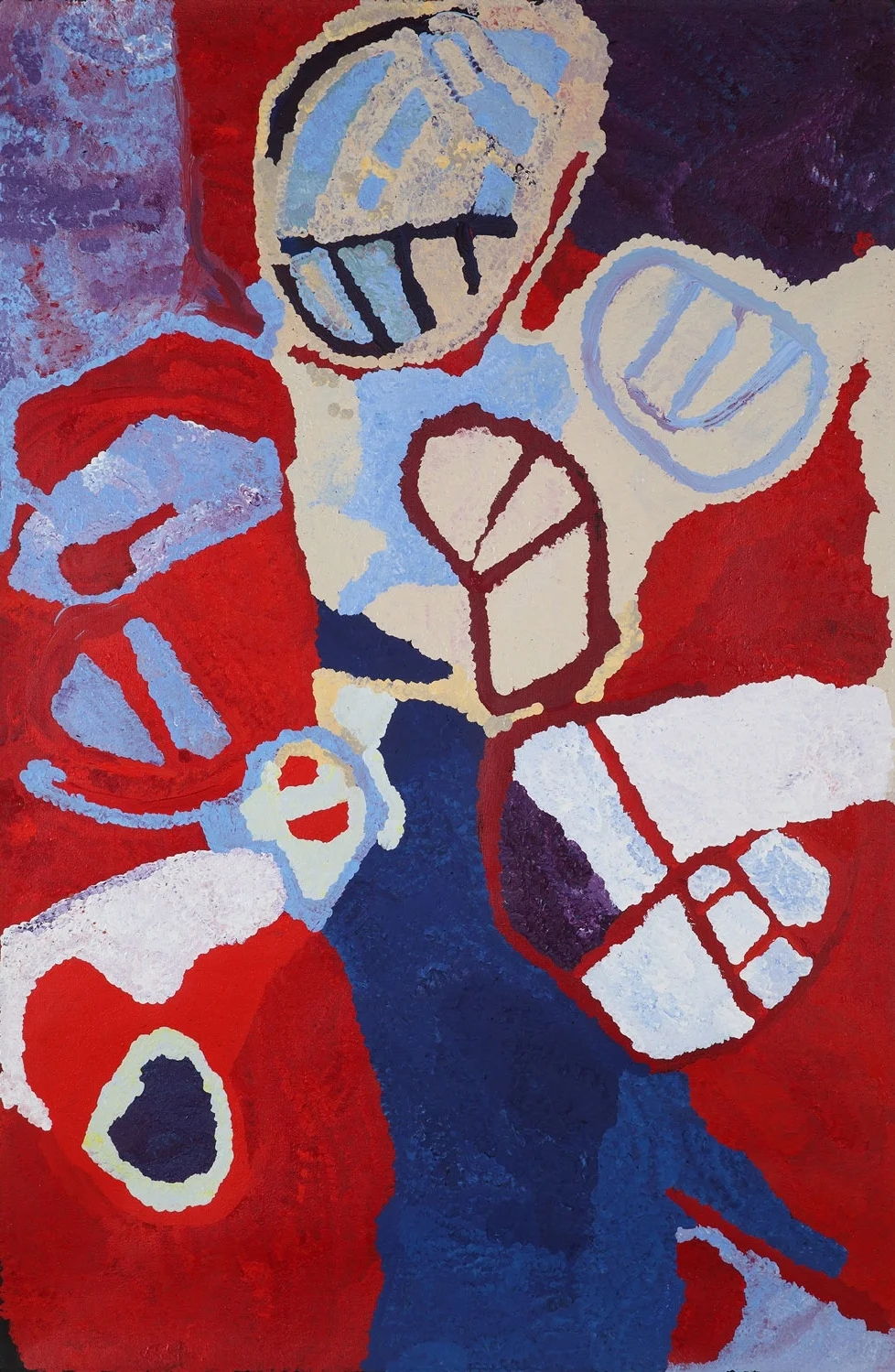
Myrtle Pennington
2018, acrylic on linen
137 x 90 cm
Cat No. 18-94
Witamin
Myrtle Pennington
The Spinifex People inhabited the Great Victoria Desert long before Europeans landed on this continent’s shoreline. They survived in an arid but beautiful environment, equipped with the necessary skills required for such a life. A spiritual people guided by cultural law were able to exist virtually unchallenged and unchanged until the 1950’s when the British atomic testing began at Emu Fields and later at Maralinga. These tests directly displaced the Spinifex People and it would be over thirty years before their traditional lands were finally returned to them in the form of native title and they were able to once again access the country that formed them from birth. For the landscape holds the culture of the Spinifex People and their daily interactions are governed by the moral compass of the first beings who created the physical realm. With story interwoven in song and dance, the country maps a tangible way forward for the people to reflect and learn upon.
It is this country, this spiritual landscape that defines and permeates Myrtle Pennington’s work. Although abstract in appearance each piece holds part history, part ceremony and part country. Myrtle assumes the vastness of the landscape imbued with the colourful light in profound yet simple compositions. She recalls the places that sustained her during those early formative years and gives rise to the sites of Mulpulya and Kanpa, surrounding them with sandhills and salt lakes or plains that lead to rocky escarpments. She reads the scene from a sense of belonging, of being interwoven into the fabric of the landscape she creates. All this Myrtle captures and colour freely, building a textural quality that prompts one to walk with her through this vast Country.
– SPINIFEX ARTS PROJECT
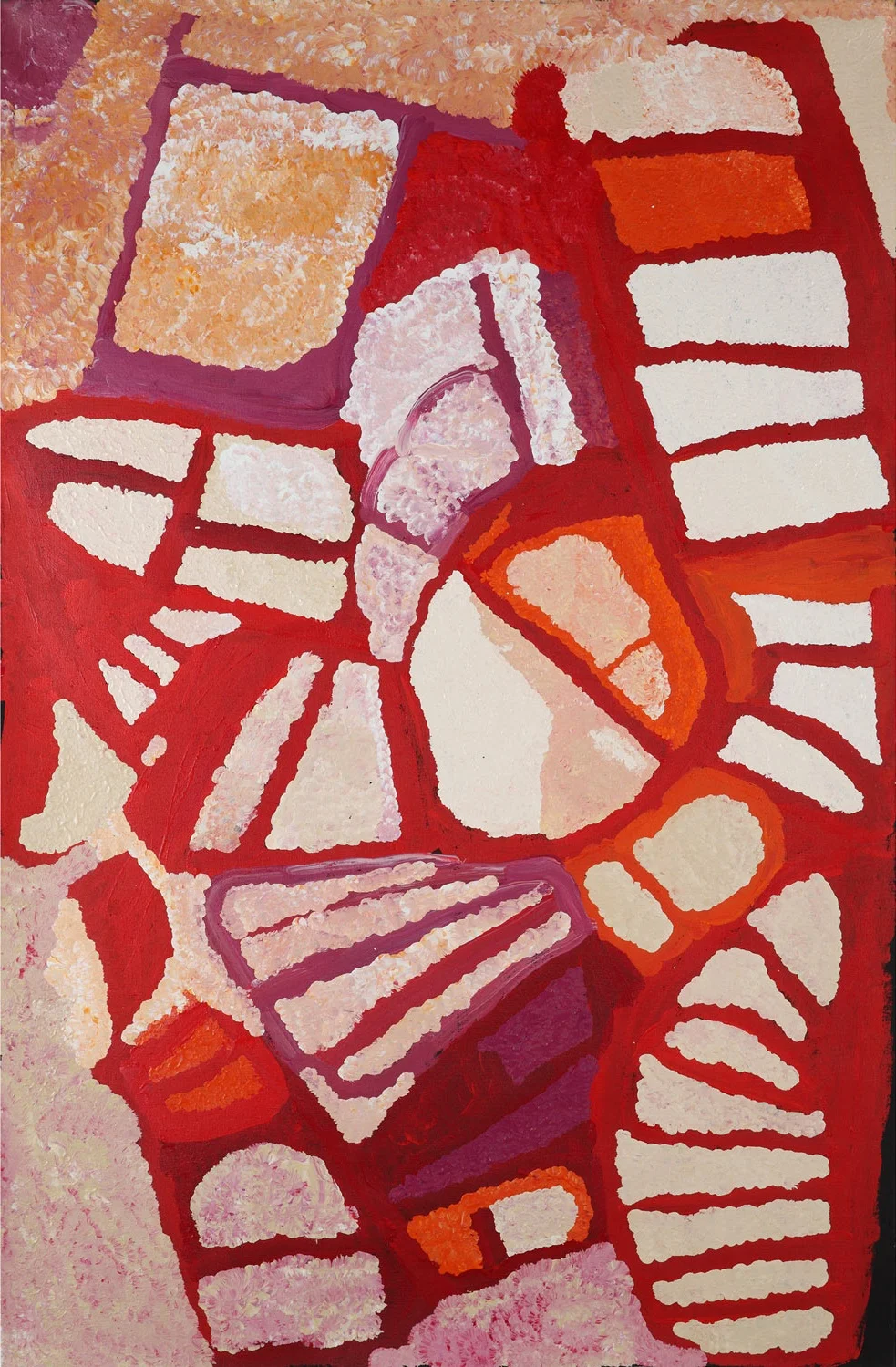
Myrtle Pennington
2018, acrylic on linen
137 x 90 cm
Cat No. 18-133
Witamin
Myrtle Pennington
The Spinifex People inhabited the Great Victoria Desert long before Europeans landed on this continent’s shoreline. They survived in an arid but beautiful environment, equipped with the necessary skills required for such a life. A spiritual people guided by cultural law were able to exist virtually unchallenged and unchanged until the 1950’s when the British atomic testing began at Emu Fields and later at Maralinga. These tests directly displaced the Spinifex People and it would be over thirty years before their traditional lands were finally returned to them in the form of native title and they were able to once again access the country that formed them from birth. For the landscape holds the culture of the Spinifex People and their daily interactions are governed by the moral compass of the first beings who created the physical realm. With story interwoven in song and dance, the country maps a tangible way forward for the people to reflect and learn upon.
It is this country, this spiritual landscape that defines and permeates Myrtle Pennington’s work. Although abstract in appearance each piece holds part history, part ceremony and part country. Myrtle assumes the vastness of the landscape imbued with the colourful light in profound yet simple compositions. She recalls the places that sustained her during those early formative years and gives rise to the sites of Mulpulya and Kanpa, surrounding them with sandhills and salt lakes or plains that lead to rocky escarpments. She reads the scene from a sense of belonging, of being interwoven into the fabric of the landscape she creates. All this Myrtle captures and colour freely, building a textural quality that prompts one to walk with her through this vast Country.
– SPINIFEX ARTS PROJECT

Myrtle Pennington
2019, acrylic on linen
137 x 90 cm
Cat No. 19-30
Witamin
Myrtle Pennington
The Spinifex People inhabited the Great Victoria Desert long before Europeans landed on this continent’s shoreline. They survived in an arid but beautiful environment, equipped with the necessary skills required for such a life. A spiritual people guided by cultural law were able to exist virtually unchallenged and unchanged until the 1950’s when the British atomic testing began at Emu Fields and later at Maralinga. These tests directly displaced the Spinifex People and it would be over thirty years before their traditional lands were finally returned to them in the form of native title and they were able to once again access the country that formed them from birth. For the landscape holds the culture of the Spinifex People and their daily interactions are governed by the moral compass of the first beings who created the physical realm. With story interwoven in song and dance, the country maps a tangible way forward for the people to reflect and learn upon.
It is this country, this spiritual landscape that defines and permeates Myrtle Pennington’s work. Although abstract in appearance each piece holds part history, part ceremony and part country. Myrtle assumes the vastness of the landscape imbued with the colourful light in profound yet simple compositions. She recalls the places that sustained her during those early formative years and gives rise to the sites of Mulpulya and Kanpa, surrounding them with sandhills and salt lakes or plains that lead to rocky escarpments. She reads the scene from a sense of belonging, of being interwoven into the fabric of the landscape she creates. All this Myrtle captures and colour freely, building a textural quality that prompts one to walk with her through this vast Country.
– SPINIFEX ARTS PROJECT
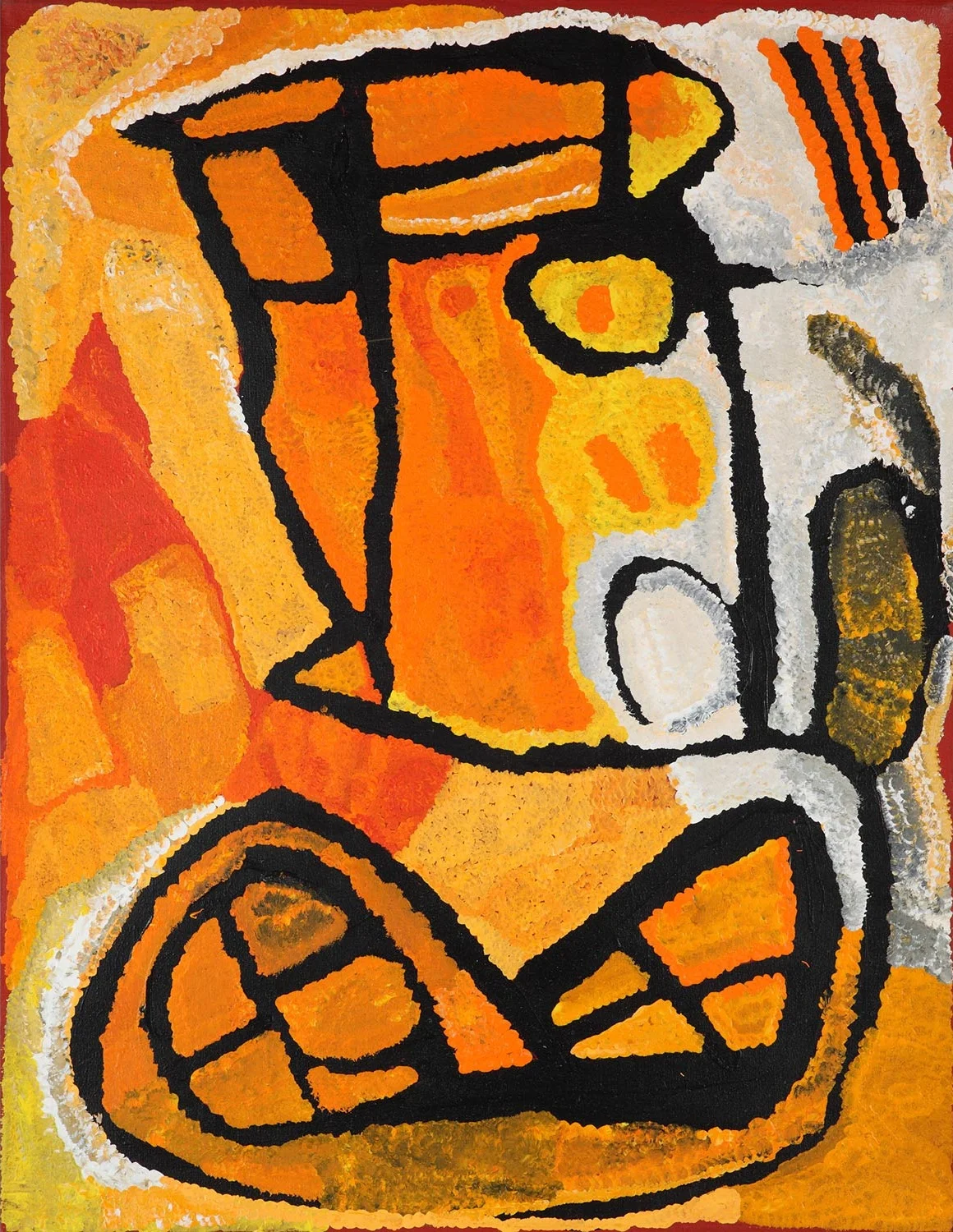
Myrtle Pennington
2019, acrylic on linen
110 x 85 cm
Cat No. 19-129
Witamin
Myrtle Pennington
The Spinifex People inhabited the Great Victoria Desert long before Europeans landed on this continent’s shoreline. They survived in an arid but beautiful environment, equipped with the necessary skills required for such a life. A spiritual people guided by cultural law were able to exist virtually unchallenged and unchanged until the 1950’s when the British atomic testing began at Emu Fields and later at Maralinga. These tests directly displaced the Spinifex People and it would be over thirty years before their traditional lands were finally returned to them in the form of native title and they were able to once again access the country that formed them from birth. For the landscape holds the culture of the Spinifex People and their daily interactions are governed by the moral compass of the first beings who created the physical realm. With story interwoven in song and dance, the country maps a tangible way forward for the people to reflect and learn upon.
It is this country, this spiritual landscape that defines and permeates Myrtle Pennington’s work. Although abstract in appearance each piece holds part history, part ceremony and part country. Myrtle assumes the vastness of the landscape imbued with the colourful light in profound yet simple compositions. She recalls the places that sustained her during those early formative years and gives rise to the sites of Mulpulya and Kanpa, surrounding them with sandhills and salt lakes or plains that lead to rocky escarpments. She reads the scene from a sense of belonging, of being interwoven into the fabric of the landscape she creates. All this Myrtle captures and colour freely, building a textural quality that prompts one to walk with her through this vast Country.
– SPINIFEX ARTS PROJECT

Myrtle Pennington
2019, acrylic on linen
110 x 85 cm
Cat No. 19-130
Witamin
Myrtle Pennington
The Spinifex People inhabited the Great Victoria Desert long before Europeans landed on this continent’s shoreline. They survived in an arid but beautiful environment, equipped with the necessary skills required for such a life. A spiritual people guided by cultural law were able to exist virtually unchallenged and unchanged until the 1950’s when the British atomic testing began at Emu Fields and later at Maralinga. These tests directly displaced the Spinifex People and it would be over thirty years before their traditional lands were finally returned to them in the form of native title and they were able to once again access the country that formed them from birth. For the landscape holds the culture of the Spinifex People and their daily interactions are governed by the moral compass of the first beings who created the physical realm. With story interwoven in song and dance, the country maps a tangible way forward for the people to reflect and learn upon.
It is this country, this spiritual landscape that defines and permeates Myrtle Pennington’s work. Although abstract in appearance each piece holds part history, part ceremony and part country. Myrtle assumes the vastness of the landscape imbued with the colourful light in profound yet simple compositions. She recalls the places that sustained her during those early formative years and gives rise to the sites of Mulpulya and Kanpa, surrounding them with sandhills and salt lakes or plains that lead to rocky escarpments. She reads the scene from a sense of belonging, of being interwoven into the fabric of the landscape she creates. All this Myrtle captures and colour freely, building a textural quality that prompts one to walk with her through this vast Country.
– SPINIFEX ARTS PROJECT

Myrtle Pennington
2019, acrylic on linen
110 x 85 cm
Cat No. 19-131
Witamin
Myrtle Pennington
The Spinifex People inhabited the Great Victoria Desert long before Europeans landed on this continent’s shoreline. They survived in an arid but beautiful environment, equipped with the necessary skills required for such a life. A spiritual people guided by cultural law were able to exist virtually unchallenged and unchanged until the 1950’s when the British atomic testing began at Emu Fields and later at Maralinga. These tests directly displaced the Spinifex People and it would be over thirty years before their traditional lands were finally returned to them in the form of native title and they were able to once again access the country that formed them from birth. For the landscape holds the culture of the Spinifex People and their daily interactions are governed by the moral compass of the first beings who created the physical realm. With story interwoven in song and dance, the country maps a tangible way forward for the people to reflect and learn upon.
It is this country, this spiritual landscape that defines and permeates Myrtle Pennington’s work. Although abstract in appearance each piece holds part history, part ceremony and part country. Myrtle assumes the vastness of the landscape imbued with the colourful light in profound yet simple compositions. She recalls the places that sustained her during those early formative years and gives rise to the sites of Mulpulya and Kanpa, surrounding them with sandhills and salt lakes or plains that lead to rocky escarpments. She reads the scene from a sense of belonging, of being interwoven into the fabric of the landscape she creates. All this Myrtle captures and colour freely, building a textural quality that prompts one to walk with her through this vast Country.
– SPINIFEX ARTS PROJECT

Myrtle Pennington
2019, acrylic on linen
110 x 85 cm
Cat No. 19-132
Witamin
Myrtle Pennington
The Spinifex People inhabited the Great Victoria Desert long before Europeans landed on this continent’s shoreline. They survived in an arid but beautiful environment, equipped with the necessary skills required for such a life. A spiritual people guided by cultural law were able to exist virtually unchallenged and unchanged until the 1950’s when the British atomic testing began at Emu Fields and later at Maralinga. These tests directly displaced the Spinifex People and it would be over thirty years before their traditional lands were finally returned to them in the form of native title and they were able to once again access the country that formed them from birth. For the landscape holds the culture of the Spinifex People and their daily interactions are governed by the moral compass of the first beings who created the physical realm. With story interwoven in song and dance, the country maps a tangible way forward for the people to reflect and learn upon.
It is this country, this spiritual landscape that defines and permeates Myrtle Pennington’s work. Although abstract in appearance each piece holds part history, part ceremony and part country. Myrtle assumes the vastness of the landscape imbued with the colourful light in profound yet simple compositions. She recalls the places that sustained her during those early formative years and gives rise to the sites of Mulpulya and Kanpa, surrounding them with sandhills and salt lakes or plains that lead to rocky escarpments. She reads the scene from a sense of belonging, of being interwoven into the fabric of the landscape she creates. All this Myrtle captures and colour freely, building a textural quality that prompts one to walk with her through this vast Country.
– SPINIFEX ARTS PROJECT
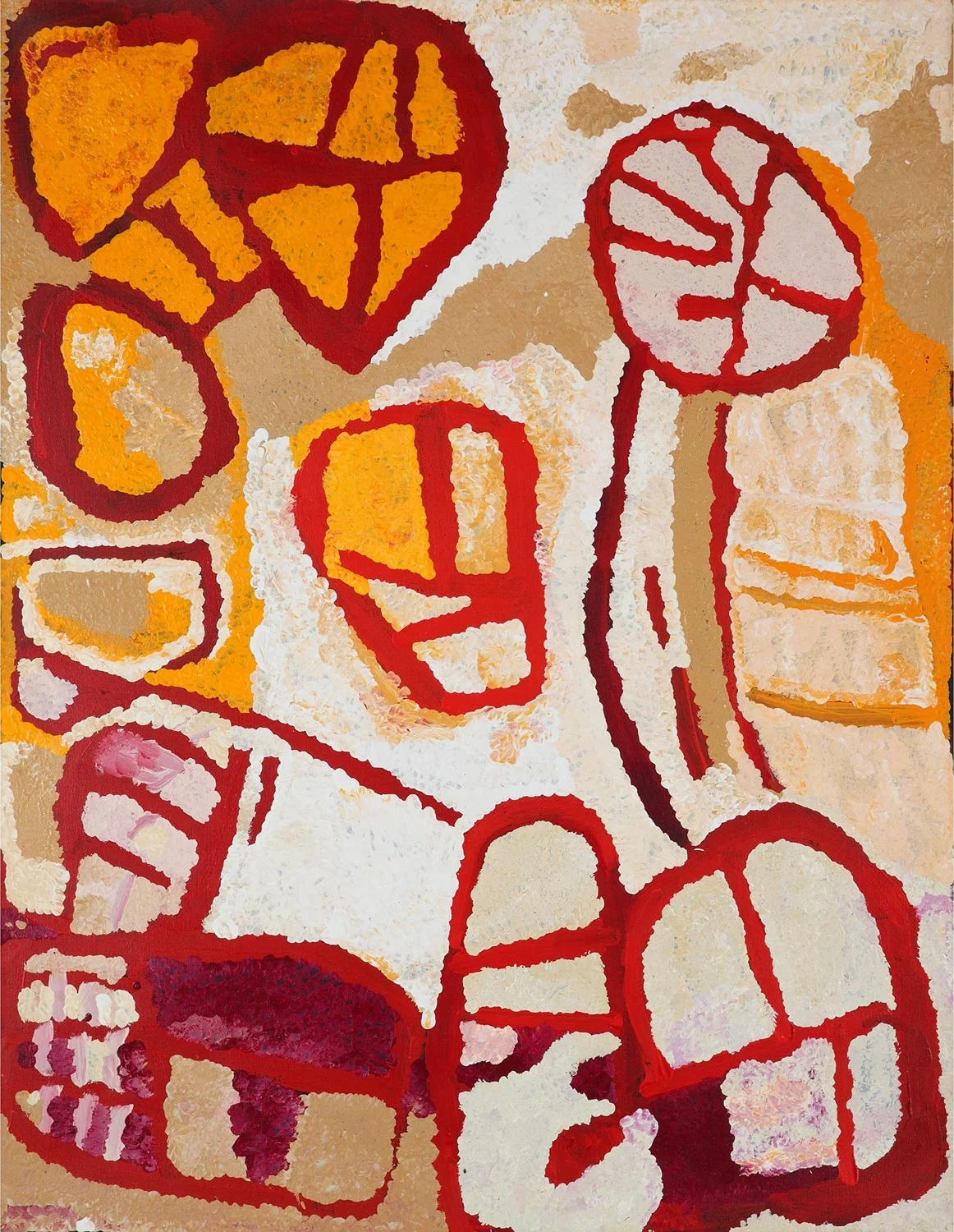
Myrtle Pennington
2019, acrylic on linen
110 x 85 cm
Cat No. 19-133
Witamin
Myrtle Pennington
The Spinifex People inhabited the Great Victoria Desert long before Europeans landed on this continent’s shoreline. They survived in an arid but beautiful environment, equipped with the necessary skills required for such a life. A spiritual people guided by cultural law were able to exist virtually unchallenged and unchanged until the 1950’s when the British atomic testing began at Emu Fields and later at Maralinga. These tests directly displaced the Spinifex People and it would be over thirty years before their traditional lands were finally returned to them in the form of native title and they were able to once again access the country that formed them from birth. For the landscape holds the culture of the Spinifex People and their daily interactions are governed by the moral compass of the first beings who created the physical realm. With story interwoven in song and dance, the country maps a tangible way forward for the people to reflect and learn upon.
It is this country, this spiritual landscape that defines and permeates Myrtle Pennington’s work. Although abstract in appearance each piece holds part history, part ceremony and part country. Myrtle assumes the vastness of the landscape imbued with the colourful light in profound yet simple compositions. She recalls the places that sustained her during those early formative years and gives rise to the sites of Mulpulya and Kanpa, surrounding them with sandhills and salt lakes or plains that lead to rocky escarpments. She reads the scene from a sense of belonging, of being interwoven into the fabric of the landscape she creates. All this Myrtle captures and colour freely, building a textural quality that prompts one to walk with her through this vast Country.
– SPINIFEX ARTS PROJECT

Myrtle Pennington
2019, acrylic on linen
110 x 85 cm
Cat No. 19-134
Witamin
Myrtle Pennington
The Spinifex People inhabited the Great Victoria Desert long before Europeans landed on this continent’s shoreline. They survived in an arid but beautiful environment, equipped with the necessary skills required for such a life. A spiritual people guided by cultural law were able to exist virtually unchallenged and unchanged until the 1950’s when the British atomic testing began at Emu Fields and later at Maralinga. These tests directly displaced the Spinifex People and it would be over thirty years before their traditional lands were finally returned to them in the form of native title and they were able to once again access the country that formed them from birth. For the landscape holds the culture of the Spinifex People and their daily interactions are governed by the moral compass of the first beings who created the physical realm. With story interwoven in song and dance, the country maps a tangible way forward for the people to reflect and learn upon.
It is this country, this spiritual landscape that defines and permeates Myrtle Pennington’s work. Although abstract in appearance each piece holds part history, part ceremony and part country. Myrtle assumes the vastness of the landscape imbued with the colourful light in profound yet simple compositions. She recalls the places that sustained her during those early formative years and gives rise to the sites of Mulpulya and Kanpa, surrounding them with sandhills and salt lakes or plains that lead to rocky escarpments. She reads the scene from a sense of belonging, of being interwoven into the fabric of the landscape she creates. All this Myrtle captures and colour freely, building a textural quality that prompts one to walk with her through this vast Country.
– SPINIFEX ARTS PROJECT
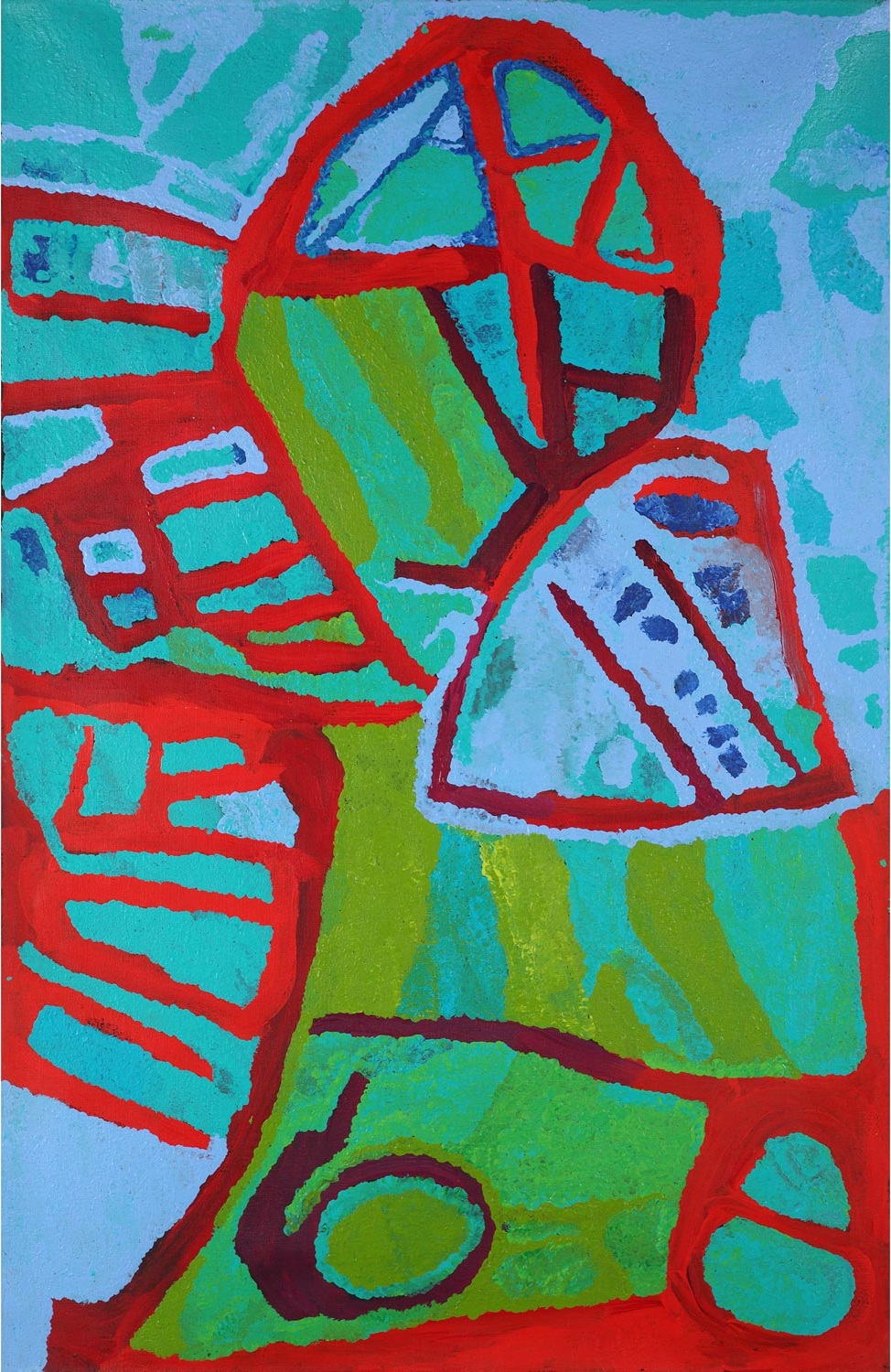
Myrtle Pennington
2019, acrylic on linen
137 x 90 cm
Cat No. 19-135
Witamin
Myrtle Pennington
The Spinifex People inhabited the Great Victoria Desert long before Europeans landed on this continent’s shoreline. They survived in an arid but beautiful environment, equipped with the necessary skills required for such a life. A spiritual people guided by cultural law were able to exist virtually unchallenged and unchanged until the 1950’s when the British atomic testing began at Emu Fields and later at Maralinga. These tests directly displaced the Spinifex People and it would be over thirty years before their traditional lands were finally returned to them in the form of native title and they were able to once again access the country that formed them from birth. For the landscape holds the culture of the Spinifex People and their daily interactions are governed by the moral compass of the first beings who created the physical realm. With story interwoven in song and dance, the country maps a tangible way forward for the people to reflect and learn upon.
It is this country, this spiritual landscape that defines and permeates Myrtle Pennington’s work. Although abstract in appearance each piece holds part history, part ceremony and part country. Myrtle assumes the vastness of the landscape imbued with the colourful light in profound yet simple compositions. She recalls the places that sustained her during those early formative years and gives rise to the sites of Mulpulya and Kanpa, surrounding them with sandhills and salt lakes or plains that lead to rocky escarpments. She reads the scene from a sense of belonging, of being interwoven into the fabric of the landscape she creates. All this Myrtle captures and colour freely, building a textural quality that prompts one to walk with her through this vast Country.
– SPINIFEX ARTS PROJECT

Myrtle Pennington
2019, acrylic on linen
137 x 90 cm
Cat No. 19-136
Witamin
Myrtle Pennington
The Spinifex People inhabited the Great Victoria Desert long before Europeans landed on this continent’s shoreline. They survived in an arid but beautiful environment, equipped with the necessary skills required for such a life. A spiritual people guided by cultural law were able to exist virtually unchallenged and unchanged until the 1950’s when the British atomic testing began at Emu Fields and later at Maralinga. These tests directly displaced the Spinifex People and it would be over thirty years before their traditional lands were finally returned to them in the form of native title and they were able to once again access the country that formed them from birth. For the landscape holds the culture of the Spinifex People and their daily interactions are governed by the moral compass of the first beings who created the physical realm. With story interwoven in song and dance, the country maps a tangible way forward for the people to reflect and learn upon.
It is this country, this spiritual landscape that defines and permeates Myrtle Pennington’s work. Although abstract in appearance each piece holds part history, part ceremony and part country. Myrtle assumes the vastness of the landscape imbued with the colourful light in profound yet simple compositions. She recalls the places that sustained her during those early formative years and gives rise to the sites of Mulpulya and Kanpa, surrounding them with sandhills and salt lakes or plains that lead to rocky escarpments. She reads the scene from a sense of belonging, of being interwoven into the fabric of the landscape she creates. All this Myrtle captures and colour freely, building a textural quality that prompts one to walk with her through this vast Country.
– SPINIFEX ARTS PROJECT

Myrtle Pennington
2019, acrylic on linen
137 x 90 cm
Cat No. 19-137
Witamin
Myrtle Pennington
The Spinifex People inhabited the Great Victoria Desert long before Europeans landed on this continent’s shoreline. They survived in an arid but beautiful environment, equipped with the necessary skills required for such a life. A spiritual people guided by cultural law were able to exist virtually unchallenged and unchanged until the 1950’s when the British atomic testing began at Emu Fields and later at Maralinga. These tests directly displaced the Spinifex People and it would be over thirty years before their traditional lands were finally returned to them in the form of native title and they were able to once again access the country that formed them from birth. For the landscape holds the culture of the Spinifex People and their daily interactions are governed by the moral compass of the first beings who created the physical realm. With story interwoven in song and dance, the country maps a tangible way forward for the people to reflect and learn upon.
It is this country, this spiritual landscape that defines and permeates Myrtle Pennington’s work. Although abstract in appearance each piece holds part history, part ceremony and part country. Myrtle assumes the vastness of the landscape imbued with the colourful light in profound yet simple compositions. She recalls the places that sustained her during those early formative years and gives rise to the sites of Mulpulya and Kanpa, surrounding them with sandhills and salt lakes or plains that lead to rocky escarpments. She reads the scene from a sense of belonging, of being interwoven into the fabric of the landscape she creates. All this Myrtle captures and colour freely, building a textural quality that prompts one to walk with her through this vast Country.
– SPINIFEX ARTS PROJECT

Myrtle Pennington
2019, acrylic on linen
137 x 90 cm
Cat No. 19-138
Witamin
Myrtle Pennington
The Spinifex People inhabited the Great Victoria Desert long before Europeans landed on this continent’s shoreline. They survived in an arid but beautiful environment, equipped with the necessary skills required for such a life. A spiritual people guided by cultural law were able to exist virtually unchallenged and unchanged until the 1950’s when the British atomic testing began at Emu Fields and later at Maralinga. These tests directly displaced the Spinifex People and it would be over thirty years before their traditional lands were finally returned to them in the form of native title and they were able to once again access the country that formed them from birth. For the landscape holds the culture of the Spinifex People and their daily interactions are governed by the moral compass of the first beings who created the physical realm. With story interwoven in song and dance, the country maps a tangible way forward for the people to reflect and learn upon.
It is this country, this spiritual landscape that defines and permeates Myrtle Pennington’s work. Although abstract in appearance each piece holds part history, part ceremony and part country. Myrtle assumes the vastness of the landscape imbued with the colourful light in profound yet simple compositions. She recalls the places that sustained her during those early formative years and gives rise to the sites of Mulpulya and Kanpa, surrounding them with sandhills and salt lakes or plains that lead to rocky escarpments. She reads the scene from a sense of belonging, of being interwoven into the fabric of the landscape she creates. All this Myrtle captures and colour freely, building a textural quality that prompts one to walk with her through this vast Country.
– SPINIFEX ARTS PROJECT

Myrtle Pennington
2019, acrylic on linen
60 x 75 cm
Cat No. 19-152
Witamin
Myrtle Pennington
The Spinifex People inhabited the Great Victoria Desert long before Europeans landed on this continent’s shoreline. They survived in an arid but beautiful environment, equipped with the necessary skills required for such a life. A spiritual people guided by cultural law were able to exist virtually unchallenged and unchanged until the 1950’s when the British atomic testing began at Emu Fields and later at Maralinga. These tests directly displaced the Spinifex People and it would be over thirty years before their traditional lands were finally returned to them in the form of native title and they were able to once again access the country that formed them from birth. For the landscape holds the culture of the Spinifex People and their daily interactions are governed by the moral compass of the first beings who created the physical realm. With story interwoven in song and dance, the country maps a tangible way forward for the people to reflect and learn upon.
It is this country, this spiritual landscape that defines and permeates Myrtle Pennington’s work. Although abstract in appearance each piece holds part history, part ceremony and part country. Myrtle assumes the vastness of the landscape imbued with the colourful light in profound yet simple compositions. She recalls the places that sustained her during those early formative years and gives rise to the sites of Mulpulya and Kanpa, surrounding them with sandhills and salt lakes or plains that lead to rocky escarpments. She reads the scene from a sense of belonging, of being interwoven into the fabric of the landscape she creates. All this Myrtle captures and colour freely, building a textural quality that prompts one to walk with her through this vast Country.
– SPINIFEX ARTS PROJECT

Myrtle Pennington
2019, acrylic on linen
182 x 75 cm
Cat No. 19-150
Witamin
Myrtle Pennington
The Spinifex People inhabited the Great Victoria Desert long before Europeans landed on this continent’s shoreline. They survived in an arid but beautiful environment, equipped with the necessary skills required for such a life. A spiritual people guided by cultural law were able to exist virtually unchallenged and unchanged until the 1950’s when the British atomic testing began at Emu Fields and later at Maralinga. These tests directly displaced the Spinifex People and it would be over thirty years before their traditional lands were finally returned to them in the form of native title and they were able to once again access the country that formed them from birth. For the landscape holds the culture of the Spinifex People and their daily interactions are governed by the moral compass of the first beings who created the physical realm. With story interwoven in song and dance, the country maps a tangible way forward for the people to reflect and learn upon.
It is this country, this spiritual landscape that defines and permeates Myrtle Pennington’s work. Although abstract in appearance each piece holds part history, part ceremony and part country. Myrtle assumes the vastness of the landscape imbued with the colourful light in profound yet simple compositions. She recalls the places that sustained her during those early formative years and gives rise to the sites of Mulpulya and Kanpa, surrounding them with sandhills and salt lakes or plains that lead to rocky escarpments. She reads the scene from a sense of belonging, of being interwoven into the fabric of the landscape she creates. All this Myrtle captures and colour freely, building a textural quality that prompts one to walk with her through this vast Country.
– SPINIFEX ARTS PROJECT
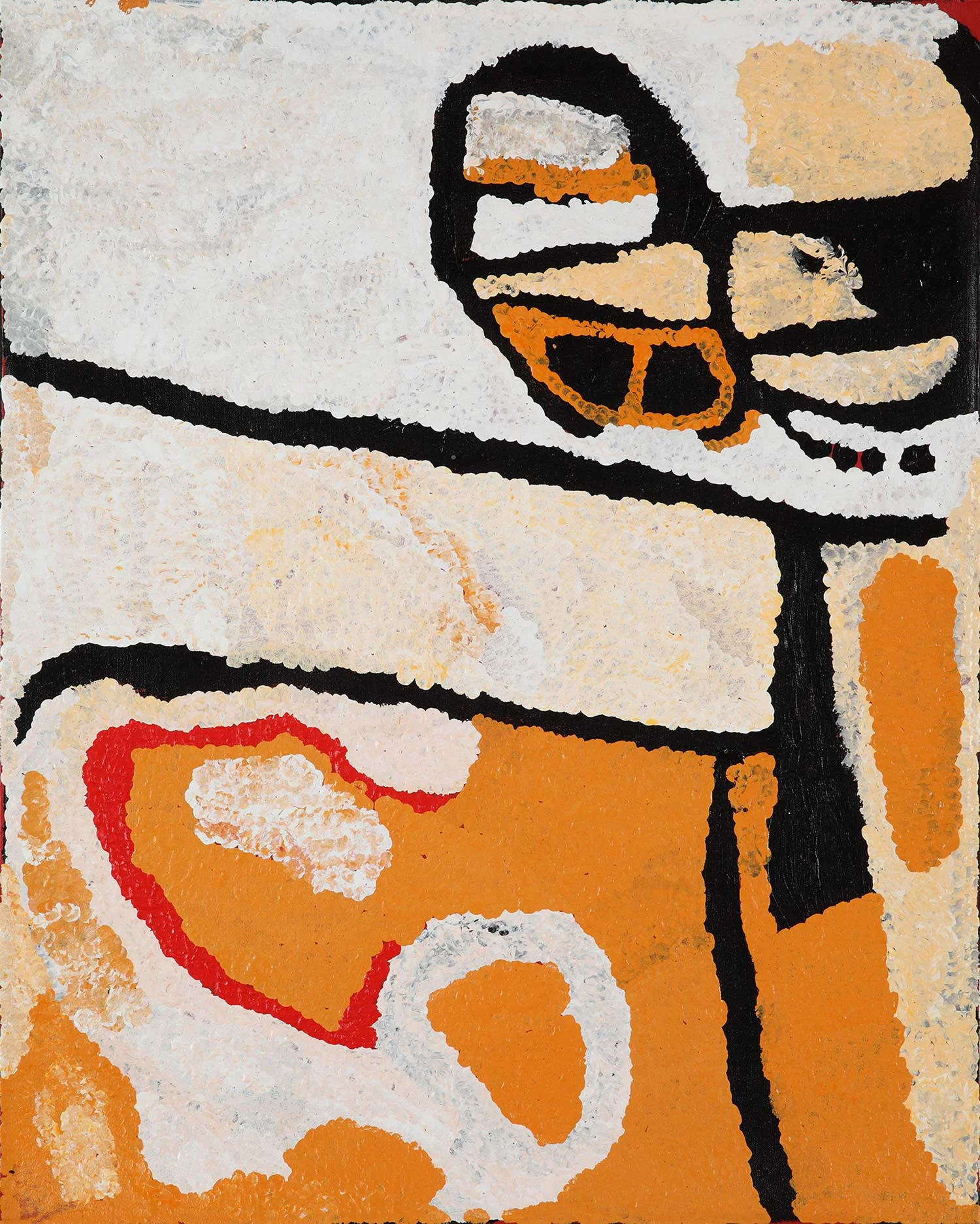
Myrtle Pennington
2019, acrylic on linen
182 x 75 cm
Cat No. 19-153
Witamin
Myrtle Pennington
The Spinifex People inhabited the Great Victoria Desert long before Europeans landed on this continent’s shoreline. They survived in an arid but beautiful environment, equipped with the necessary skills required for such a life. A spiritual people guided by cultural law were able to exist virtually unchallenged and unchanged until the 1950’s when the British atomic testing began at Emu Fields and later at Maralinga. These tests directly displaced the Spinifex People and it would be over thirty years before their traditional lands were finally returned to them in the form of native title and they were able to once again access the country that formed them from birth. For the landscape holds the culture of the Spinifex People and their daily interactions are governed by the moral compass of the first beings who created the physical realm. With story interwoven in song and dance, the country maps a tangible way forward for the people to reflect and learn upon.
It is this country, this spiritual landscape that defines and permeates Myrtle Pennington’s work. Although abstract in appearance each piece holds part history, part ceremony and part country. Myrtle assumes the vastness of the landscape imbued with the colourful light in profound yet simple compositions. She recalls the places that sustained her during those early formative years and gives rise to the sites of Mulpulya and Kanpa, surrounding them with sandhills and salt lakes or plains that lead to rocky escarpments. She reads the scene from a sense of belonging, of being interwoven into the fabric of the landscape she creates. All this Myrtle captures and colour freely, building a textural quality that prompts one to walk with her through this vast Country.
– SPINIFEX ARTS PROJECT

Myrtle Pennington
2019, acrylic on linen
137 x 90 cm
Cat No. 19-156
Witamin
Myrtle Pennington
The Spinifex People inhabited the Great Victoria Desert long before Europeans landed on this continent’s shoreline. They survived in an arid but beautiful environment, equipped with the necessary skills required for such a life. A spiritual people guided by cultural law were able to exist virtually unchallenged and unchanged until the 1950’s when the British atomic testing began at Emu Fields and later at Maralinga. These tests directly displaced the Spinifex People and it would be over thirty years before their traditional lands were finally returned to them in the form of native title and they were able to once again access the country that formed them from birth. For the landscape holds the culture of the Spinifex People and their daily interactions are governed by the moral compass of the first beings who created the physical realm. With story interwoven in song and dance, the country maps a tangible way forward for the people to reflect and learn upon.
It is this country, this spiritual landscape that defines and permeates Myrtle Pennington’s work. Although abstract in appearance each piece holds part history, part ceremony and part country. Myrtle assumes the vastness of the landscape imbued with the colourful light in profound yet simple compositions. She recalls the places that sustained her during those early formative years and gives rise to the sites of Mulpulya and Kanpa, surrounding them with sandhills and salt lakes or plains that lead to rocky escarpments. She reads the scene from a sense of belonging, of being interwoven into the fabric of the landscape she creates. All this Myrtle captures and colour freely, building a textural quality that prompts one to walk with her through this vast Country.
– SPINIFEX ARTS PROJECT

Myrtle Pennington
2019, acrylic on linen
110 x 85 cm
Cat No. 19-157
Witamin
Myrtle Pennington
The Spinifex People inhabited the Great Victoria Desert long before Europeans landed on this continent’s shoreline. They survived in an arid but beautiful environment, equipped with the necessary skills required for such a life. A spiritual people guided by cultural law were able to exist virtually unchallenged and unchanged until the 1950’s when the British atomic testing began at Emu Fields and later at Maralinga. These tests directly displaced the Spinifex People and it would be over thirty years before their traditional lands were finally returned to them in the form of native title and they were able to once again access the country that formed them from birth. For the landscape holds the culture of the Spinifex People and their daily interactions are governed by the moral compass of the first beings who created the physical realm. With story interwoven in song and dance, the country maps a tangible way forward for the people to reflect and learn upon.
It is this country, this spiritual landscape that defines and permeates Myrtle Pennington’s work. Although abstract in appearance each piece holds part history, part ceremony and part country. Myrtle assumes the vastness of the landscape imbued with the colourful light in profound yet simple compositions. She recalls the places that sustained her during those early formative years and gives rise to the sites of Mulpulya and Kanpa, surrounding them with sandhills and salt lakes or plains that lead to rocky escarpments. She reads the scene from a sense of belonging, of being interwoven into the fabric of the landscape she creates. All this Myrtle captures and colour freely, building a textural quality that prompts one to walk with her through this vast Country.
– SPINIFEX ARTS PROJECT
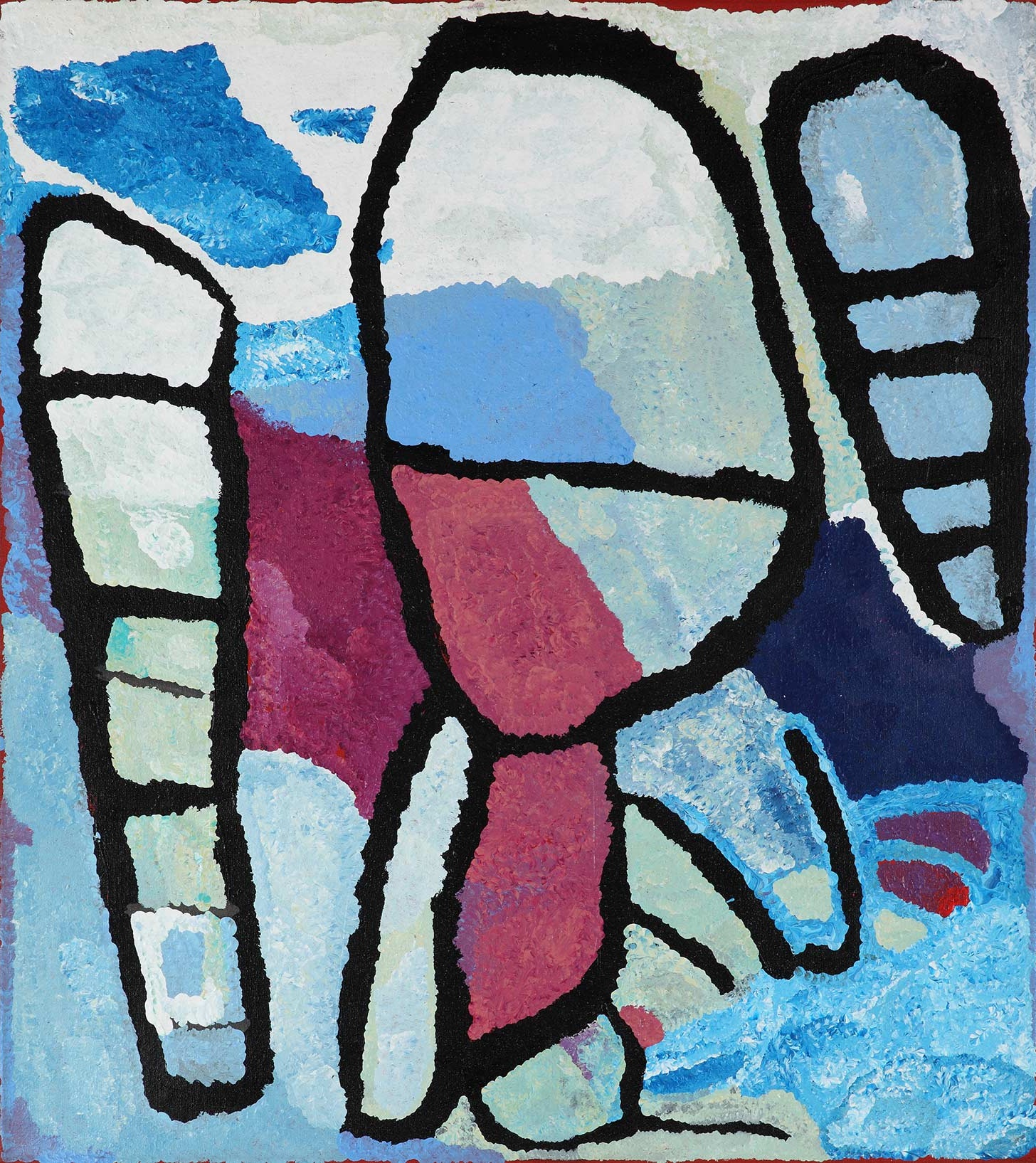
Myrtle Pennington
2019, acrylic on linen
95 x 85 cm
Cat No. 19-188
Witamin
Myrtle Pennington
The Spinifex People inhabited the Great Victoria Desert long before Europeans landed on this continent’s shoreline. They survived in an arid but beautiful environment, equipped with the necessary skills required for such a life. A spiritual people guided by cultural law were able to exist virtually unchallenged and unchanged until the 1950’s when the British atomic testing began at Emu Fields and later at Maralinga. These tests directly displaced the Spinifex People and it would be over thirty years before their traditional lands were finally returned to them in the form of native title and they were able to once again access the country that formed them from birth. For the landscape holds the culture of the Spinifex People and their daily interactions are governed by the moral compass of the first beings who created the physical realm. With story interwoven in song and dance, the country maps a tangible way forward for the people to reflect and learn upon.
It is this country, this spiritual landscape that defines and permeates Myrtle Pennington’s work. Although abstract in appearance each piece holds part history, part ceremony and part country. Myrtle assumes the vastness of the landscape imbued with the colourful light in profound yet simple compositions. She recalls the places that sustained her during those early formative years and gives rise to the sites of Mulpulya and Kanpa, surrounding them with sandhills and salt lakes or plains that lead to rocky escarpments. She reads the scene from a sense of belonging, of being interwoven into the fabric of the landscape she creates. All this Myrtle captures and colour freely, building a textural quality that prompts one to walk with her through this vast Country.
– SPINIFEX ARTS PROJECT
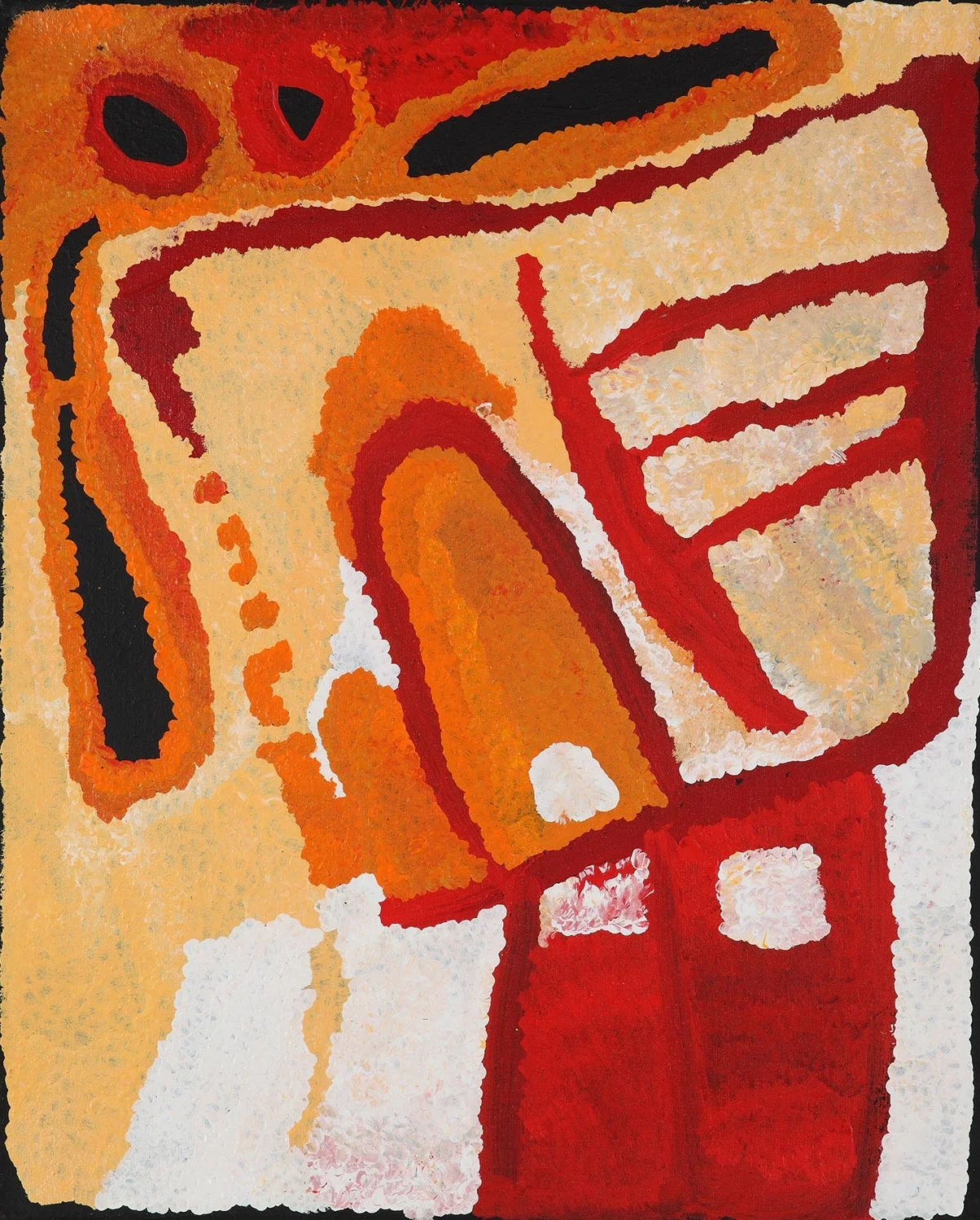
Myrtle Pennington
2019, acrylic on linen
60 x 75 cm
Cat No. 19-159
Witamin
Myrtle Pennington
The Spinifex People inhabited the Great Victoria Desert long before Europeans landed on this continent’s shoreline. They survived in an arid but beautiful environment, equipped with the necessary skills required for such a life. A spiritual people guided by cultural law were able to exist virtually unchallenged and unchanged until the 1950’s when the British atomic testing began at Emu Fields and later at Maralinga. These tests directly displaced the Spinifex People and it would be over thirty years before their traditional lands were finally returned to them in the form of native title and they were able to once again access the country that formed them from birth. For the landscape holds the culture of the Spinifex People and their daily interactions are governed by the moral compass of the first beings who created the physical realm. With story interwoven in song and dance, the country maps a tangible way forward for the people to reflect and learn upon.
It is this country, this spiritual landscape that defines and permeates Myrtle Pennington’s work. Although abstract in appearance each piece holds part history, part ceremony and part country. Myrtle assumes the vastness of the landscape imbued with the colourful light in profound yet simple compositions. She recalls the places that sustained her during those early formative years and gives rise to the sites of Mulpulya and Kanpa, surrounding them with sandhills and salt lakes or plains that lead to rocky escarpments. She reads the scene from a sense of belonging, of being interwoven into the fabric of the landscape she creates. All this Myrtle captures and colour freely, building a textural quality that prompts one to walk with her through this vast Country.
– SPINIFEX ARTS PROJECT
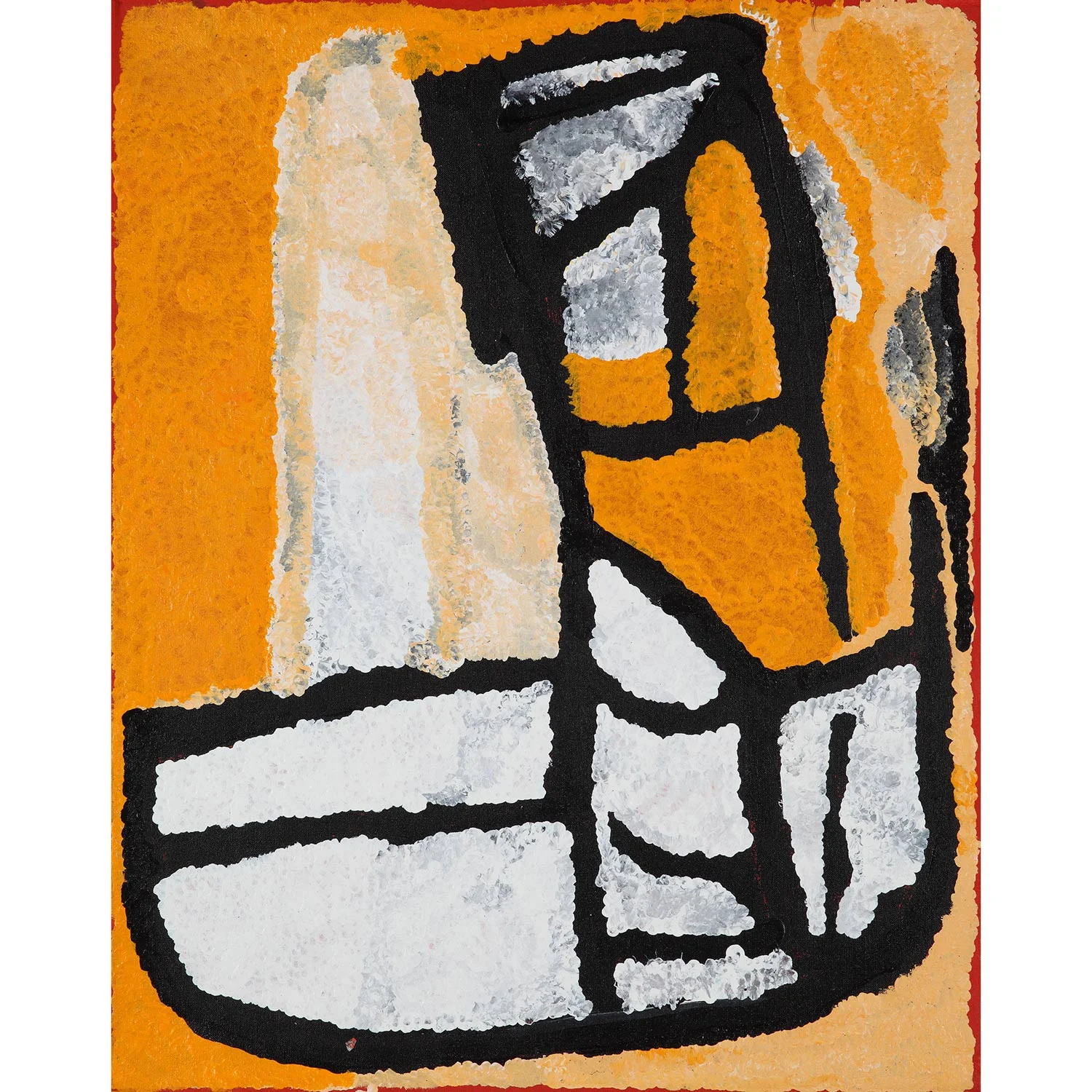
Myrtle Pennington
2019, acrylic on linen
60 x 75 cm
Cat No. 19-189
Witamin
Myrtle Pennington
The Spinifex People inhabited the Great Victoria Desert long before Europeans landed on this continent’s shoreline. They survived in an arid but beautiful environment, equipped with the necessary skills required for such a life. A spiritual people guided by cultural law were able to exist virtually unchallenged and unchanged until the 1950’s when the British atomic testing began at Emu Fields and later at Maralinga. These tests directly displaced the Spinifex People and it would be over thirty years before their traditional lands were finally returned to them in the form of native title and they were able to once again access the country that formed them from birth. For the landscape holds the culture of the Spinifex People and their daily interactions are governed by the moral compass of the first beings who created the physical realm. With story interwoven in song and dance, the country maps a tangible way forward for the people to reflect and learn upon.
It is this country, this spiritual landscape that defines and permeates Myrtle Pennington’s work. Although abstract in appearance each piece holds part history, part ceremony and part country. Myrtle assumes the vastness of the landscape imbued with the colourful light in profound yet simple compositions. She recalls the places that sustained her during those early formative years and gives rise to the sites of Mulpulya and Kanpa, surrounding them with sandhills and salt lakes or plains that lead to rocky escarpments. She reads the scene from a sense of belonging, of being interwoven into the fabric of the landscape she creates. All this Myrtle captures and colour freely, building a textural quality that prompts one to walk with her through this vast Country.
– SPINIFEX ARTS PROJECT

Myrtle Pennington
2019, acrylic on linen
137 x 90 cm
Cat No. 19-179
Witamin
Myrtle Pennington
The Spinifex People inhabited the Great Victoria Desert long before Europeans landed on this continent’s shoreline. They survived in an arid but beautiful environment, equipped with the necessary skills required for such a life. A spiritual people guided by cultural law were able to exist virtually unchallenged and unchanged until the 1950’s when the British atomic testing began at Emu Fields and later at Maralinga. These tests directly displaced the Spinifex People and it would be over thirty years before their traditional lands were finally returned to them in the form of native title and they were able to once again access the country that formed them from birth. For the landscape holds the culture of the Spinifex People and their daily interactions are governed by the moral compass of the first beings who created the physical realm. With story interwoven in song and dance, the country maps a tangible way forward for the people to reflect and learn upon.
It is this country, this spiritual landscape that defines and permeates Myrtle Pennington’s work. Although abstract in appearance each piece holds part history, part ceremony and part country. Myrtle assumes the vastness of the landscape imbued with the colourful light in profound yet simple compositions. She recalls the places that sustained her during those early formative years and gives rise to the sites of Mulpulya and Kanpa, surrounding them with sandhills and salt lakes or plains that lead to rocky escarpments. She reads the scene from a sense of belonging, of being interwoven into the fabric of the landscape she creates. All this Myrtle captures and colour freely, building a textural quality that prompts one to walk with her through this vast Country.
– SPINIFEX ARTS PROJECT
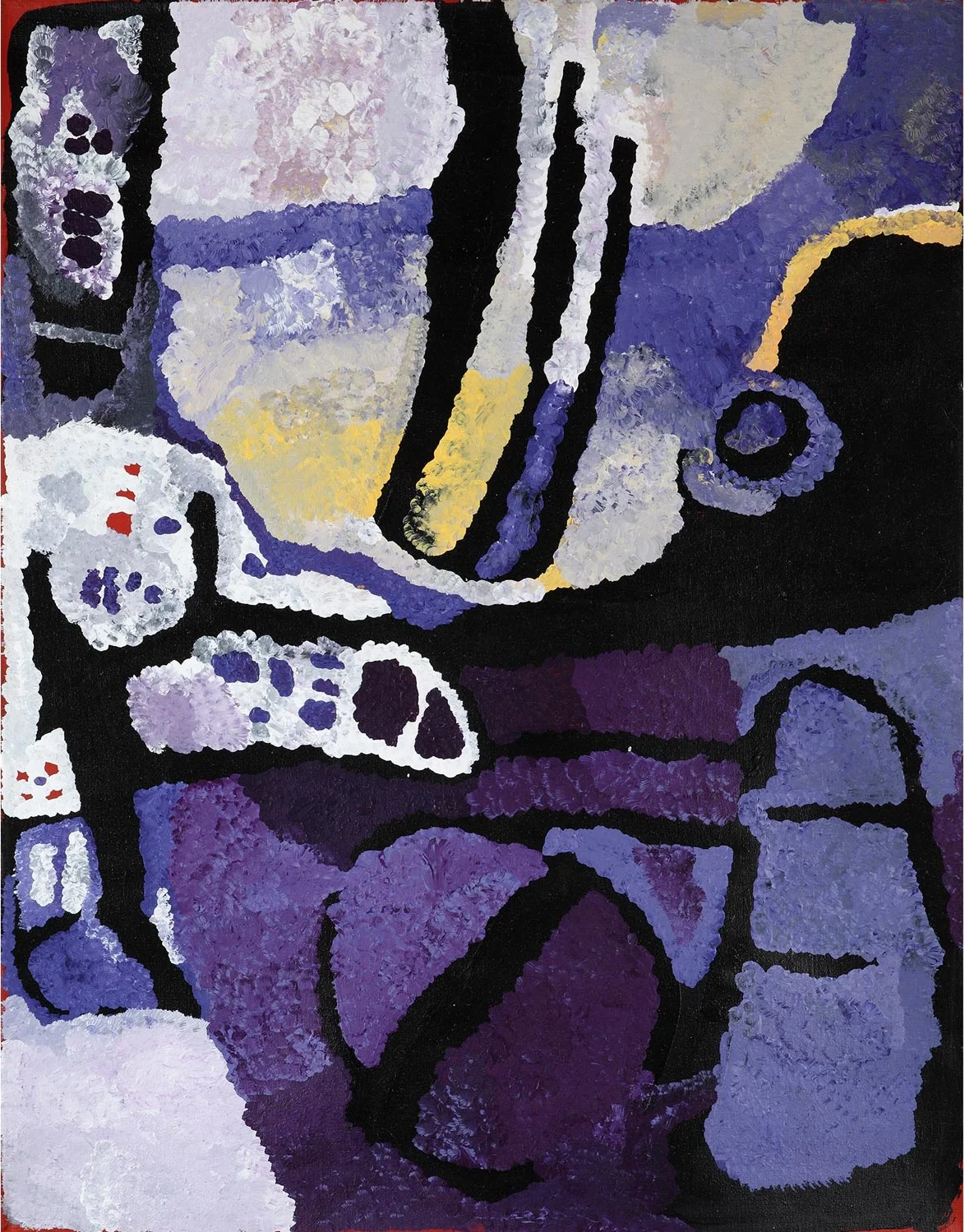
Myrtle Pennington
2019, acrylic on linen
110 x 85 cm
Cat No. 19-194
Witamin
Myrtle Pennington
The Spinifex People inhabited the Great Victoria Desert long before Europeans landed on this continent’s shoreline. They survived in an arid but beautiful environment, equipped with the necessary skills required for such a life. A spiritual people guided by cultural law were able to exist virtually unchallenged and unchanged until the 1950’s when the British atomic testing began at Emu Fields and later at Maralinga. These tests directly displaced the Spinifex People and it would be over thirty years before their traditional lands were finally returned to them in the form of native title and they were able to once again access the country that formed them from birth. For the landscape holds the culture of the Spinifex People and their daily interactions are governed by the moral compass of the first beings who created the physical realm. With story interwoven in song and dance, the country maps a tangible way forward for the people to reflect and learn upon.
It is this country, this spiritual landscape that defines and permeates Myrtle Pennington’s work. Although abstract in appearance each piece holds part history, part ceremony and part country. Myrtle assumes the vastness of the landscape imbued with the colourful light in profound yet simple compositions. She recalls the places that sustained her during those early formative years and gives rise to the sites of Mulpulya and Kanpa, surrounding them with sandhills and salt lakes or plains that lead to rocky escarpments. She reads the scene from a sense of belonging, of being interwoven into the fabric of the landscape she creates. All this Myrtle captures and colour freely, building a textural quality that prompts one to walk with her through this vast Country.
– SPINIFEX ARTS PROJECT
Myrtle Pennington
2018, acrylic on linen
60 x 60 cm
Cat No. 18-82
» ENQUIRE
Witamin
Myrtle Pennington
The Spinifex People inhabited the Great Victoria Desert long before Europeans landed on this continent’s shoreline. They survived in an arid but beautiful environment, equipped with the necessary skills required for such a life. A spiritual people guided by cultural law were able to exist virtually unchallenged and unchanged until the 1950’s when the British atomic testing began at Emu Fields and later at Maralinga. These tests directly displaced the Spinifex People and it would be over thirty years before their traditional lands were finally returned to them in the form of native title and they were able to once again access the country that formed them from birth. For the landscape holds the culture of the Spinifex People and their daily interactions are governed by the moral compass of the first beings who created the physical realm. With story interwoven in song and dance, the country maps a tangible way forward for the people to reflect and learn upon.
It is this country, this spiritual landscape that defines and permeates Myrtle Pennington’s work. Although abstract in appearance each piece holds part history, part ceremony and part country. Myrtle assumes the vastness of the landscape imbued with the colourful light in profound yet simple compositions. She recalls the places that sustained her during those early formative years and gives rise to the sites of Mulpulya and Kanpa, surrounding them with sandhills and salt lakes or plains that lead to rocky escarpments. She reads the scene from a sense of belonging, of being interwoven into the fabric of the landscape she creates. All this Myrtle captures and colour freely, building a textural quality that prompts one to walk with her through this vast Country.
– SPINIFEX ARTS PROJECT