
New Directions in Printmaking
27 Jul
1/3 Vickers Street
Parap

“This is my country. I can’t remember how it all happened, because it happened before I was born”
Recalling the origins of the Ikuntji Artists’ art movement, New directions in Printmaking focuses on works on paper, with a particular emphasis on screenprints.
This series is a result of two workshops with Timothy Growcott, printed by master printmaker Basil Hall, of Basil Hall Editions.
The exhibition showcases a series of limited edition prints by Ikuntji Artists - the first prints created at Ikuntji Artists art centre since 2011. Artists include Alice Nampitjinpa, Eunice Napanangka Jack and the final works produced by the late Kumuntjai Napurrula.
Ikuntji artists have returned to their origins by working with screenprinting. This began in 1992 after artists completed a series of workshops exploring techniques with works on paper and screenprinting at the aged care facility. Recently, after the older artists expressed their wish for young and emerging artists to learn techniques developed in the 1990’s, the art centre organised for renowned printmaker and artist Timothy Growcott to conduct a series of workshops. Over several weeks in 2017 and 2018 artists developed designs working on screens. These designs were then printed as limited edition prints by Basil Hall Editions. The prints on exhibition highlight the diversity of Ikuntji Artists. These artworks are a testament to the long history of printmaking at Ikuntji Artists. The medium emphasises the painterly quality used by the artists, along with their bold colour use and abstraction. This is the first exhibition of prints by Ikuntji Artists and includes several generations of artists. Founding member Eunice Napanangka Jack’s prints of Kuruyultu are shown alongside emerging stars Keturah Zimran and Susie Lane. The last signed prints of the late Mitjili Napurrula are also included. Consequently, this exhibition is both unique, and a milestone for the artists.
– DR CHRISCHONA SCHMIDT (EDITED), Manager Ikuntji Artists 2019
IMAGE ABOVE: Eunice Napanangka Jack, Kuruyultu, 2019, etching, image size 50 x 100 cm Edition of 20, Cat No. 19-EJ112
Leonie Kamutu
Mitjili Napurrula
Keturah Zimran
Eunice Napanangka Jack
Alice Nampitjinpa Dixon
Mavis Marks
Limited edition prints

Leonie Kamutu
2018, screenprint
IMAGE SIZE: 30 x 42 cm
Edition of 20
Cat No. 18-LK297
New Directions in Printmaking
Ikuntji Artists
This story is of the Papa Tjukurrpa - Dog Dreaming, which is the story of the artist's father. It is of Niyuman, east of Kintore and it is secret men's business.

Leonie Kamutu
2019, screenprint
IMAGE SIZE: 70 x 107 cm
Edition of 20
Cat No. 19-LK27
New Directions in Printmaking
Ikuntji Artists
This story is of the Papa Tjukurrpa - Dog Dreaming, which is the story of the artist's father. It is of Niyuman, east of Kintore and it is secret men's business.
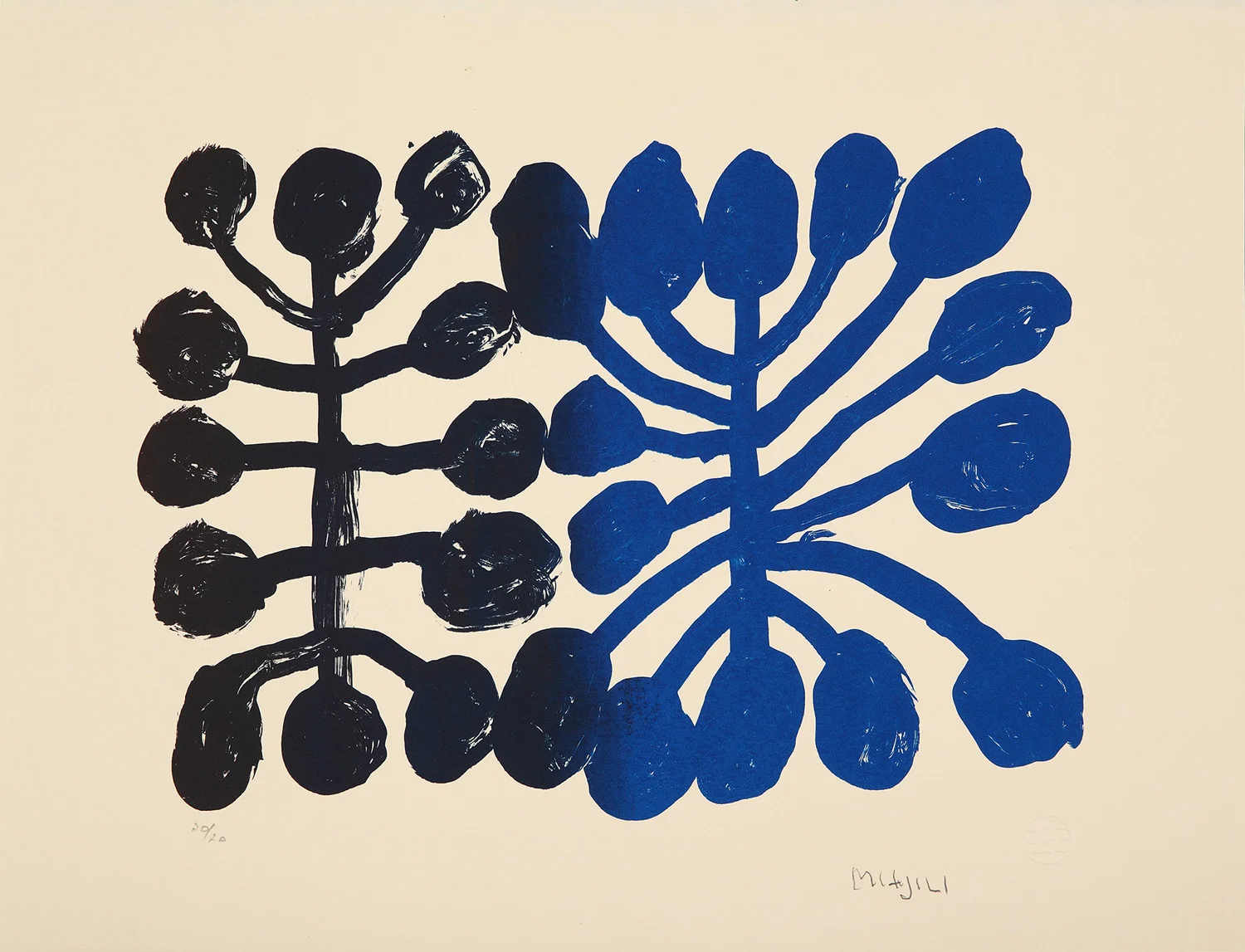
Mitjili Napurrula
2018, screenprint
IMAGE SIZE: 30 x 42 cm
Edition of 20
Cat No. 18-MN296
New Directions in Printmaking
Ikuntji Artists
Napurrula's father, Tupa Tjakamarra gave her the right to paint works related to Ilyingaungau in the Gibson Desert. This site, south of Walungurru (Kintore), some 520 kilometres west of Mparntwe (Alice Springs), is where the artist’s Mutikatjirri ancestors assembled their kulata (spears) for a conflict with the Tjukula men. Allusive works that refer to the straightening of kulata by Tjupurrula are among the landmark paintings of the Ikuntji Artists movement’s 30-year history. The paintings of Napurrula and her husband, Long Tom Tjapanangka, have come to be understood as archetypical of Ikuntji art since they began to work with the arts centre in 1993. Napurrula remembers,
… After I got married, my mother taught me my father’s Tjukurrpa in the sand, that’s what I’m painting on the canvas.
The white pigment eddies around abstract forms that refer to the spearwood trees. The tightly structured patterning of the key motifs and bold use of colour demonstrates the artist’s confidence in her individual artistic vision within a family of superlative artists – and the cultural heritage that continues to inform the myriad expressions of Western Desert artists.
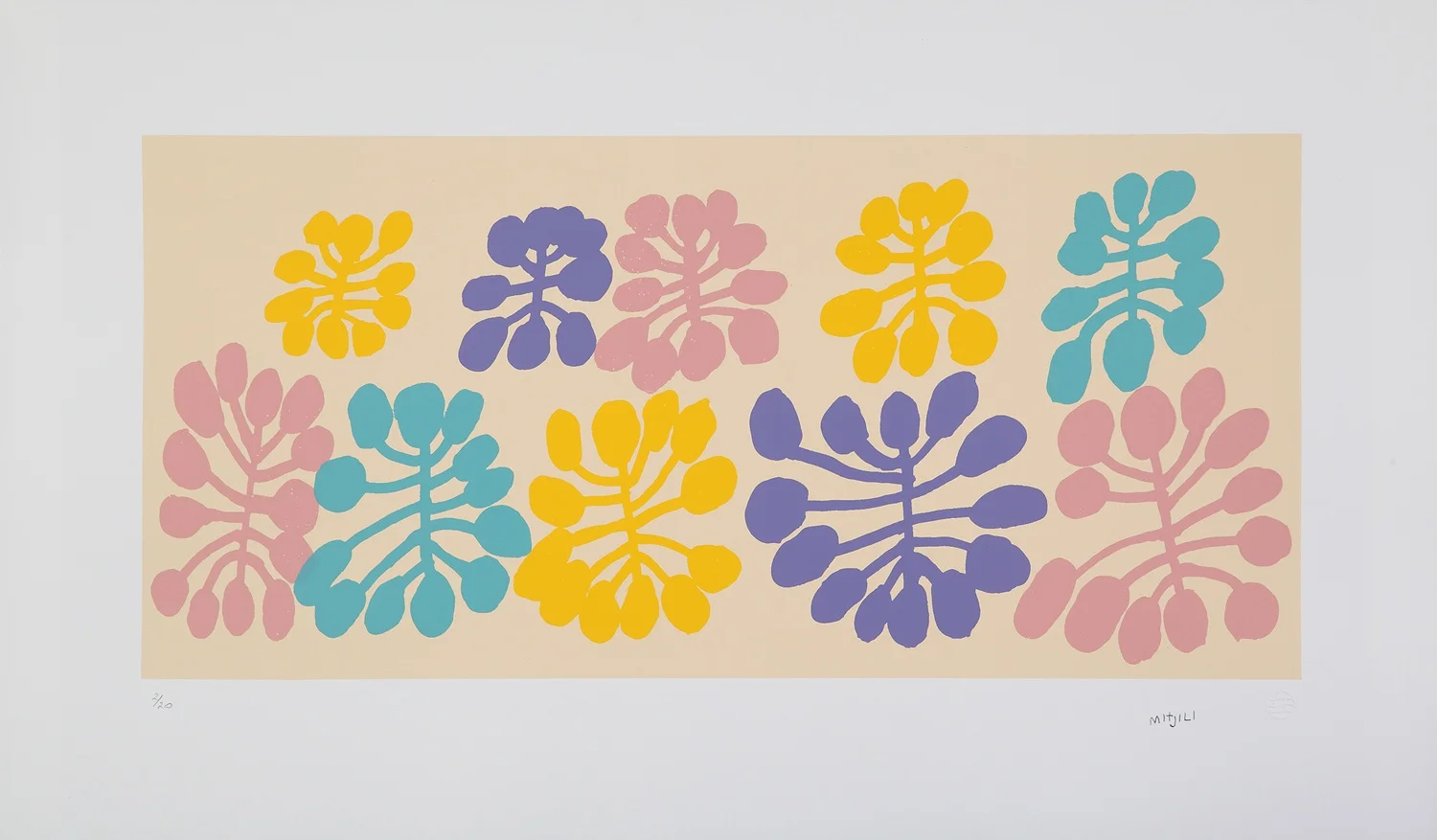
Mitjili Napurrula
2019, screenprint
IMAGE SIZE: 70 x 107 cm
Edition of 20
Cat No. 19-MN28
New Directions in Printmaking
Ikuntji Artists
Mitjili paints her fathers Tjukurrpa, the ceremonial spear straightening in Uwalkari country (Gibson desert region). The Watiya Tjuta (Acacia Trees) are the trees that are used to make these spears. Uwalkari country is abundant with Watiya Tjuta, as well as sand hills and other plants. Mitjili paints the motif of the Watiya Tjuta, carrying on the recurring motif as her mother used to draw in the sand. Her mother passed on this Dreaming to her.
– IKUNTJI ARTISTS

Keturah Zimran
2018, screenprint
IMAGE SIZE: 30 x 42 cm
Edition of 20
Cat No. 18-KZ293
New Directions in Printmaking
Ikuntji Artists
In this work Keturah depicts the natural rock formations (puli) found in and around Haasts Bluff.

Eunice Napanangka Jack
2018, screenprint
IMAGE SIZE: 30 x 42 cm
Edition of 20
Cat No. 18-EJ290
New Directions in Printmaking
Ikuntji Artists
In this print Eunice depicts her father's Tjukurrpa (Dreaming). It shows the country at Kuruyultu, near Tjukurrla in Western Australia.
Eunice Napanangka Jack says about the artwork:
This is my country. I can’t remember how it all happened, because it happened before I was born. I have a scar on my back from it. My grandfather speared a wallaby at Kuruyultu. That night he ate that wallaby. At the same time my mother could feel me moving inside her. She was heavily pregnant with me. That next morning, after my grandfather had speared the wallaby, killed it and eaten it, I was born. I was born at Kuruyultu, near the rockhole there. I can’t remember my grandfather or my grandmother. I was still a little baby. We left that place, Kuruyultu. My father, my mother, my big sister and my father’s brother, we all left together and went to Haasts Bluff. I grew up in Haasts Bluff. I have been back to Kuruyultu for visits but I never lived there again in my country. I think about it every day. Only my father knows all the stories for that country and he painted them too … all the men’s stories. I know the story of the wallaby mother and daughter which left me with a birthmark. That’s what I paint: the wallaby mother and daughter.
– IKUNTJI ARTISTS

Eunice Napanangka Jack
2018, screenprint
IMAGE SIZE: 30 x 42 cm
Edition of 20
Cat No. 18-EJ291
New Directions in Printmaking
Ikuntji Artists
In this print Eunice depicts her father's Tjukurrpa (Dreaming). It shows the country at Kuruyultu, near Tjukurrla in Western Australia.
Eunice Napanangka Jack says about the artwork:
This is my country. I can’t remember how it all happened, because it happened before I was born. I have a scar on my back from it. My grandfather speared a wallaby at Kuruyultu. That night he ate that wallaby. At the same time my mother could feel me moving inside her. She was heavily pregnant with me. That next morning, after my grandfather had speared the wallaby, killed it and eaten it, I was born. I was born at Kuruyultu, near the rockhole there. I can’t remember my grandfather or my grandmother. I was still a little baby. We left that place, Kuruyultu. My father, my mother, my big sister and my father’s brother, we all left together and went to Haasts Bluff. I grew up in Haasts Bluff. I have been back to Kuruyultu for visits but I never lived there again in my country. I think about it every day. Only my father knows all the stories for that country and he painted them too … all the men’s stories. I know the story of the wallaby mother and daughter which left me with a birthmark. That’s what I paint: the wallaby mother and daughter.
– IKUNTJI ARTISTS
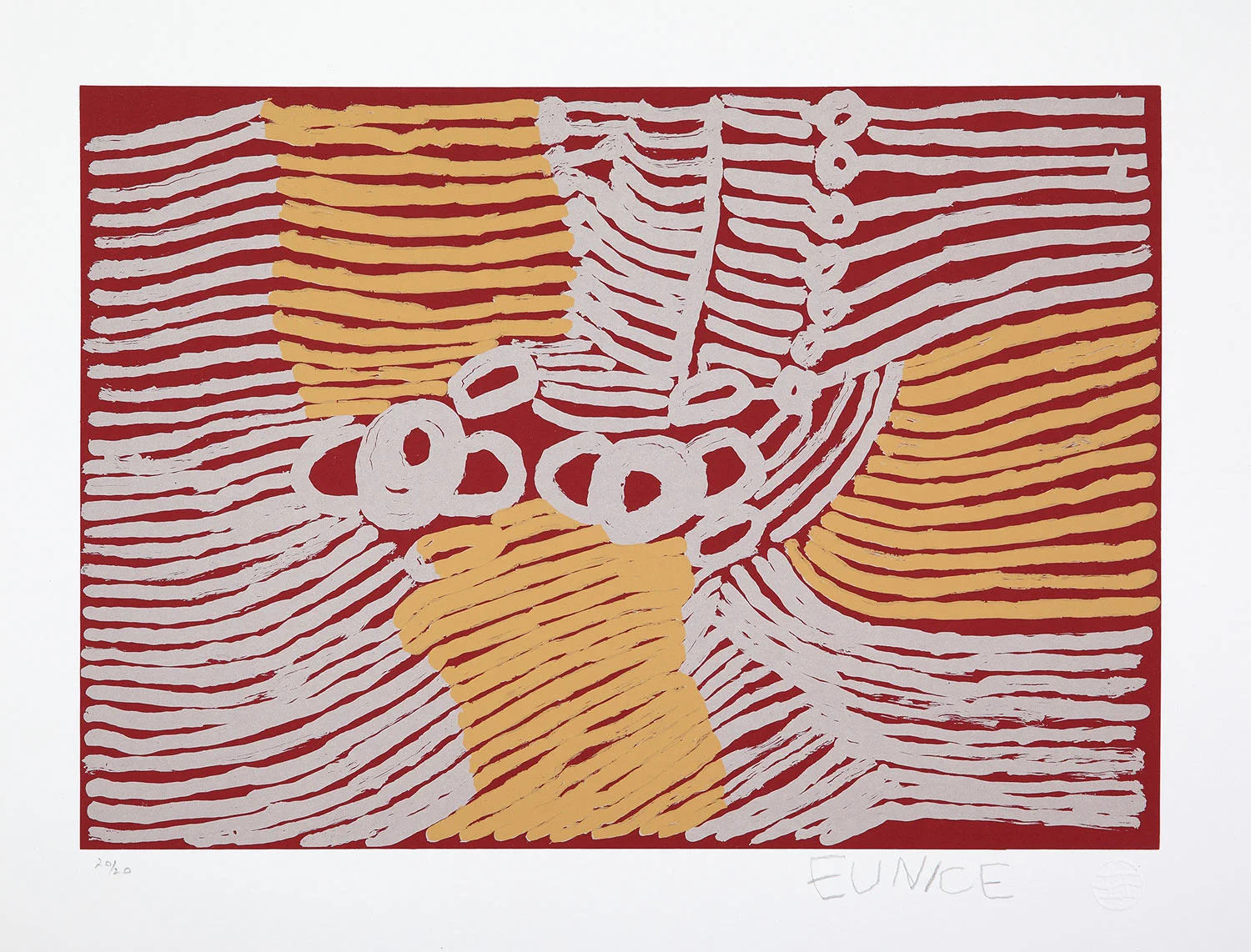
Eunice Napanangka Jack
2018, screenprint
IMAGE SIZE: 30 x 42 cm
Edition of 20
Cat No. 18-EJ292
New Directions in Printmaking
Ikuntji Artists
In this print Eunice depicts her father's Tjukurrpa (Dreaming). It shows the country at Kuruyultu, near Tjukurrla in Western Australia.
Eunice Napanangka Jack says about the artwork:
This is my country. I can’t remember how it all happened, because it happened before I was born. I have a scar on my back from it. My grandfather speared a wallaby at Kuruyultu. That night he ate that wallaby. At the same time my mother could feel me moving inside her. She was heavily pregnant with me. That next morning, after my grandfather had speared the wallaby, killed it and eaten it, I was born. I was born at Kuruyultu, near the rockhole there. I can’t remember my grandfather or my grandmother. I was still a little baby. We left that place, Kuruyultu. My father, my mother, my big sister and my father’s brother, we all left together and went to Haasts Bluff. I grew up in Haasts Bluff. I have been back to Kuruyultu for visits but I never lived there again in my country. I think about it every day. Only my father knows all the stories for that country and he painted them too … all the men’s stories. I know the story of the wallaby mother and daughter which left me with a birthmark. That’s what I paint: the wallaby mother and daughter.
– IKUNTJI ARTISTS

Eunice Napanangka Jack
2019, screenprint
IMAGE SIZE: 50 x 100 cm
Edition of 20
Cat No. 19-EJ112
New Directions in Printmaking
Ikuntji Artists
In this print Eunice depicts her father's Tjukurrpa (Dreaming). It shows the country at Kuruyultu, near Tjukurrla in Western Australia.
Eunice Napanangka Jack says about the artwork:
This is my country. I can’t remember how it all happened, because it happened before I was born. I have a scar on my back from it. My grandfather speared a wallaby at Kuruyultu. That night he ate that wallaby. At the same time my mother could feel me moving inside her. She was heavily pregnant with me. That next morning, after my grandfather had speared the wallaby, killed it and eaten it, I was born. I was born at Kuruyultu, near the rockhole there. I can’t remember my grandfather or my grandmother. I was still a little baby. We left that place, Kuruyultu. My father, my mother, my big sister and my father’s brother, we all left together and went to Haasts Bluff. I grew up in Haasts Bluff. I have been back to Kuruyultu for visits but I never lived there again in my country. I think about it every day. Only my father knows all the stories for that country and he painted them too … all the men’s stories. I know the story of the wallaby mother and daughter which left me with a birthmark. That’s what I paint: the wallaby mother and daughter.
– IKUNTJI ARTISTS

Alice Nampitjinpa Dixon
2018, screenprint
IMAGE SIZE: 45 x 30 cm
Edition of 20
Cat No. 18-AN287
New Directions in Printmaking
Ikuntji Artists
This print shows the artist's Tjukurrpa, the Tali Tali Dreaming. It refers to the vast and desolate sandhills of her country near Taalalpi, which is located beyond the Kintore/Kiwikurra road near the West Australian and Northern Territory border. This is the country where her father and mother used to travel by foot when she was a young girl. The place is still of great spiritual significance to Alice and her father's family as it contains both, personal and tribal law to which Alice relates in her work. Water has collected in between the sandhills, providing sustenance for her porcupine. The tjikamamta (porcupine) is Alice's own personal tjukurrpa (dreaming).
She returned to her country for a visit in late 2005.

Alice Nampitjinpa Dixon
2018, screenprint
IMAGE SIZE: 50 x 30 cm
Edition of 20
Cat No. 18-AN288
New Directions in Printmaking
Ikuntji Artists
This print shows the trees in Alice's country, Talaalpi. Her country is situated close to Kintore on the Western Australian border.
She grew up there and moved to Haasts Bluff later in life.

Mavis Marks
2018, screenprint
IMAGE SIZE: 30 x 42 cm
Edition of 20
Cat No. 18-MM295
New Directions in Printmaking
Ikuntji Artists
In this print Mavis Nampitjinpa paints her Tjukurrpa (Dreaming), the Water Dreaming. It's north of Kintore. For Aboriginal people of the Western Desert, Kapi (water) is a crucial resource for survival. When the rains arrive in the desert the landscape comes to life with all the desert flowers blooming, bush tucker abundant and people taking advantage of all the joys that water brings.

Mavis Marks
2018, screenprint
IMAGE SIZE: 30 x 42 cm
Edition of 20
Cat No. 18-MM295
New Directions in Printmaking
Ikuntji Artists
In this print Mavis Nampitjinpa paints her Tjukurrpa (Dreaming), the Water Dreaming. It's north of Kintore. For Aboriginal people of the Western Desert, Kapi (water) is a crucial resource for survival. When the rains arrive in the desert the landscape comes to life with all the desert flowers blooming, bush tucker abundant and people taking advantage of all the joys that water brings.
Susie Lane
2019 screenprint
IMAGE SIZE: 42 x 30 cm
Edition of 20
Cat No. 18-SL289
» ENQUIRE
New Directions in Printmaking
Ikuntji Artists
This print shows the bushflowers and seeds in and around the Haasts Bluff area after the rain.