
Kun-waral: Spirit Shadows
18 Jun
1/3 Vickers Street
Parap
LIMITED EDITION PRINTS

“The kun-waral, they are the shadows of the spirit mob who used to live here. Long time ago, when we were nothing ... these spirits can change shape, transforming from one shape to the next ... All of the spirits are stuck forever in the bim (rock art) on the stone country. That is what my grandfather told me.”
Kun-waral, a collaboration between Bábbarra Women’s Centre and Maningrida Arts & Culture, refers to the shadow or memory of powerful beings who transformed as they moved across country, before humans arrived.
In the same way, the artists in this show transform and move across artistic mediums, presenting Japanese woodblock prints, etchings, linocuts on fabric and pandanus woven panels.
It was the first time the artists from Bábbarra Women’s Centre had created limited edition fine art prints. The artists carved their own woodblocks and created their own etching plates. Produced during a workshop with Jacqueline Gribbin and Sean Smith in February 2019, artists used the water-based Japanese method "mokuhanga". The prints were editioned by Jacqueline Gribbin in her Darwin studio.
The figures depicted in this exhibition are from over five Arnhem Land language groups, and cross multiple clan estates. The artists only illustrate figures they have the cultural custodianship and family permissions to depict. Marawarr explains that these spirits were all on the earth around the same time, before bininj (people) came in Arnhem Land. They all spoke different languages, the language belonging to their country, and many of them also sing in their languages as they travel and change across country. Some people in Maningrida still know these spirit songs to this day.
Each spirit being has a kinship name, and also belong to either the duwa or yirridjdja moiety. The figures include Mimih (Kuninjku), Mongerrd (Kuninjku), Yawkyawk (Kuninjku), Ngalhdolbo (Kuninjku), Djomi (Kunibidji), Buluwana (Kuninjku), Bawaliba (Gurr-guni), Ngalkalngunjkabarn (Rembarrgna), and Djurrung (Kuninjku).
All aspects of the natural world today are embedded within the complex kinship system and the vast ancestral song lines that define this region. Animals, fish and plants depicted in the artworks reflect this transformative dimension being both natural species and the embodiment of Djang – ancestral power.
IMAGE ABOVE: Laura Badalune, Stingray, 2019, pandanas spiralis and natural dyes, 104 x 59 cm, Cat No. 488-19

Janet Marawarr in front of her linoprint fabric at Salon Project Space, 2019.
Lucy Yarawanga
Deborah Wurrkidj
Jennifer Wurrkidj
Carol Campion
Melba Gunjarrwanga
Miriam Jinmanga
Jacinta Lami Lami
Laura Badalune
Samantha Malkudja
Alison Guwanjguwanj
Raylene Bonson
Limited edition prints
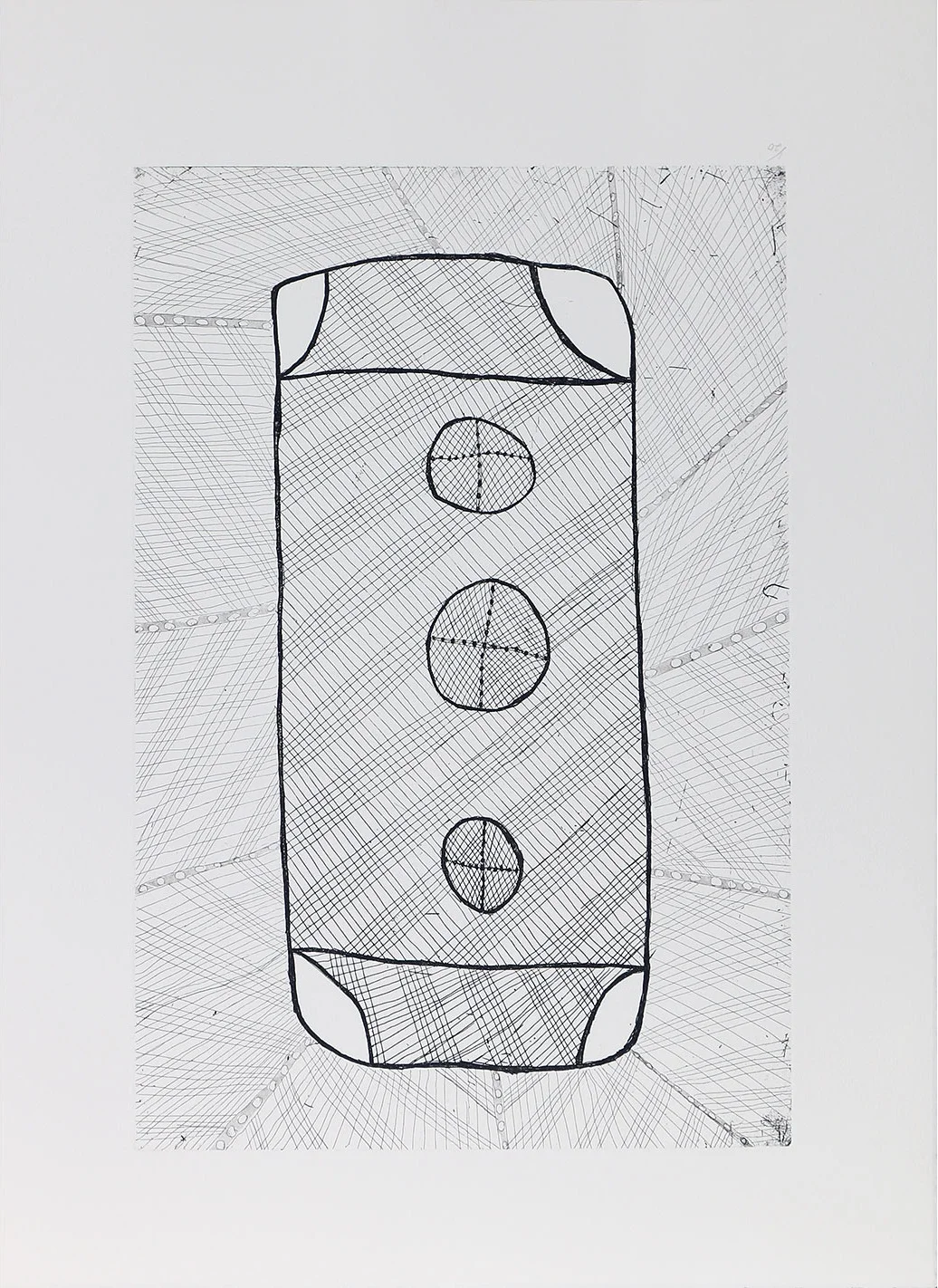
Deborah Wurrkidj
2019, etching
IMAGE SIZE: 50 x 33 cm
PAPER SIZE: 66 x 47 cm
Edition of 20
Cat No. 1016-19
Kun-waral: Spirit Shadows
A collaboration between Bábbarra Women’s Centre and Maningrida Arts & Culture
Deborah Wurrkidj is a highly regarded, versatile artist who has readily adapted to new art forms while retaining her strong clan traditions. She has been working with Bábbarra Designs since 1991, alongside her mother, Helen Lanyinwanga, and sister Jennifer Wurrkidj. She is a leading textile artist and an integral member of Bábbarra Women’s Centre.Deborah’s work is vibrant, tactile and intricate, evocative of the local natural environment as well as referencing her deep cultural knowledge. Her extensive body of textile art is illustrative of the artistic innovation that has occurred in Maningrida in recent times.Deborah is world renowned for her bark painting, lorrkkon (hollow logs), and fibre baskets. She has exhibited widely since 2001, throughout Australia as well as in Europe and the United States. She is represented in many of Australia’s state gallery collections
– BÁBBARRA WOMEN’S CENTRE

Jennifer Wurrkidj
2019, etching
IMAGE SIZE: 50 x 33 cm
PAPER SIZE: 66 x 47 cm
Edition of 20
Cat No. 1016-19
Kun-waral: Spirit Shadows
A collaboration between Bábbarra Women’s Centre and Maningrida Arts & Culture
Jennifer Wurrkidjis a highly regarded textile artist who has been working at Bábbarra Designs since 2007. Her print designs often feature bush foods and food-collecting and reference the activities of ancestor beings and the ceremonial sites of her homeland, Mumeka. Jennifer works at Bábbarra Women’s Centre alongside other members of her family who are also accomplished artists: her mother, Helen Lanyinwanga, and sister Deborah Wurrkidj. She is a daughter of Australia’s most highly acclaimed bark painter, John Mawurndjul, and she is renowned, in her own right, for her bark paintings, hollow logs and carved sculptures. Jennifer’s artwork has been exhibited throughout Australia and her textile art is in the collection of the Art Gallery of South Australia.
– BÁBBARRA WOMEN’S CENTRE
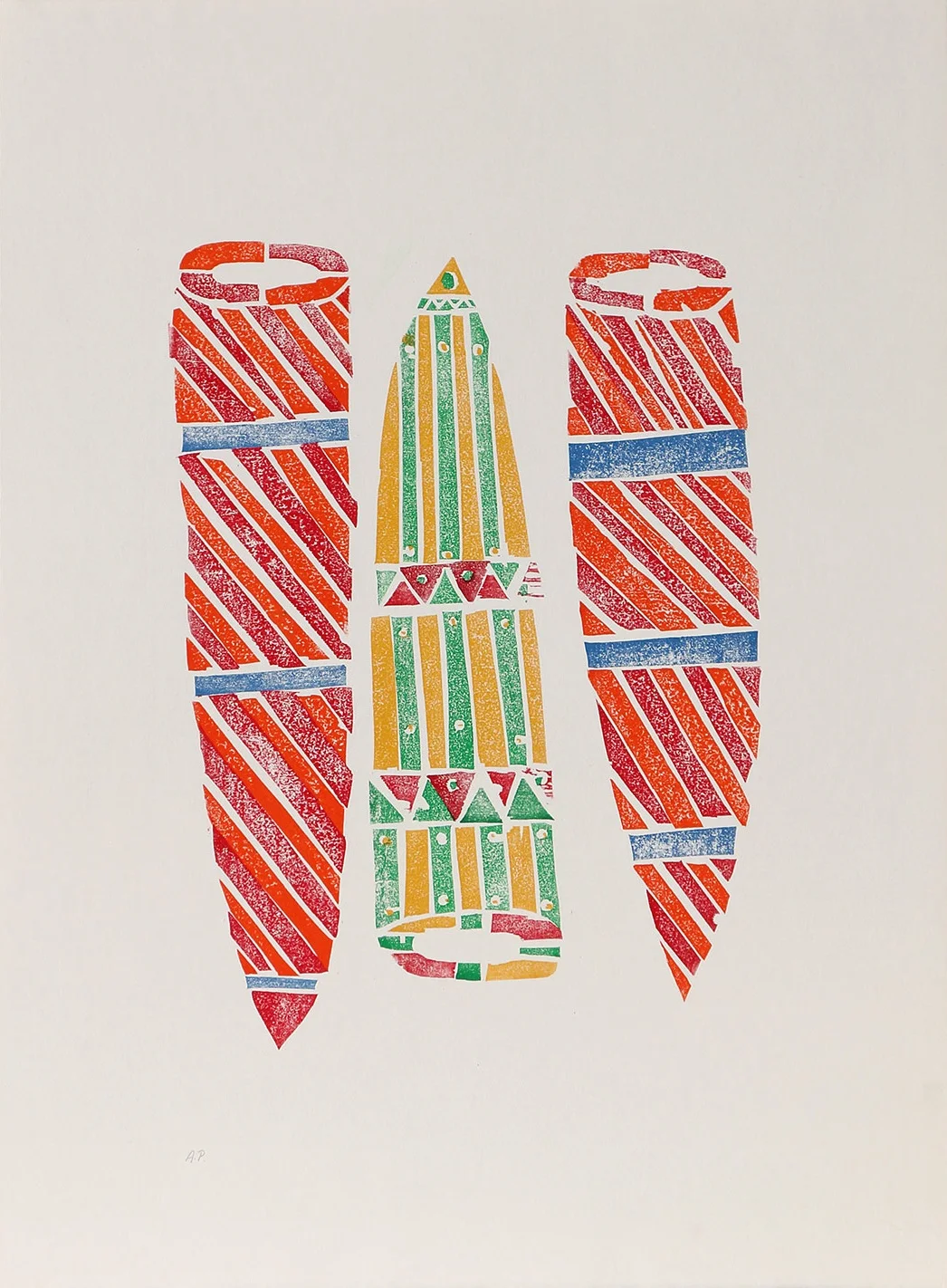
Raylene Bonson
2019, Japanese Woodblock
IMAGE SIZE: 46 x 31 cm
PAPER SIZE: 60 x 44 cm
Edition of 20
Cat No. 1012-19
Kun-waral: Spirit Shadows
A collaboration between Bábbarra Women’s Centre and Maningrida Arts & Culture
Raylene Bonson is a talented textile artist, specialising in linocut technique. She has been working with Bábbarra Designs since 2012. Raylene was mentored by her late mother, Nancy Gununwanga, a senior textile artist at Bábbarra Designs and a founding member of Bábbarra Women’s Centre. Raylene is well known for her designs depicting ancestral stories and ceremonial objects, in particular lorrkkon (hollow log for burial ceremony), kunmadj (dillybag) and mandjabu (conical fishtrap).
– BÁBBARRA WOMEN’S CENTRE

Jacinta Lami Lami
2019, Japanese Woodblock
IMAGE SIZE: 31 x 46 cm
PAPER SIZE: 45 x 59 cm
Edition of 20
Cat No. 1020-19
Kun-waral: Spirit Shadows
A collaboration between Bábbarra Women’s Centre and Maningrida Arts & Culture
Jacinta is an emerging artist, who has developed a strong portfolio of hand carved lino designs. Jacinta is also a talented screen printer, with an innovative eye for hue and colour layering.Jacinta’s mother is a traditional owner of the land of Maningrida, on which Babbarra Women’s Centre lies. Jacinta has family connections across the top end, and has lived in Minjilang (Crocker Island) and Warruwi (Goulburn Island)
– BÁBBARRA WOMEN’S CENTRE

Carol Campion
2019 etching
IMAGE SIZE: 33 x 50 cm
PAPER SIZE: 49 x 64 cm
Edition of 20
Cat No. 1021-19
Kun-waral: Spirit Shadows
A collaboration between Bábbarra Women’s Centre and Maningrida Arts & Culture
Carol is an emerging artist, who has grown a portfolio of hand carved lino designs. Carol often depicts imagery from her country, in particular designs offish and plants from west Arnhem Land. Carol lives on an outstation Buluhkaduru, which is Kune country. Carol is a prolific fibre artist who works with Pandanus and Kurrajong to weave dillybags, fibre panels and other artworks.
– BÁBBARRA WOMEN’S CENTRE

Janet Marawarr
2019 etching
IMAGE SIZE: 33 x 50 cm
PAPER SIZE: 49 x 64 cm
Edition of 20
Cat No. 1022-19
Kun-waral: Spirit Shadows
A collaboration between Bábbarra Women’s Centre and Maningrida Arts & Culture
My designs, they are all alive living up in my head.
– JANET MARAWARR
Janet is a talented linocut and screenprint designer and comes from a strong family of Kuninjku artists. She regards textile design as an opportunity to work with colour and new methods to express her djang (ancestral creator stories).As well as her artistic work with Bábbarra Women’s Centre, she is an established bark painter with Maningrida Arts & Crafts, and she works for the Maningrida Night Patrol, a community safety service
– BÁBBARRA WOMEN’S CENTRE

Miriam Jinmanga
2019 etching
IMAGE SIZE: 33 x 50 cm
PAPER SIZE: 49 x 64 cm
Edition of 20
Cat No. 1013-19
Kun-waral: Spirit Shadows
A collaboration between Bábbarra Women’s Centre and Maningrida Arts & Culture
Miriam is a Nakara woman whose country is Rocky Point. Miriam grew up on her homeland, attending the remote outstation school. Miriam joined Bábbarra Women’s Centre in 2017. Nakara is an endangered language, which belongs to the coastal country east of Maningrida community. Miriam is a competent lino printer, often depicting salt-water stories and imagery relating to her country.
– BÁBBARRA WOMEN’S CENTRE

Melba Gunjarrwanga
2019 etching
IMAGE SIZE: 50 x 33 cm
PAPER SIZE: 66 x 47 cm
Edition of 20
Cat No. 1023-19
Kun-waral: Spirit Shadows
A collaboration between Bábbarra Women’s Centre and Maningrida Arts & Culture
Melba Gunjarrwanga is a Kuninjku artist, and is a skilled printmaker, sculptor, weaver and bark painter. Melba has taken part in group exhibitions acrossAustralia and the world presented by Maningrida Arts and Culture. Her work is held in the national collection and most state art galleries.
– BÁBBARRA WOMEN’S CENTRE
FIBRE SCULPTURE

Grace Laraidbi
2019, woven sculpture
pandanas spiralis and natural dyes
172 x 67 cm
Cat No. 133-19
Kun-waral: Spirit Shadows
A collaboration between Bábbarra Women’s Centre and Maningrida Arts & Culture
Grace Laradjbi is the daughter of senior fibre artist Lulu Laradjbi whose partner was the acclaimed bark painter Mick Kubarkku. Grace makes2D pandanus panels and sculptures often depicting barramundi, stingrays and yawkyawks (female water spirits).Her works are characterised by strong designs, intricate technique and bold use of colour. Grace uses gun-menama (pandanus spiralis) to create her works. To prepare the pandanus the inner leaves of the plant are collected using a hook. Each V-shaped leaf is first split in half along its spine. After removing the sharp spines, the two surfaces of the leaf are then split away from other. After this preparation, the pandanus is boiled in a billycan with plant materials to dye the fibre. Like her contemporaries, Grace only uses natural dyes and achieves enormous variation.
– MANINGRIDA ARTS & CULTURE

Laura Badalune
2019, woven sculpture
pandanas spiralis and natural dyes
104 x 59 cm
Cat No. 488-19
Kun-waral: Spirit Shadows
A collaboration between Bábbarra Women’s Centre and Maningrida Arts & Culture
Laura Badalune is a Kuninjku fibre artist who learned to weave from her mother Frewa Bardaluna, a master fibre artist who had numerous exhibitions with leading Australian commercial galleries. Laura and her sister Alison Kuwanjguwanj continue her legacy, creating works that are bold in design, diverse in colour and tonal range and intricate in execution. Laura predominately uses gun-menama (pandanus spiralis) it make woven panels, dilly bags and 2D sculptures of animals and yawkyawks (female water spirits). To prepare the pandanus the inner leaves of the plant are collected using a hook. Each V-shaped leaf is first split in half along its spine. After removing the sharp spines, the two surfaces of the leaf are then split away from other. After this preparation, the pandanus is boiled in a billy can with plant materials to dye the fibre. Like her contemporaries, Laura only uses natural dyes and achieves enormous variation.
– MANINGRIDA ARTS & CULTURE

Samantha Malkudja
2018, woven sculpture
pandanas spiralis and natural dyes
114 x 62 cm
Cat No. 3178-18
Kun-waral: Spirit Shadows
A collaboration between Bábbarra Women’s Centre and Maningrida Arts & Culture
Samantha Malkadja learned to weave from her mother Frewa Bardaluna, a master fibre artist who had numerous exhibitions with leading Australian commercial galleries. Samantha’s work is distinguished by her soft tonal range, strong sense of design and intricate technique.Samantha makes panels and 2D sculptures which depict local fish and animal species and often yawkyawks, female water spirits.Samantha predominately uses gun-menama (pandanus spiralis) in her works. To prepare the pandanus the inner leaves of the plant are collected using a hook. Each V-shaped leaf is first split in half along its spine. After removing the sharp spines, the two surfaces of the leaf are then split away from other. After this preparation, the pandanus is boiled in a billycan with plant materials to dye the fibre. Like her contemporaries, Alison only uses natural dyes and achieves enormous variation.
– MANINGRIDA ARTS & CULTURE

Alison Guwanjguwanj
2019, woven sculpture
pandanas spiralis and natural dyes
174 x 71 cm
Cat No. 200-19
Kun-waral: Spirit Shadows
A collaboration between Bábbarra Women’s Centre and Maningrida Arts & Culture

Alison Guwanjguwanj
2019, woven sculpture
pandanas spiralis and natural dyes
174 x 71 cm
Cat No. 200-19
Kun-waral: Spirit Shadows
A collaboration between Bábbarra Women’s Centre and Maningrida Arts & Culture

Alison Guwanjguwanj
2019, woven sculpture
pandanas spiralis and natural dyes
166 x 80 cm
Cat No. 484-19
Kun-waral: Spirit Shadows
A collaboration between Bábbarra Women’s Centre and Maningrida Arts & Culture

POA
pandanas spiralis and natural dyes
Various artists from Maningrida Arts & Culture
Kun-waral: Spirit Shadows
A collaboration between Bábbarra Women’s Centre and Maningrida Arts & Culture
Lino print textiles

Janet Marawarr
2019, linoprint on silk
200 x 140 cm
Cat No. 1660-19
Kun-waral: Spirit Shadows
A collaboration between Bábbarra Women’s Centre and Maningrida Arts & Culture
My lino designs depict the kun-waral, the shadows of the spirit mob who used to live here. Long time ago, when we were nothing. Just like ka-djal-marnburren yiman wak (he who transforms from a mimih being into a black crow), these spirits can change shape, transforming from one shape to the next. My grandfather told me the story of those kun-waral, and he learned it from the ‘old people’ (mythical ancestors/spirits). They live on all different country around Maningrida, and sometimes like that Báwaliba (depicted in print by Lucy Yarawanga), they come awake only at night. All of the spirits are stuck forever in the bim (rock art) on the stone country.That is what my grand father told me. Normal people, we cannot see them. Only the man-kordang (traditional witch doctors) can see them, they know the spirits.
Janet Marawarr speaking with Ingrid Johanson
– BÁBBARRA WOMEN’S CENTRE, MARCH 2019

Janet Marawarr
2019, linoprint on cotton
200 x 110 cm
Cat No. 1661-19
Kun-waral: Spirit Shadows
A collaboration between Bábbarra Women’s Centre and Maningrida Arts & Culture
My lino designs depict the kun-waral, the shadows of the spirit mob who used to live here. Long time ago, when we were nothing. Just like ka-djal-marnburren yiman wak (he who transforms from a mimih being into a black crow), these spirits can change shape, transforming from one shape to the next. My grandfather told me the story of those kun-waral, and he learned it from the ‘old people’ (mythical ancestors/spirits). They live on all different country around Maningrida, and sometimes like that Báwaliba (depicted in print by Lucy Yarawanga), they come awake only at night. All of the spirits are stuck forever in the bim (rock art) on the stone country.That is what my grand father told me. Normal people, we cannot see them. Only the man-kordang (traditional witch doctors) can see them, they know the spirits.
Janet Marawarr speaking with Ingrid Johanson
– BÁBBARRA WOMEN’S CENTRE, MARCH 2019

Janet Marawarr
2019, linoprint on cotton
200 x 110 cm
Cat No. 1662-19
Kun-waral: Spirit Shadows
A collaboration between Bábbarra Women’s Centre and Maningrida Arts & Culture
My lino designs depict the kun-waral, the shadows of the spirit mob who used to live here. Long time ago, when we were nothing. Just like ka-djal-marnburren yiman wak (he who transforms from a mimih being into a black crow), these spirits can change shape, transforming from one shape to the next. My grandfather told me the story of those kun-waral, and he learned it from the ‘old people’ (mythical ancestors/spirits). They live on all different country around Maningrida, and sometimes like that Báwaliba (depicted in print by Lucy Yarawanga), they come awake only at night. All of the spirits are stuck forever in the bim (rock art) on the stone country.That is what my grand father told me. Normal people, we cannot see them. Only the man-kordang (traditional witch doctors) can see them, they know the spirits.
Janet Marawarr speaking with Ingrid Johanson
– BÁBBARRA WOMEN’S CENTRE, MARCH 2019

Janet Marawarr
2019, linoprint on cotton
300 x 105 cm
Cat No. 1663-19
Kun-waral: Spirit Shadows
A collaboration between Bábbarra Women’s Centre and Maningrida Arts & Culture
My lino designs depict the kun-waral, the shadows of the spirit mob who used to live here. Long time ago, when we were nothing. Just like ka-djal-marnburren yiman wak (he who transforms from a mimih being into a black crow), these spirits can change shape, transforming from one shape to the next. My grandfather told me the story of those kun-waral, and he learned it from the ‘old people’ (mythical ancestors/spirits). They live on all different country around Maningrida, and sometimes like that Báwaliba (depicted in print by Lucy Yarawanga), they come awake only at night. All of the spirits are stuck forever in the bim (rock art) on the stone country.That is what my grand father told me. Normal people, we cannot see them. Only the man-kordang (traditional witch doctors) can see them, they know the spirits.
Janet Marawarr speaking with Ingrid Johanson
– BÁBBARRA WOMEN’S CENTRE, MARCH 2019

Janet Marawarr
2019, linoprint on cotton
200 x 150 cm
Cat No. 1664-19
Kun-waral: Spirit Shadows
A collaboration between Bábbarra Women’s Centre and Maningrida Arts & Culture
My lino designs depict the kun-waral, the shadows of the spirit mob who used to live here. Long time ago, when we were nothing. Just like ka-djal-marnburren yiman wak (he who transforms from a mimih being into a black crow), these spirits can change shape, transforming from one shape to the next. My grandfather told me the story of those kun-waral, and he learned it from the ‘old people’ (mythical ancestors/spirits). They live on all different country around Maningrida, and sometimes like that Báwaliba (depicted in print by Lucy Yarawanga), they come awake only at night. All of the spirits are stuck forever in the bim (rock art) on the stone country.That is what my grand father told me. Normal people, we cannot see them. Only the man-kordang (traditional witch doctors) can see them, they know the spirits.
Janet Marawarr speaking with Ingrid Johanson
– BÁBBARRA WOMEN’S CENTRE, MARCH 2019

Janet Marawarr
2019, linoprint on cotton
200 x 113 cm
Cat No. 1665-19
Kun-waral: Spirit Shadows
A collaboration between Bábbarra Women’s Centre and Maningrida Arts & Culture
My lino designs depict the kun-waral, the shadows of the spirit mob who used to live here. Long time ago, when we were nothing. Just like ka-djal-marnburren yiman wak (he who transforms from a mimih being into a black crow), these spirits can change shape, transforming from one shape to the next. My grandfather told me the story of those kun-waral, and he learned it from the ‘old people’ (mythical ancestors/spirits). They live on all different country around Maningrida, and sometimes like that Báwaliba (depicted in print by Lucy Yarawanga), they come awake only at night. All of the spirits are stuck forever in the bim (rock art) on the stone country.That is what my grand father told me. Normal people, we cannot see them. Only the man-kordang (traditional witch doctors) can see them, they know the spirits.
Janet Marawarr speaking with Ingrid Johanson
– BÁBBARRA WOMEN’S CENTRE, MARCH 2019
Lucy Yarawanga
2019, etching
IMAGE SIZE: 50 x 33 cm
PAPER SIZE: 66 x 47 cm
Edition of 20
Cat No. 1015-19
» ENQUIRE
Kun-waral: Spirit Shadows
A collaboration between Bábbarra Women’s Centre and Maningrida Arts & Culture
Lucy is an emerging textile artist and as well as an office worker at Bábbarra Women’s Centre. Lucy often depicts stories of her ancestral stories in her textile work, including Buwaluba woman spirit. Lucy is from the Gurr-goni language group of Arnhem Land. Gurr-goni language is one of the least commonly spoken languages in Arnhem Land, and is facing threat of extinction.
– BÁBBARRA WOMEN’S CENTRE